
There is a specific kind of joy that comes from looking down at your hands and seeing something that makes you smile before you’ve had your morning coffee. That is the exact energy that fruit nails and tropical nails deliver — a miniature celebration of summer’s most vivid, exuberant, life-affirming imagery painted directly onto your fingertips.
Fruit nails and tropical nails are two of the most beloved and enduring summer nail art traditions, and in 2026 they have evolved into something richer, more varied, and more wearable than ever before. Where once “fruit nails” meant a simple painted watermelon slice on a bright green base, today’s fruit and tropical nail designs span everything from photorealistic botanical illustrations to abstract color palettes inspired by tropical fruit, from delicate single-nail accents surrounded by complementary solids to full-hand maximalist nail art that tells a complete visual story across all ten fingers.
This comprehensive guide covers every dimension of the fruit and tropical nail universe — the best designs, the most flattering color combinations, the techniques behind achieving each look, which nail shapes work best, how to match these designs to your skin tone and lifestyle, and all the expert tips and aftercare advice you need to make your fruit or tropical manicure last through the full heat of summer. Whether you’re a nail art enthusiast with years of experience or someone trying a decorative nail look for the very first time, this is your complete roadmap.
Why Fruit Nails and Tropical Nails Are Summer’s Most Joyful Trend
Before diving into specific designs and techniques, it’s worth pausing to understand why these two closely related nail aesthetics have such enduring power and why they continue to resonate so strongly in 2026.
They are inherently seasonal. Fruit nails and tropical nails are among the most season-specific nail aesthetics in existence. Unlike neutral nudes or classic reds, which work year-round, a watermelon nail or a hibiscus design is unambiguously, unapologetically summer. Wearing them is a deliberate celebration of the season — a way of saying that summer is here and you are fully, joyfully present in it.
They are visually rich and deeply satisfying. The natural world provides extraordinary source material for nail art. The cross-section of a kiwi, the precise geometry of a pineapple’s exterior, the layered petals of a tropical hibiscus, the fluid arc of a palm frond — these are all visually complex, colorful, and fascinating subjects that translate into genuinely compelling nail art.
They are instantly mood-lifting. Multiple studies have explored the relationship between color and mood, and the warm, saturated, vivid palette of fruit and tropical nail designs consistently produces positive emotional responses. These are nails that make you — and everyone around you — feel better simply by existing.
They have extraordinary range. Fruit and tropical nail designs can be as minimal as a single painted lime slice on an otherwise plain nude nail, or as elaborate as a full botanical illustration across all ten fingers in professional-grade gel. This range means the aesthetic is genuinely accessible to everyone, regardless of skill level, time, or budget.
They photograph magnificently. In the age of visual social media, nails that look extraordinary in photographs matter. The vivid colors, clear motifs, and strong graphic quality of fruit and tropical nail designs make them among the most photogenic nail art categories in existence.
Part One: Fruit Nail Designs — A Complete Guide
What Are Fruit Nails?
Fruit nails are nail art designs that feature fruits — either as realistic painted illustrations, graphic symbols, abstract color references, or textural interpretations — as the primary decorative motif. They range from hyper-detailed botanical renderings that require professional skill to simple, graphic designs achievable at home with basic tools.
The category encompasses everything from a single painted lemon slice on an accent nail to a full-hand multi-fruit celebration where each nail features a different fruit. What unites all fruit nail designs is their immediacy — you know exactly what you’re looking at, and it makes you happy.
The Most Popular Fruit Nail Designs for 2026
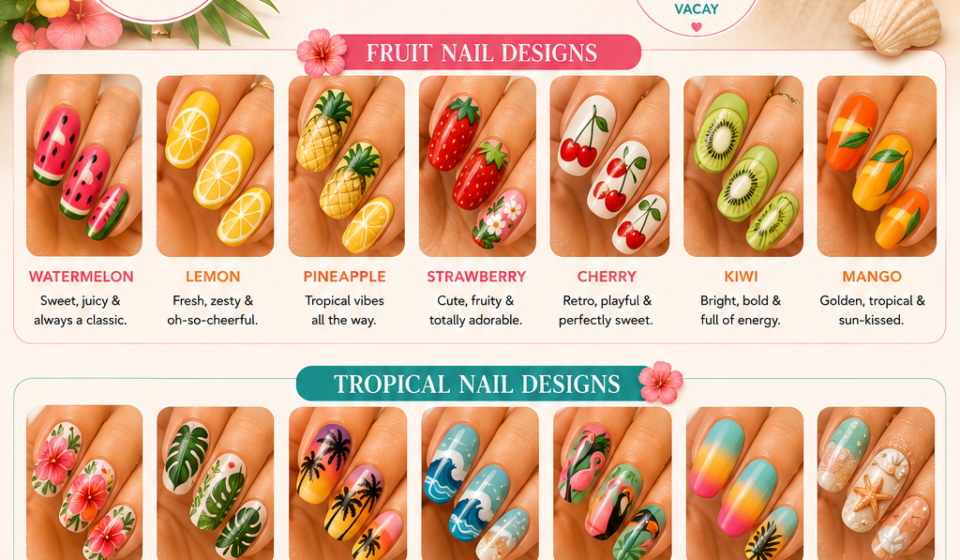
Watermelon Nails
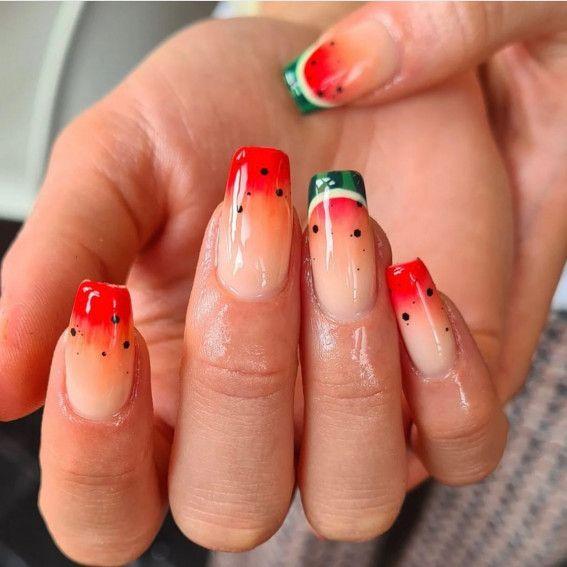
Watermelon nails are the undisputed classics of the fruit nail world — they have topped summer nail art popularity charts for years, and summer 2026 shows no signs of dethroning them. Their enduring appeal comes from their perfect combination of visual clarity, vivid color, and immediate summer association.
The most iconic watermelon nail design features the cross-section of the fruit: vivid pink or red flesh with small black seed details and a green rind border. Variations include:
Classic cross-section: The full face of a watermelon slice rendered on the nail — red or pink base, thin white layer near the edge transitioning to bright green, black dot seeds scattered across the flesh. Clean, graphic, and instantly recognizable.
Negative space watermelon: The watermelon motif drawn in outline rather than filled in, using the bare nail as the “flesh” color and drawing only the seeds, white pith line, and green rind in polish. Modern, sophisticated, and more wearable for everyday settings.
Jelly watermelon: A semi-transparent, jelly-finish red or pink base with delicate seed details — the translucency of the jelly formula creates the impression of actual fruit flesh lit from within. One of the most beautiful fruit nail executions of the season.
Abstract watermelon: A geometric interpretation where the curved rind is replaced with a straight diagonal or chevron line, creating an abstract color-block design inspired by watermelon rather than literally depicting it. The most wearable and office-appropriate version.
Color tips for watermelon nails: Vivid pink or watermelon red for the flesh, bright white for the pith layer, bold green for the rind, black for seeds. On a full set, watermelon accent nails look stunning surrounded by coordinating solid greens or pinks on the remaining fingers.
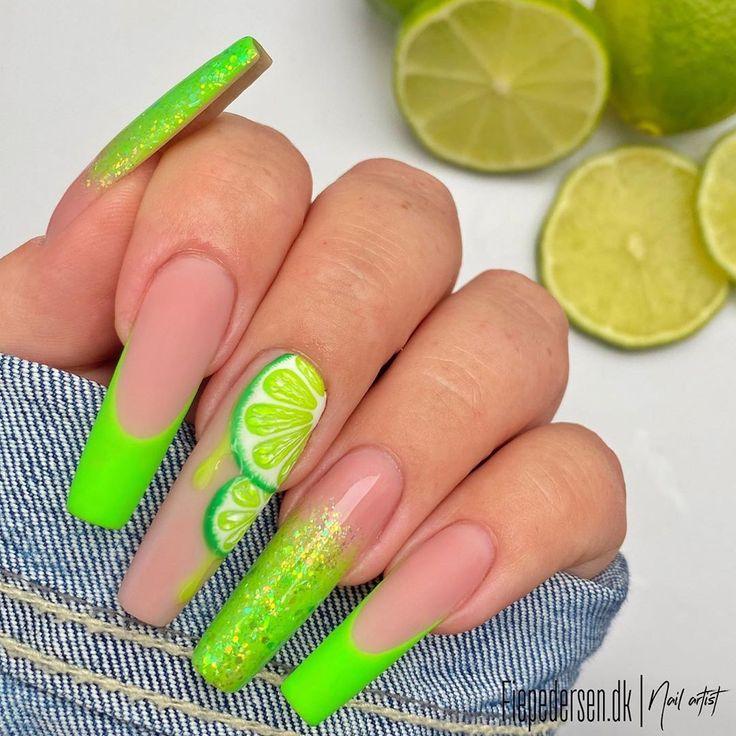
Lemon and Citrus Nails
Lemon nails bring the brightness, freshness, and energy of citrus to the summer manicure. The cross-section of a lemon — with its radiating segments, textured rind, and vivid yellow color — is one of the most satisfying subjects in fruit nail art.
Classic lemon cross-section: Bright yellow base with a slightly deeper yellow center point and radiating white lines indicating segments, surrounded by a textured or bumpy rind edge. Often most effective as an accent nail against a sunny yellow, white, or sage green base on the remaining nails.
Mixed citrus set: Each nail features a different citrus fruit — lemon, lime, orange, grapefruit, blood orange — creating a vibrant, colorful collection that works beautifully as a full set. This is one of the most popular fruit nail formats for those who love the aesthetic but want variety across the hand.
Citrus slice French tip: The citrus design appears only at the tip of the nail, replacing the traditional white French tip with a tiny painted citrus slice. A clever, subtle incorporation of the fruit nail trend into a more classic format.
Color tips for citrus nails: Sunshine yellow for lemon, vivid lime green for lime, warm orange for orange, pink-yellow for grapefruit. White for the pith and segment lines is essential for clarity and realism.
Pineapple Nails
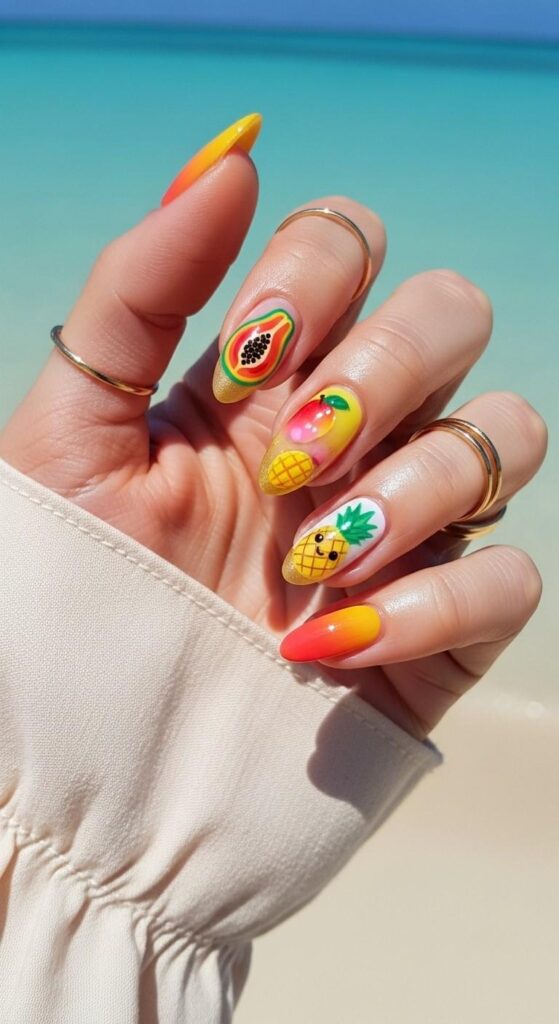
The pineapple is one of the most enduringly popular symbols of tropical summer style — an immediately recognizable motif with a complex, visually interesting texture that translates beautifully into nail art. In 2026, pineapple nail designs have evolved toward more sophisticated interpretations alongside the classic versions.
Classic illustrated pineapple: A full pineapple rendered in nail art — yellow diamond-pattern body, green crown of leaves at the top. Works best on longer nails where the full fruit has room to be illustrated.
Geometric pineapple: An abstracted, geometric version where the diamond pattern of the pineapple’s exterior becomes a repeating all-over pattern across the nail surface. Graphic, modern, and more wearable than a literal illustration.
Pineapple outline: A simple silhouette of a pineapple drawn in gold or black nail art pen over a vivid tropical base color. Minimal, chic, and very achievable at home with a nail art pen.
Color tips for pineapple nails: Warm golden yellow for the body, olive or vivid green for the crown leaves, warm brown for the diamond outlines. Gold accents add a luxurious tropical quality.
Strawberry Nails
Strawberries translate into nail art with remarkable clarity — the deep red fruit body, tiny yellow seed details, and bright green leaf cap are distinctive enough to be immediately recognizable even in a small scale.
Classic strawberry illustration: A rounded, red fruit body with yellow dot seeds and a small green cap illustrated on the nail. Most effective on oval or almond nails where the rounded shape of the nail echoes the rounded shape of the fruit.
Strawberry French tip: A strawberry motif appears at the tip, with the body of the fruit forming the colored tip and the green cap illustrated at the very edge. One of the most charming and creative French manicure variations.
Strawberry pattern: Instead of a single fruit, a repeating pattern of small strawberries scattered across the nail surface creates an all-over print effect reminiscent of vintage strawberry fabric. Particularly beautiful on a white or cream base.
Color tips for strawberry nails: Deep vivid red for the fruit body, bright yellow for the seeds, vivid green for the cap. A slightly darker red outline around the fruit body adds dimension and realism.
Cherry Nails
Cherries — round, vivid red, attached in pairs by their thin stems — are one of the most graphic and versatile fruit nail motifs of 2026. Their strong silhouette, vivid color, and romantic associations have made them one of the season’s most requested designs.
Classic cherry pair: Two round cherries in deep red or cherry red, connected by curving dark green stems with a small leaf or two. The most iconic and beloved cherry nail design.
Cherry with white background: The cherry motif is most striking against a clean white or cream base, where the deep red creates maximum contrast and the green stems read clearly.
Single cherry accent: One cherry on the ring finger accent nail, surrounded by deep red or glazed nude on the remaining nails. The most restrained and sophisticated cherry nail approach.
Retro cherry nails: A vintage-inspired, slightly graphic interpretation of cherries in bolder outlines and flatter colors, referencing 1950s and 1960s graphic design aesthetics. One of the most photographically striking cherry nail variations.
Color tips for cherry nails: Deep cherry red for the fruit, dark forest green for the stems and leaves. A tiny white highlight dot on each cherry creates the impression of the fruit’s glossy surface — a small detail that makes an enormous difference to the realism of the design.
Kiwi Nails
The kiwi cross-section is one of the most geometrically satisfying fruit nail motifs — a vivid green interior with tiny white seed details radiating from a cream center, surrounded by a brown rind. It is distinctive, slightly unexpected, and visually extraordinary in nail art form.
Kiwi cross-section: The face of a sliced kiwi rendered on the nail — white or cream center, vivid green flesh with radiating white lines, tiny black oval seeds, pale brown rind edge. On a full set, kiwi accent nails look beautiful against vivid lime green or soft sage on the remaining fingers.
Color tips for kiwi nails: Vivid lime or chartreuse green for the flesh, cream or white for the center and segment lines, near-black oval shapes for seeds, light tan for the rind. The precision of the seed placement is what elevates a kiwi nail from amateur to extraordinary.
Mango Nails
Mango — the king of tropical fruits — brings its warm, golden-orange palette and tropical associations to nail art in 2026 with particular energy. Mango nail designs can range from literal fruit illustrations to abstract explorations of the fruit’s color palette.
Mango cross-section or half: The orange-gold flesh of a halved mango, sometimes with a scored grid pattern on the flesh, illustrated on the nail. A slightly more unusual and sophisticated choice than the more common watermelon or lemon designs.
Abstract mango palette: Rather than illustrating the fruit, mango nails use the fruit’s characteristic color palette — deep golden yellow fading into warm orange — as a gradient or abstract color reference. Extremely wearable and flattering.
Part Two: Tropical Nail Designs — Lush, Vivid, and Alive
What Are Tropical Nail Designs?
Tropical nail designs draw their visual language from the broader world of tropical environments — rainforests, coral reefs, island beaches, exotic blooms, and the rich, saturated color palette that defines them. Unlike fruit nails, which are anchored to specific food subjects, tropical nails encompass a wider range of motifs: flowers, leaves, birds, ocean elements, and abstract color palettes inspired by the tropical world.
The defining quality of tropical nail designs is lushness — a sense of abundance, color, and natural vitality that makes even a simple tropical nail look feel alive and expressive.
The Most Beautiful Tropical Nail Designs for 2026
Hibiscus Flower Nails
The hibiscus is the queen of tropical flower nail art — its large, open petals, prominent stamen, and vivid color make it one of the most visually impactful floral subjects in all of nail art. In 2026, hibiscus nail designs have reached new heights of beauty and sophistication.
Watercolor hibiscus: A softly blended, painterly hibiscus with edges that dissolve into the base color rather than being sharply defined. One of the most elegant and artistic tropical nail designs of the season.
Detailed hibiscus illustration: A fully rendered hibiscus flower with careful petal shading, stamen detail, and leaf elements surrounding the bloom. Typically executed on an accent nail against coordinating solid shades.
Hibiscus and leaf combination: Hibiscus flowers paired with large, dark tropical leaves create a lush, jungle-like design that captures the full richness of the tropical floral environment.
Color tips for hibiscus nails: Vivid coral, hot pink, red, or yellow for the petals; cream or pale yellow for the stamen; deep green for leaves. A tiny white highlight at the petal edges creates a luminous, three-dimensional quality.
Palm Leaf and Monstera Nails
Botanical leaf designs — particularly palm fronds and monstera (split-leaf philodendron) leaves — are among the most sophisticated and wearable tropical nail motifs of 2026. Their strong graphic quality and deep green palette make them equally at home in casual and professional settings.
Monstera leaf: The distinctive split leaf of the monstera plant, with its characteristic oval cutouts along the main leaf body, is one of the most recognizable botanical motifs in contemporary design. On nails, rendered in deep forest green over a warm nude or white base, it is breathtakingly beautiful.
Palm frond: The arching, feathery fronds of a palm tree illustrated across one or more nails create an immediate tropical association. In watercolor style, they are particularly elegant. In a more graphic, illustrative style, they are bold and striking.
Tropical leaf print: A repeating pattern of various tropical leaves — monstera, palm, banana leaf, bird of paradise — creates an all-over print effect reminiscent of tropical fabric. Beautiful on longer nails in a cream or warm white base.
Ocean and Coral Reef Nails
The tropical ocean provides a rich and varied design vocabulary for nail art — from the gradient blues and greens of shallow water to the vivid complexity of a coral reef populated with marine life.
Ocean gradient: A blue-to-green gradient across the nail, sometimes with tiny wave details at the tip, captures the color of tropical water with breathtaking simplicity. Combined with a jelly finish, it is one of the most visually extraordinary tropical nail looks available.
Coral reef: Detailed illustrations of coral formations, tropical fish, seahorses, and shells across the nail create a complete underwater world in miniature. One of the most ambitious and rewarding tropical nail art projects.
Wave nails: Fluid, organic wave lines in white over a vivid ocean blue base capture the movement of tropical surf in a graphic, modern design that is both artistic and wearable.
Tropical Bird Nails
Exotic birds — flamingos, toucans, parrots, birds of paradise — bring the vivid color and natural drama of the tropics to nail art in a slightly unexpected and very striking way.
Flamingo nails: The elegant silhouette of a flamingo, rendered in soft pink over a tropical background or in detail with coral and rose shading, is one of the most requested bird nail designs of summer 2026.
Toucan accent: A bright, colorful toucan illustrated on an accent nail against complementary tropical colors creates a bold, conversation-starting design.
How to Achieve Fruit and Tropical Nails at Home
Essential Tools
- Fine nail art brushes (sizes 0, 00, and 000 for detail work)
- Nail art pens in black, white, and key colors
- Dotting tools (for seeds, centers, and round details)
- A thin striping brush (for stems, veins, and outlines)
- Base coat and top coat
- The relevant colored polishes for your chosen design
- A steady hand and patience — or nail art stickers and decals as an accessible alternative
The Accent Nail Strategy
The most achievable approach to fruit and tropical nail art for home nail artists is the accent nail strategy: choose one nail on each hand (typically the ring finger) for the detailed fruit or tropical design, and coordinate the remaining nails with solid colors drawn from the design’s palette. This approach delivers a complete, professional-looking manicure without requiring you to replicate the detailed design ten times.
For example, watermelon accent nails on the ring fingers, surrounded by vivid pink on two fingers and bright green on two fingers, creates a full watermelon-themed manicure without requiring a watermelon design on every nail.
Step-by-Step: Basic Fruit Nail (Lemon Slice Example)
Step 1: Apply base coat to all nails and allow to dry completely.
Step 2: Apply two coats of your base color — sunshine yellow for a lemon design — to the accent nail. Allow to dry fully between coats.
Step 3: Using a fine nail art brush dipped in white polish, paint a small dot in the center of the nail.
Step 4: From the center dot, paint 8 to 10 thin, slightly curved white lines radiating outward toward the edges of the nail — these are the segment divisions of the lemon slice.
Step 5: Using a slightly deeper yellow or a warm white, paint a slightly thicker border around the very edge of the nail to suggest the lemon rind.
Step 6: Allow all detail work to dry completely — at least five minutes — before applying top coat. Rushing this step is the most common cause of smudged fruit nail details.
Step 7: Apply two coats of glossy top coat, sealing all the detail work and creating a smooth, finished surface.
Using Nail Art Stickers and Stamps
For those who love the fruit and tropical nail aesthetic but don’t feel confident with freehand painting, nail art stickers, decals, and stamping plates offer an excellent alternative. High-quality fruit and tropical nail sticker sheets are widely available and, applied carefully over a solid color base and sealed with top coat, produce results that are virtually indistinguishable from freehand painting at a casual viewing distance.
Best Nail Shapes and Lengths for Fruit and Tropical Nails
Almond: The most popular shape for fruit and tropical nail art. The elongated silhouette provides the canvas space that detailed designs need and frames fruit motifs — particularly round fruits like cherries and strawberries — with a natural elegance.
Oval: A slightly more accessible shape than almond, oval nails work beautifully with rounded fruit motifs and softly rendered tropical flowers. The curved tip echoes the natural curves of fruit and floral subjects.
Square and squoval: For more graphic, geometric fruit designs — abstract watermelon, citrus cross-sections, geometric pineapple patterns — square and squoval provide a flat, clean canvas that emphasizes the design’s graphic quality.
Coffin: Coffin nails provide the maximum canvas space for elaborate tropical nail art — botanical illustrations, detailed coral reef designs, and multi-element tropical scenes all have room to breathe on a long coffin nail.
Short round: Don’t let short nails discourage you from fruit and tropical designs. Small, graphic motifs — a single cherry, a tiny hibiscus, a lemon slice tip — look charming and intentional on short round nails. The key is simplifying the design to suit the smaller canvas.
Fruit and Tropical Nails by Skin Tone
Fair skin: Vivid, saturated fruit colors create maximum contrast on fair skin. Watermelon pink, lemon yellow, vivid lime green, and cherry red all look particularly striking. Avoid very pale fruit designs on very fair skin, where the contrast may be insufficient for the design to read clearly.
Medium skin: The most versatile canvas for fruit and tropical nails. Every color family in the fruit and tropical palette — warm oranges, vivid pinks, deep greens, bright yellows — works harmoniously on medium skin tones.
Olive skin: Warm fruit shades — mango orange, watermelon coral, papaya yellow — create a particularly beautiful harmony with olive undertones. Vivid tropical greens also look extraordinary on olive skin.
Deep skin: Rich, saturated, fully pigmented fruit and tropical colors are where deep skin tones shine. Cherry red, vivid hibiscus pink, deep ocean blue, and electric lime green all look breathtaking on deeper complexions. Choose maximum saturation over pale or pastel versions of any shade.
Maintaining Your Fruit and Tropical Nails
Detailed nail art requires a little more care than a simple single-color manicure to maintain its crispness and longevity.
Apply top coat generously and completely. Every element of a detailed fruit or tropical design needs to be fully sealed beneath the top coat. Pay particular attention to raised edges from layered detail work — any element that isn’t fully covered by top coat is vulnerable to lifting and chipping.
Refresh top coat every two to three days. As top coat wears, the edges of detail work become exposed. A fresh layer every few days keeps the design crisp and protected.
Avoid prolonged water exposure. Submerging fruit and tropical nail designs in water for extended periods — swimming, long baths, dishwashing without gloves — accelerates lifting of the detail layers. Gloves for wet work significantly extend the life of any detailed nail art.
Be gentle with the nail tips. The tip of the nail is where detailed designs are most vulnerable to chipping. Avoid using your nails as tools and be mindful of activities that create impact at the nail tip.
Apply cuticle oil to the skin — not the design. Cuticle oil is essential for nail health, but applying it directly to the detail work can lift or blur the design over time. Apply carefully around the nail edges rather than over the art itself.
Frequently Asked Questions
Are fruit nails and tropical nails the same thing? They are closely related but distinct. Fruit nails specifically feature fruits as their primary motif. Tropical nails is a broader category that includes fruits, flowers, leaves, birds, ocean elements, and tropical color palettes. All fruit nails are tropical in spirit, but not all tropical nails feature fruit.
How long do fruit and tropical nail designs last? With proper sealing and care, a fruit or tropical nail art design on a gel base lasts two to three weeks. On regular polish, expect seven to ten days with regular top coat refreshing.
Can I do fruit and tropical nails at home without artistic ability? Yes — with the right tools and approach. Nail art stickers and decals provide professional-looking results without requiring freehand painting skills. The accent nail strategy also reduces the amount of detail work required. Starting with simpler motifs like a lemon slice or a cherry and building your skills gradually is the most rewarding path.
What colors complement fruit nail designs? Coordinating solid colors work best alongside fruit accent nails. For watermelon designs: vivid pink and lime green. For lemon designs: sunshine yellow and white. For cherry designs: deep red and cream. For tropical florals: warm nude, white, or solid versions of the flower’s primary color.
Do fruit and tropical nails work in a professional setting? It depends on the specific design and workplace. A subtle fruit accent nail surrounded by solid coordinating colors is generally considered professional. An elaborate all-over tropical illustration on every nail may not be appropriate in very conservative settings. The accent nail strategy is the most reliable approach for making fruit and tropical nails work-appropriate.
What is the easiest fruit nail design to try at home? A lemon or lime cross-section is widely considered the most beginner-friendly fruit nail design — the radiating segment lines are simple to paint with a thin brush, the color palette is uncomplicated, and the graphic quality of the design is forgiving of minor imperfections.
Final Thoughts
Fruit nails and tropical nails represent the most joyful, creative, and visually rich corner of the summer nail world — a place where color, nature, artistry, and pure seasonal pleasure come together in a way that no other nail aesthetic quite replicates.
Whether you’re drawn to the iconic simplicity of a watermelon slice, the botanical sophistication of a monstera leaf design, the romantic detail of a hibiscus bloom, or the graphic impact of a mixed citrus set, the fruit and tropical nail universe has something genuinely extraordinary waiting for you this summer.
Choose your fruit, pick your palette, find your technique — and let your nails become the most joyful thing you wear all season.