
Gel nail varnish is one of the most popular manicure choices in the world — and for very good reason. The glossy, chip-resistant finish that stays perfect for two to three weeks without lifting, peeling, or fading is genuinely transformative for anyone who has experienced the frustration of a regular polish manicure chipping within 48 hours of application. But when that two-to-three-week window is up and it is time for a fresh start, many people find themselves facing the same question: how do you actually get gel nail varnish off at home without causing damage?
The short answer is that gel nail varnish can absolutely be removed at home, safely and completely, without a salon visit — provided you use the right method, the right product, and — most importantly — the right amount of patience. The process is not complicated, but it does require following specific steps correctly. Skip steps, rush the timing, or use the wrong remover, and you risk either incomplete removal or real nail damage.
This comprehensive guide covers everything you need to remove gel nail varnish at home confidently: why gel varnish requires a different removal approach than regular varnish, every supply you need, three full step-by-step removal methods, tips for making the process faster and more effective, the mistakes that cause nail damage, aftercare advice for restoring nail health, and answers to the most frequently asked questions.
Why Gel Nail Varnish Is Different to Remove
Understanding why gel varnish behaves so differently from regular varnish during removal helps you approach the process with the right expectations and technique — and explains why simply wiping it off with regular nail varnish remover will never work.
Regular nail varnish forms a temporary, physically adherent film on the nail surface. It dries through solvent evaporation alone and can be dissolved by standard removers in seconds, because the polymer structure is relatively simple and accessible to solvents.
Gel nail varnish is fundamentally different. When gel is cured under a UV or LED lamp, the liquid formula undergoes a chemical reaction called photopolymerization — the light energy triggers the individual molecules in the gel to bond together into long, interwoven, cross-linked polymer chains. These chains create the hard, durable structure that gives gel its extraordinary chip resistance and longevity.
This cross-linked structure also means that removing gel requires breaking down those polymer chains — a process that only pure acetone can accomplish effectively. Acetone penetrates the cross-linked gel matrix, disrupts the bonds from within, and gradually softens the gel into a consistency that can be gently pushed away from the nail. No other widely available solvent accomplishes this as reliably or as safely.
The soak-off process is simply the controlled application of acetone for long enough — and with enough sustained contact — to allow this chemical softening to occur across the full depth of the gel layer.
What You Need to Remove Gel Nail Varnish at Home
Having everything assembled before you begin makes the process smoother, faster, and less likely to result in shortcuts that cause problems.
Essential supplies:
- 100% pure acetone (this is critical — regular nail varnish remover, even acetone-based formulas at standard dilution, is not concentrated enough for gel removal)
- Cotton balls, cotton pads, or cotton wool
- Aluminum foil cut into rectangles large enough to wrap around each fingertip (approximately 3 × 5 inches)
- A nail file (180-grit)
- A soft nail buffer
- A cuticle pusher or orangewood stick
- Cuticle oil
- Hand cream or moisturiser
Optional but helpful:
- Gel nail removal clips (reusable plastic clamps — an excellent alternative to foil)
- A glass or ceramic bowl (for the bowl soak method)
- Petroleum jelly or thick cuticle oil (to protect the skin around nails)
- A larger bowl of warm water (to warm the acetone)
- A nail brush for cleanup
What to avoid:
- Regular nail varnish remover — insufficient acetone concentration for gel
- Acetone-free remover — will not dissolve gel at all
- Plastic bowls — acetone degrades many plastics
- Metal scrapers — can scratch and gouge the nail surface
Before You Begin: Preparing Your Nails
Proper preparation is the step most people skip, and it is genuinely one of the most important parts of the entire process. Five minutes of preparation can save fifteen or twenty minutes of soaking time and dramatically improves results.
Step 1: Identify Your Gel Type
Not all gel nail varnish is the same, and the removal process varies slightly by type:
Standard soak-off gel varnish — the most common format, both at salons and in home gel kits — responds well to acetone soaking and typically softens within 10 to 15 minutes once the seal is broken.
Shellac — a popular brand of hybrid gel-polish formula — also soaks off with acetone but is sometimes slightly more resistant than basic gel varnish. Allow up to 20 minutes.
Hard gel or builder gel — thicker structural gels used for extensions or overlays — does not dissolve in acetone regardless of soak time and must be filed away rather than soaked. If you have nail extensions or very thick sculptured nails, consult a professional rather than attempting acetone soaking.
If you had gel applied at a salon and are unsure of the type, ask your technician before attempting home removal.
Step 2: Break the Surface Seal
This is the single most impactful preparation step. Gel nail varnish has a hard, shiny, polymerized top coat surface that acetone cannot penetrate efficiently without preparation. Using your 180-grit nail file, lightly buff the entire surface of each nail until the shine is completely gone and the nail surface looks matte and slightly powdery.
You are not trying to file through the gel — you are simply creating a roughened surface that allows acetone to begin penetrating the gel layer immediately rather than sitting on the sealed surface. Two to four gentle passes across the full nail surface is typically sufficient.
Important: Use light, controlled pressure. File the gel, not your natural nail. If you file too aggressively, you risk thinning your natural nail beneath the gel. The surface just needs to look dull — it does not need to be filed down to the nail bed.
Step 3: Protect the Surrounding Skin
Acetone is highly drying and will be in contact with the skin around your nails for the duration of the soak. Apply a thin layer of petroleum jelly, thick cuticle oil, or barrier cream to all the skin surrounding each nail — the cuticle area, the sides of the nail (the lateral folds), and the fingertip skin — but not on the nail surface itself. This protective barrier prevents excessive drying and irritation during soaking.
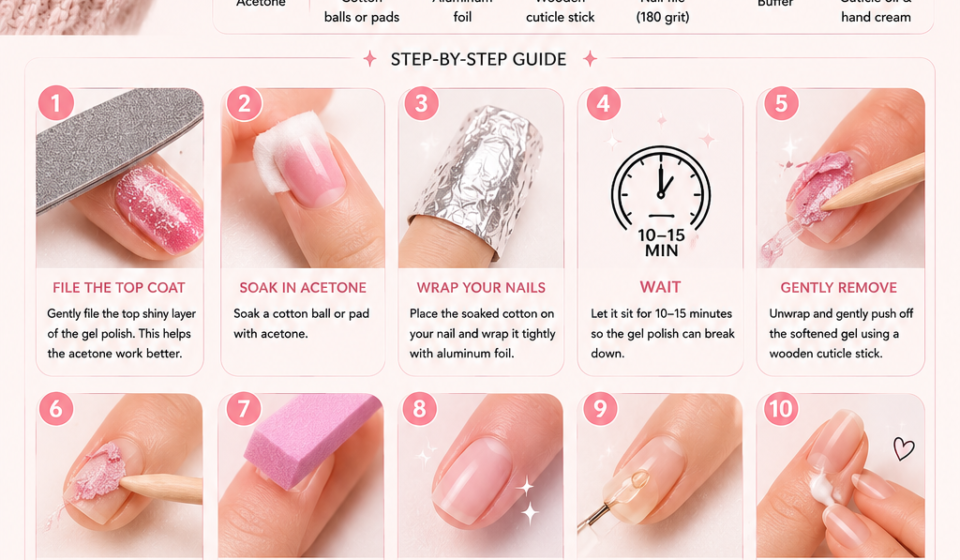
Method 1: The Foil Wrap Method (Most Recommended)
The foil wrap method is the gold standard for at-home gel nail varnish removal. It delivers sustained, concentrated acetone contact to each nail, traps heat that accelerates the chemical process, and allows all ten nails to be treated simultaneously. This is the method used by professional nail technicians in salons worldwide and produces the most consistently reliable home results.
Step 1: Prepare Your Foil Pieces
If you haven’t already, cut ten rectangles of aluminium foil — one per finger — each approximately 3 inches wide and 5 inches long. They should be large enough to wrap snugly around the full fingertip.
Step 2: Saturate the Cotton
Cut or tear cotton balls, cotton pads, or cotton wool into pieces roughly the size of each nail. Saturate each piece generously with 100% acetone — the cotton should be genuinely soaked through, not just damp. This is the step people most commonly underdo, and insufficient acetone is one of the primary reasons the soak-off process takes longer than it should or produces incomplete results.
Step 3: Apply the Cotton and Wrap with Foil
Place one saturated piece of cotton directly on top of a nail, positioning it to cover the entire nail surface from cuticle to free edge. Immediately wrap the foil rectangle around the fingertip, holding the cotton firmly in place. Wrap snugly — the foil should be in close contact with the finger with no gaps that allow heat to escape or acetone to evaporate.
Repeat for all ten fingers. Most people find it easiest to complete all five fingers on one hand before moving to the other.
Step 4: Wait the Full Time
Set a timer. For standard soak-off gel varnish, the minimum soak time is 10 to 15 minutes. For thicker builds, older gel, or Shellac, allow up to 20 minutes.
This waiting period is where patience is most important. The most common gel removal mistake is removing the foil too early — at eight or ten minutes, finding the gel resistant, and then either forcing it off (causing nail damage) or having to rewrap and start again (losing time). Give the acetone the time it needs to penetrate and soften the gel properly.
The foil traps body heat against the finger, which meaningfully accelerates the chemical process. Keep your wrapped hands still during the soak — moving them frequently breaks the heat seal and makes the process less efficient.
Step 5: Test One Nail
When your timer goes off, unwrap one finger and hold the cotton briefly against the nail as you pull it away — you may notice some gel coming away with the cotton. Using a cuticle pusher or orangewood stick, gently press against the gel from the cuticle end toward the tip.
If the gel has softened correctly, it will feel slightly gummy or rubbery and slide away from the nail with very gentle pressure — almost like pushing soft wax across a smooth surface. There should be no resistance. If the gel feels firm or resists movement, it needs more time. Rewrap the finger with fresh acetone-soaked cotton and wait another five minutes.
Never force, scrape hard, or try to peel gel that is not ready. The condition of the gel under light pressure tells you everything you need to know: if it slides, proceed; if it resists, wait.
Step 6: Remove the Softened Gel
Working one nail at a time, remove each foil wrap and use the cuticle pusher to gently slide the softened gel from the cuticle toward the free edge. Use light, consistent pressure — the softened gel should move easily across the nail surface and pile up at the tip to be wiped away.
For any sections that feel slightly more resistant, do not scrape harder. Instead, hold a small piece of fresh acetone-soaked cotton directly against that area for an additional one to two minutes, then try again. Stubborn spots almost always yield to a brief targeted additional soak.
Step 7: Address Any Remaining Residue
After the main body of gel has been removed, there may be a thin film or minor residue remaining on the nail surface. Apply a small piece of cotton with fresh acetone, hold for 60 seconds, then wipe firmly from base to tip. This final wipe typically clears the last traces of gel cleanly.
Step 8: Buff the Nail Surface
Using a soft nail buffer, gently smooth the nail surface with light, even passes. Two to three passes is sufficient — over-buffing removes natural nail material that is already slightly depleted from the gel application and removal process. The goal is to remove the matte texture left from your initial filing and restore a smooth, even surface.
Step 9: Wash and Moisturise Immediately
Wash both hands thoroughly with mild soap and warm water to remove all acetone residue and gel particles. Pat completely dry. Apply cuticle oil generously to each nail and massage it in for 30 seconds per nail. Follow with a rich hand cream applied over the full hand. Do not skip this step — it is not an optional afterthought, it is an essential component of the process that directly affects nail health after acetone exposure.
Method 2: The Bowl Soak Method
The bowl soak method is a useful alternative for those who find the foil wrapping process awkward, or for removing gel from toenails where foil wrapping is more difficult.
Step 1: Set Up the Bowl
Pour approximately half an inch to an inch of 100% pure acetone into a glass or ceramic bowl — enough to fully submerge all your fingernails. Never use a plastic bowl, as acetone dissolves or degrades many types of plastic.
To warm the acetone — which speeds up the softening process considerably — place the acetone bowl inside a larger bowl containing warm (not hot) water. The warm water heats the acetone gently without creating any fire risk. Never place acetone near an open flame or heat source, as it is highly flammable.
Step 2: Protect Your Skin
Because the bowl method exposes more of the hand and fingers to acetone than the targeted foil method, apply petroleum jelly or thick barrier cream generously to all skin on the hand — the entire finger length, the palm, and the back of the hand — everywhere except the nail surfaces.
Step 3: Soak Your Nails
Submerge your fingertips in the acetone, ensuring all nails are in full contact with the solvent. Soak for 10 to 20 minutes. Check one nail at the 10-minute mark by pressing a cuticle pusher gently against the gel — if it begins to move, the gel is softening. If it is still firm, continue soaking.
When the gel is ready, it will look wrinkled, slightly swollen, or will have begun lifting at the edges on its own.
Step 4: Remove the Softened Gel
Remove your hand from the bowl and immediately use the cuticle pusher to slide the softened gel away from each nail. Work quickly — once removed from the acetone, the gel begins to re-harden as the solvent evaporates. If the gel starts to firm up before you’ve finished all five nails, briefly re-submerge the hand.
Step 5: Finish
Follow the same finishing steps as the foil method: buff gently, wash thoroughly, apply cuticle oil and hand cream immediately.
Method 3: Gel Nail Removal Clips
Gel removal clips are reusable plastic clamps that hold an acetone-soaked cotton pad against the nail without requiring foil. They are an increasingly popular option for regular home gel removers because they are convenient, reusable (and therefore more environmentally friendly than single-use foil), and just as effective as the foil wrap method.
How to Use Removal Clips
The process is identical to the foil wrap method — file the surface, protect the skin, saturate the cotton with acetone, and position it against the nail — but instead of wrapping with foil, you snap a removal clip over the fingertip to hold everything securely in place.
Clips come in sets with different sizes to accommodate different finger widths. A well-fitting clip holds the cotton firmly against the nail with no movement during the soak.
Soak for the same 10 to 15 minutes, then remove each clip and proceed with the cuticle pusher, buffer, wash, and moisturise sequence as described above.
Clips are washable and can be used repeatedly over many removal sessions. If you remove gel at home regularly, a set of good-quality removal clips is a worthwhile investment in both convenience and sustainability.
Tips for Faster, More Effective Gel Varnish Removal
Warm the Acetone First
Warm acetone is significantly more chemically active than cold or room-temperature acetone. Using the warm water bath setup can reduce standard soak time from 15 minutes down to 10 minutes or less. This simple step consistently makes a noticeable difference to both speed and completeness of removal.
File More Thoroughly
Spending an extra minute on the preparation filing step pays dividends in reduced soak time. If you notice after the initial soak that certain nails needed significantly more time than others, it typically means those nails were filed less thoroughly before soaking. A consistently matte, evenly dulled surface across every nail before soaking produces the most uniform results.
Use Generous Amounts of Acetone
The cotton must be genuinely saturated — not lightly dampened. If you find that results are incomplete or soak times consistently run long, try using significantly more acetone on the cotton and ensure the foil is wrapped tightly enough to prevent early evaporation.
Work at a Warm Room Temperature
Acetone is more effective in warmer ambient temperatures. If you are doing this in a cold bathroom or room, move to a warmer space before you begin. The difference in efficiency between removing gel in a cold room versus a warm one is surprisingly significant.
Have Everything Ready Before You Start
Stopping midway to fetch supplies — getting up to find the cuticle pusher, realising you’ve run out of cotton — is disruptive to the process and often leads to rushing. Lay out everything you need in advance, within arm’s reach, before you apply the first foil wrap.
Common Mistakes That Damage Nails
Peeling the Gel Off
This is by far the most damaging thing you can do during gel nail varnish removal — and it is also, unfortunately, very tempting when the gel is lifting at the edges. Gel bonds to the top layers of the natural nail plate, and peeling it away takes those layers with it. The result is nails that are visibly thinner, feel sensitive or rough, and are significantly more prone to breaking and peeling for weeks afterward.
No matter how tempting the loose edge looks, never peel. The gel that isn’t lifting is still fully bonded, and tearing the sheet away causes the most damage at exactly the areas where the bond is strongest.
Using the Wrong Remover
Regular nail varnish remover — whether marketed as “acetone-based” or not — contains acetone at concentrations far too low for gel removal. You need 100% pure acetone. Acetone-free removers contain entirely different solvents that do not dissolve gel at all.
If you have been soaking for 20 minutes with no result, check the product you are using. It may not be pure acetone.
Not Breaking the Surface Seal
The shiny, polymerized surface of cured gel varnish prevents acetone from penetrating efficiently. Skipping the preparation filing step means the acetone spends the first several minutes simply sitting on the surface rather than working on the gel structure beneath. Nails that are not pre-filed will take significantly longer to soak off and may produce incomplete results.
Removing Wraps Too Early
Gel needs the full soak time to soften properly. Ten minutes is the minimum, not the average. Removing the foil at eight minutes, finding the gel resistant, and then scraping or peeling is the sequence that leads to nail damage. If the gel is not ready, the solution is always more time — never more force.
Scraping Resistant Gel
If the gel resists gentle pressure from the cuticle pusher, it is not adequately softened. Pressing harder removes nail material along with the gel. Stop, rewrap with fresh acetone, and wait longer. The gel will eventually yield to the acetone — it never yields safely to force.
Skipping Aftercare
Acetone is a powerful desiccant — it removes moisture aggressively from everything it contacts, including the nail plate and the surrounding skin. Skipping cuticle oil and moisturiser after removal leaves nails dehydrated, brittle, and the surrounding skin tight and cracked at exactly the moment when they are most vulnerable. The aftercare routine is not optional — it is the completion of a process that begins with preparation and ends only when the nails are properly nourished.
How to Care for Your Nails After Gel Varnish Removal
The period immediately after gel varnish removal is when nails need the most deliberate care. Acetone exposure, even in a single controlled session, temporarily dehydrates the nail plate and can leave it slightly more brittle than usual. A consistent aftercare routine over the following days restores full nail health.
Immediately After Removal
Apply cuticle oil to every nail bed and massage thoroughly — at least 30 seconds of firm circular massage per nail. This stimulates blood flow to the nail matrix, drives the oil into the nail plate, and begins the rehydration process. Follow immediately with rich hand cream over the entire hand.
The Following Days
Continue applying cuticle oil morning and evening for at least one week after removal. If your nails feel thin or fragile, apply a strengthening base coat to the bare nails — this provides a protective layer while the nail plate recovers its natural resilience.
Giving Nails a Rest
If possible, allow your nails one to two weeks without gel before the next application. This rest period allows the nail plate to fully restore its moisture balance, recover any minor surface depletion from the removal process, and return to its natural strength before being subjected to another application cycle. Regular rest periods every two to three months prevent the cumulative thinning that extended continuous gel wear can cause.
Signs Your Nails Need More Recovery Time
If your nails feel noticeably thin, flexible, tender, or peel easily after removal, give them longer than the standard one to two week rest. These signs indicate the nail plate has experienced more depletion than usual — possibly from an aggressive removal or from extended uninterrupted gel wear. Continue with twice-daily cuticle oil, strengthening treatments, and gentle nail care until normal nail resilience returns.
Removing Gel Nail Varnish Without Acetone
For those who prefer to minimise chemical exposure or who have acetone sensitivity, removal without acetone is possible — but significantly more limited in effectiveness.
Filing the gel away is the only genuinely effective non-acetone method. Using a medium-to-coarse file (150 to 180-grit), the gel layer is gradually filed away until only the natural nail remains. This approach requires patience, a careful technique to avoid filing into the natural nail, and comfort with the filing sensation. It works well for thin gel applications and experienced home nail care practitioners, but carries a higher risk of natural nail thinning if done carelessly.
Non-acetone nail varnish remover does not work on gel. The solvents it contains — typically ethyl acetate or isopropyl alcohol — do not have the chemical activity needed to dissolve cross-linked gel polymers. Extended soaking in non-acetone remover produces little to no useful result and is not a recommended approach.
Frequently Asked Questions
How long does it take to remove gel nail varnish at home? From preparation through aftercare, the full process takes approximately 30 to 45 minutes. This includes filing preparation (5 minutes), soaking (10 to 20 minutes), removing and buffing (5 to 10 minutes), and aftercare (5 minutes).
Can I use regular nail varnish remover to take off gel? No — regular nail varnish remover, even formulas that contain some acetone, does not have a sufficient concentration to dissolve gel varnish. You need 100% pure acetone for reliable gel removal.
Why is my gel varnish not coming off after soaking? The most common causes are: insufficient soak time, not enough acetone on the cotton, a loose foil wrap allowing the acetone to evaporate, cold acetone that is less chemically active, or — if soaking has genuinely produced no result at all — the possibility that the product is a hard gel rather than a soak-off gel, which requires filing rather than soaking.
Does removing gel nail varnish at home damage your nails? When done correctly — with proper preparation, adequate soak time, gentle removal technique, and thorough aftercare — at-home gel varnish removal does not cause significant nail damage. Damage almost always results from peeling, scraping, or forcing gel that has not been adequately softened by acetone.
How do I know when the gel is ready to come off? The gel is ready when it looks wrinkled or slightly bubbled on the nail surface and slides away from the nail with very gentle pressure from a cuticle pusher. There should be no resistance. If you need to apply firm pressure, the gel needs more soaking time.
Can I remove gel nail varnish if I have gel extensions? If your gel varnish is applied over gel extensions or a hard gel overlay, the situation is more complex. The colour gel and top coat layers may soak off with acetone, but the structural hard gel beneath will not dissolve. Attempting to soak off hard gel extensions with acetone will soften the colour layers but leave the extension structure largely intact — and at that point, attempting to remove it risks nail damage. Extensions are best removed by a professional.
Is it safe to remove gel nail varnish at home every few weeks? Yes — provided the technique is correct and aftercare is consistent. Many people successfully remove and reapply gel at home every two to three weeks without significant nail health issues. The key is proper preparation (to minimise soak time), using only the gentlest possible removal technique, and thorough moisture replenishment afterward every single time.
Final Thoughts
Removing gel nail varnish at home is one of those skills that rewards learning properly. Done correctly — with 100% acetone, proper preparation, adequate patience, and the right technique — it is a completely safe, straightforward process that produces results indistinguishable from a professional salon removal.
The entire process comes down to two fundamental principles: let the acetone do the work, and never use force. Every mistake that causes nail damage — peeling, scraping, removing foils too early — comes from impatience and the instinct to physically overcome the resistance that should instead be overcome chemically.
Give the acetone the time it needs. Use gentle pressure as your only guide to whether the gel is ready. And always, without exception, moisturise thoroughly when you are done.
Follow these principles consistently, and your nails will come through every gel removal healthy, smooth, and ready for whatever colour comes next.