
Not everyone has access to a nail salon, a gel lamp, or a full set of professional nail supplies — and not everyone needs them. Paper nails are one of the most creative, accessible, and surprisingly satisfying DIY nail projects you can do at home, requiring nothing more than paper, scissors, a little glue, and the desire to have something fun and decorative on your fingertips.
Whether you are looking for a quick creative project, trying nail art without committing to real polish, making costume nails for a special event or fancy dress party, experimenting with nail shapes before committing to acrylics, or simply exploring what longer nails might look like on your hands, paper nails are a versatile, zero-cost solution that anyone can try.
This complete guide covers everything you need to know about making paper nails from scratch: the materials that work best, multiple methods for different skill levels and purposes, step-by-step shaping and decoration techniques, how to apply them, how long they last, and how to get the most out of your paper nail experience. By the end, you will know exactly how to create paper nails that are genuinely impressive — and far more durable and polished-looking than you might expect from something made entirely out of paper.
What Are Paper Nails?
Paper nails are DIY fake nails made from paper — typically cardstock, thick craft paper, magazine pages, or watercolour paper — cut and shaped to fit the nails and attached using craft glue, nail glue, or double-sided tape. They are a completely temporary, cost-free alternative to press-on nails, acrylics, or gel extensions.
The concept is simple: paper is cut into a nail shape, decorated with drawings, paint, or other embellishments, and attached to the fingernail. Done well, paper nails can look surprisingly convincing — especially when photographed or viewed at a short distance — and they offer creative possibilities that even expensive nail products can’t always match, because you can draw, paint, stamp, or collage directly onto the paper surface with total freedom.
Paper nails are particularly popular as:
Costume and cosplay nails — for events where dramatic nail shapes or specific nail art designs are needed without the commitment or cost of professional extensions.
Experimental nails — for trying out a nail shape (coffin, stiletto, square) to see how it looks on your hands before committing to acrylics or a gel set.
Creative art projects — for nail art enthusiasts who enjoy the craft element and the freedom of working with paper as a medium.
Children’s play nails — a safe, non-toxic alternative to nail polish or fake nails for children who want to play dress-up.
Photography and social media content — for nail content creators who want to demonstrate a shape or design concept without the expense of a full professional set.
What You Need to Make Paper Nails
One of the greatest appeals of paper nails is how minimal the supply list is. Most of what you need is already in your home.
Paper Types — Which Works Best?
Not all paper produces equally good results for nail-making. The best options are:
Cardstock (recommended): Thick, sturdy, and available in hundreds of colours and patterns. Cardstock holds its shape well, doesn’t wilt, and is easy to cut cleanly. This is the best all-purpose paper for nail-making. Standard cardstock (65 lb / 176 gsm or heavier) produces nails that are robust enough to last several hours of normal wear.
Watercolour paper: Slightly textured, very thick, and extremely durable. Watercolour paper nails hold their shape exceptionally well, are easy to paint and decorate, and are the most robust paper nail option. The texture adds an interesting quality to the finished nail.
Magazine pages: Thin but glossy, magazine paper creates interesting nails because the printed imagery on the paper becomes part of the design. Nails made from magazine pages are more fragile than cardstock versions but look uniquely artistic.
Printer paper: Standard printer paper (80 gsm) works in a pinch but produces more fragile nails that are prone to wilting and bending under light pressure. If using printer paper, apply multiple layers (two to three) glued together before cutting to improve durability.
Origami paper: Thin but stiff, comes in beautiful colours and patterns. Origami paper nails have a lovely finish but are slightly fragile. Best for decorative or short-wear purposes.
Patterned or coloured craft paper: Scrapbooking paper, decorative craft paper, and washi paper all work well and allow you to start with an interesting visual without needing to paint or decorate afterward.
Additional Supplies
- Small scissors (nail scissors or embroidery scissors work best for precision cutting)
- A pencil for tracing
- Ruler (optional but helpful for symmetry)
- Craft glue, PVA glue, or nail glue for attachment
- Double-sided tape (an alternative to glue for temporary wear)
- Clear nail polish or Mod Podge (for sealing and waterproofing)
- Colouring supplies: nail polish, acrylic paint, markers, gel pens, watercolours
- Rhinestones, glitter, stickers, foil, or other decorative elements (optional)
- A nail buffer or fine sandpaper (for smoothing edges)
Step-by-Step: How to Make Paper Nails
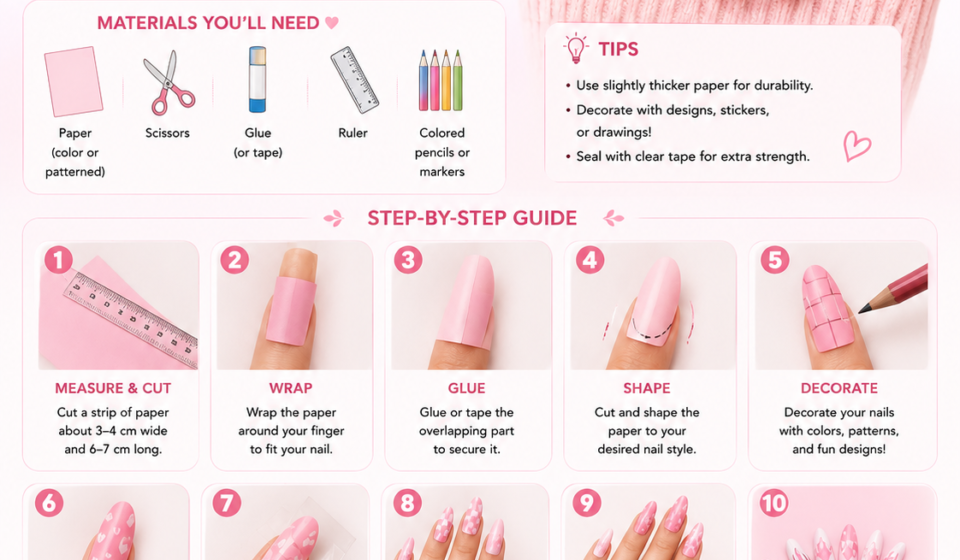
Step 1: Measure and Create Your Nail Templates
The most important factor in making paper nails that look good and fit properly is getting the sizing right for each individual finger. Your nails are all different widths, and a one-size template will not produce a convincing or comfortable result.
Method A: Trace your own nails directly
Using a pencil, trace around the outline of each of your natural nails directly onto your chosen paper. Press the paper flat against each nail surface and trace around the edges carefully. Add approximately 3 to 5 millimetres beyond the nail tip to create the extended free edge — this extension is what creates the look of a longer nail.
Cut just outside your traced lines to create ten individual nail-shaped templates. Label each one lightly with the finger it belongs to (thumb, index, middle, ring, pinky — left and right) so you don’t mix them up.
Method B: Measure and draw from scratch
Using a ruler, measure the width of each nail at its widest point. Draw a rectangle on your paper with that width, then shape the template by hand — rounding the base (to follow the cuticle curve), straightening or shaping the sides according to your preferred nail shape, and extending the tip to whatever length you want.
This method takes slightly longer but allows for more precise control over the final shape and length of each nail.
Step 2: Choose and Cut Your Nail Shape
The shape you cut determines the overall look of the finished nail. The most popular shapes for paper nails are:
Square: The sides of the nail are straight and parallel, and the tip is cut flat and horizontal. One of the easiest shapes to cut accurately and produces a clean, modern result.
Round: The sides curve gently inward and the tip is rounded to follow the natural arc of the fingertip. Cut the general nail shape, then use scissors to trim the tip into a soft curve. Natural and easy to wear.
Oval: Similar to round but with more pronounced tapering — the sides angle slightly inward before the rounded tip. Flattering and elongating, particularly effective for paper nails because the tapered shape draws attention away from the paper edge.
Almond: Significantly tapered sides meeting at a rounded point. Cut the sides in at a steep angle and round the very tip. Creates elegant, dramatic-looking paper nails with a pointed quality that reads as very long even at moderate extensions.
Stiletto: Like almond but with a sharp point at the tip rather than a rounded one. The most dramatic shape for paper nails and particularly effective for costume or theatrical purposes. Cut the sides to a steep angle meeting at a precise central point.
Coffin/Ballerina: Tapered like stiletto but with the tip cut flat and horizontal rather than pointed. A very popular salon shape that works beautifully in paper nail form — the flat tip is easy to decorate and reads as very fashion-forward.
Use your small scissors to cut each template into your chosen shape. Work slowly and make incremental cuts rather than trying to achieve the final shape in one cut — paper nails benefit from a careful, gradual shaping approach.
Step 3: Refine and Smooth the Edges
Paper edges can be rough, slightly frayed, or uneven after cutting — and rough edges catch the eye and break the illusion that you want paper nails to create. Take a moment to refine each nail:
Sand the edges lightly with fine-grit sandpaper (220-grit or higher) or a nail buffer to smooth any roughness. Run the sandpaper along the edge of the paper nail in one direction, the same way you would file a natural nail.
Curve the base of each nail slightly — the base should curve gently to match the curvature of your natural nail where the gel or acrylic would meet the skin. A small, curved snip with scissors achieves this.
Check symmetry by holding each paper nail up to the corresponding finger. The sides should appear even and the shape should be consistent from side to side.
Step 4: Seal and Reinforce the Paper (Optional but Recommended)
Raw paper is vulnerable to moisture, bending, and tearing. Before decorating, consider sealing each paper nail with a layer of clear nail polish, Mod Podge, or clear acrylic medium. Apply a thin, even coat to both sides of each paper nail and allow to dry completely (approximately 10 to 15 minutes) before proceeding.
This sealing step significantly improves durability — paper nails that have been sealed hold their shape better, resist the light moisture exposure that comes from everyday hand movement, and provide a smoother surface for painting and decoration.
If you want particularly durable paper nails, apply two layers of sealer, allowing each to dry fully before the next.
Step 5: Decorate Your Paper Nails
This is the most enjoyable and creative part of the process. Because you are working with paper, your decoration options are far wider than with a standard nail — you can use any medium that adheres to paper, in any combination.
Solid colours with nail polish: Apply regular nail polish to the surface of the sealed paper nail using the nail polish brush. The polish adheres well to sealed paper and dries with the same glossy finish it would on a natural nail. Apply two coats for full opacity and finish with a clear top coat.
Acrylic paint: Acrylic paint gives you far more colour control than nail polish, allows for custom mixing, and can be applied with fine brushes for detailed art. Apply in thin coats to prevent warping, and seal with a clear finish when complete.
Markers and gel pens: For line art, writing, and fine detail, permanent markers and gel pens work directly on paper with no preparation needed. Metallic gel pens create a luxurious effect on dark paper nails.
Watercolour effects: On unsealed watercolour paper, watercolour paints create beautiful soft washes of colour with a natural, painterly quality. Seal with Mod Podge after the watercolour dries to lock in the pigment.
Collage and print: Cut tiny images from magazines, print microscale patterns on your printer, or use patterned paper as your starting material for a built-in design. Collage elements can be layered and sealed for a complex, multi-dimensional look.
Washi tape patterns: Small pieces of patterned washi tape applied to the paper nail surface create instant pattern — stripes, florals, geometric prints — that require no artistic skill and look polished and intentional.
Rhinestones and glitter: Apply rhinestones and gems using a tiny dot of craft glue, and dust glitter over a layer of wet glue for a sparkle effect. Seal everything under a final clear coat.
Gradient effects: Apply two colours of nail polish side by side on the paper nail and blend the meeting point with a small cosmetic sponge while still wet to create an ombre or gradient effect.
Step 6: Add a Final Sealant Layer
Once all decoration is complete and fully dry, apply one final generous coat of clear nail polish or Mod Podge over the entire decorated surface of each paper nail. This protects the artwork, adds gloss or matte finish depending on the product you use, and significantly extends the wear life of the nail.
Allow this final coat to dry completely — at least 20 to 30 minutes — before attempting to apply the nails.
How to Apply Paper Nails
Application technique matters significantly for how convincing and comfortable your paper nails look and feel.
Method 1: Nail Glue (Most Secure)
Nail glue — the same cyanoacrylate-based adhesive used for press-on nails — provides the strongest and most realistic attachment for paper nails.
Step 1: Lightly buff the surface of your natural nail to create a slightly roughened adhesion surface.
Step 2: Apply a very small drop of nail glue to the paper nail’s underside, near the base.
Step 3: Position the paper nail over your natural nail, aligning the base with your cuticle line, and press firmly for 30 to 60 seconds.
Step 4: Avoid water for at least 30 minutes after application to allow the glue to cure fully.
Nail glue attachment can last several hours to a full day with careful wear and is the closest to the wearing experience of a professional press-on nail.
Method 2: Double-Sided Tape (Most Temporary)
Double-sided tape is ideal when you want paper nails you can remove easily and quickly — for photos, short events, or trying out a shape.
Step 1: Cut a small piece of double-sided tape to approximately the size and shape of the paper nail’s base.
Step 2: Apply the tape to the underside of the paper nail.
Step 3: Press firmly onto the natural nail surface and hold for 10 to 15 seconds.
Double-sided tape provides lighter adhesion than glue — the nails are easily removable and will not last as long, but removal is completely non-damaging and takes seconds.
Method 3: Clear Craft Glue (Most Accessible)
PVA craft glue or clear-drying craft glue is the most universally available adhesive option and works adequately for paper nails worn for short periods.
Apply a thin, even layer to the underside of the paper nail, allow it to become slightly tacky (30 to 60 seconds), then press firmly onto the natural nail and hold. Clear craft glue is the least durable option but is easily removed with warm water and produces no damage to the natural nail.
How to Make Paper Nails More Durable
Paper nails have a reputation for fragility, but with the right techniques they are far more durable than most people expect.
Use thick paper. Cardstock at 65 lb (176 gsm) or heavier produces nails that are significantly more resistant to bending and tearing than thinner paper.
Apply multiple layers. Gluing two or three layers of paper together before cutting creates a composite material that is considerably stronger than a single layer.
Seal both sides. Apply sealant to the back of the paper nail as well as the front. This prevents moisture from reaching the raw paper underside and causing the nail to soften or warp.
Apply layers of clear nail polish. Multiple coats of clear nail polish build up a hard, protective coating over the paper that approaches the rigidity of a thin gel layer. Apply three to five coats, allowing each to dry between applications.
Keep nails short. Shorter paper nails experience less mechanical stress and leverage than long, extended ones. For everyday wear, a moderate extension produces nails that last meaningfully longer than dramatic stiletto or coffin lengths.
Avoid water. Even sealed paper nails become vulnerable when submerged in water for extended periods. Wear rubber gloves for washing dishes and avoid prolonged water exposure to maximise wear time.
How Long Do Paper Nails Last?
The honest answer: it depends significantly on how they are made, how they are applied, and how carefully they are worn.
With double-sided tape: Two to four hours of careful wear under normal conditions.
With craft glue: Four to eight hours with careful wear.
With nail glue and good sealing: Eight to twenty-four hours or longer with reasonably careful use.
For photos or short events: Paper nails are perfectly suitable for the duration of a photoshoot, costume event, or special occasion, regardless of attachment method.
Paper nails are not designed to replace acrylics or gel for multi-week wear — they are a creative, accessible, temporary option that serves specific purposes beautifully. Managing expectations around duration is part of getting the most out of the paper nail experience.
Creative Ideas and Variations for Paper Nails
Magazine Collage Nails
Cut nail shapes from glossy magazine pages — choosing sections with interesting patterns, colours, or imagery. Each nail tells a different visual story. Seal with multiple layers of Mod Podge and finish with a glossy top coat. These nails are an incredibly easy way to create complex, interesting-looking designs with zero artistic skill required.
Marble Effect Paper Nails
On white cardstock, apply drops of grey and black nail polish diluted slightly with acetone and swirl with a toothpick before the polish dries. The resulting pattern closely mimics marble. Seal and cut into nail shapes for a sophisticated, editorial result.
Galaxy Paper Nails
Use black cardstock as the base. Apply a base layer of dark purple and blue acrylic paint with a sponge for the nebula colours, then flick tiny dots of white paint with a fine brush for stars. Add a dusting of holographic glitter. The result, sealed under clear polish, is a stunning galaxy nail effect.
Newspaper Print Nails
Use newspaper as your paper — the black-and-white newsprint with text creates an edgy, graphic look when cut into nail shapes. Seal with Mod Podge to prevent smearing and finish with a glossy top coat. Simple, striking, and instantly recognisable as a deliberate aesthetic choice.
Origami Pattern Nails
Use beautifully patterned origami paper — traditional Japanese patterns, geometric designs, or floral prints — as your nail material. The patterns are intricate and colourful without requiring any decoration beyond cutting and sealing.
Layered 3D Paper Nails
Cut small paper elements — tiny flowers, leaves, butterflies — from coloured cardstock and glue them onto the nail surface before sealing. The raised paper elements create a genuine 3D effect that is charming and unique.
Gradient Watercolour Nails
On watercolour paper nails, blend two or three watercolour tones from light to dark across the nail surface using a damp brush. The natural blending quality of watercolour creates beautiful, soft gradients. Seal with Mod Podge when dry.
Paper Nails for Children: A Safe and Fun Activity
Paper nails are an excellent activity for children who want the fun of wearing nail extensions without any of the chemicals, commitment, or cost of real nail products. The project develops fine motor skills, encourages creativity, and produces a genuinely fun wearable result.
For children’s paper nails:
- Use non-toxic craft glue or double-sided tape for application only — avoid nail glue
- Keep the nails short for practical comfort and safety
- Use washable markers and non-toxic acrylic paint for decoration
- Make it a collaborative project — a child can design the nails while an adult helps with precise cutting and application
Frequently Asked Questions
How do you make paper nails without glue? Double-sided tape is the best glue-free attachment option. Cut a small piece to match the base of your paper nail and press firmly onto the natural nail. Alternatively, regular clear tape folded into a double-sided configuration works in an absolute pinch, though the adhesion is less reliable.
Can paper nails look realistic? When made carefully from thick cardstock, properly shaped, fully sealed, and decorated with nail polish or acrylic paint, paper nails can look surprisingly convincing — especially in photographs or at a short distance. The more coats of clear polish applied to build up the surface, the more they begin to resemble genuine press-on nails.
How do you make paper nails stronger? The most effective strengthening techniques are: using thick cardstock or watercolour paper, gluing multiple layers together before cutting, sealing both sides thoroughly, and applying multiple coats of clear nail polish to build a hard outer coating.
Can you reuse paper nails? If attached with double-sided tape rather than glue, paper nails can often be reused one or two times. Nails attached with nail glue are generally single-use. Damage from wear — bending, moisture exposure, or decorative layer peeling — also affects reusability.
How do you remove paper nails? Paper nails attached with double-sided tape slide off easily with no tools needed. Craft glue attachment dissolves with warm water — soak the finger briefly and the nail lifts off cleanly. Nail glue attachment can be soaked in warm soapy water for five to ten minutes to soften the bond, then the nail gently eased off. Do not pull or force.
Can you use paper nails for a costume or cosplay? Absolutely — paper nails are one of the best tools for creating dramatic costume nails. Stiletto, coffin, and extra-long shapes that would be impractical or expensive to create professionally can be made from paper in under an hour, decorated to match any costume, and worn for the duration of the event.
What is the best paper to use for paper nails? Cardstock at 65 lb / 176 gsm or heavier is the best all-purpose choice. Watercolour paper produces the most durable result. Avoid thin printer paper unless multiple layers are glued together.
Final Thoughts
Paper nails are a genuinely brilliant low-barrier entry point into the world of nail art and nail creativity — accessible to absolutely everyone, endlessly customisable, completely free of commitment, and surprisingly fun to make. The process of measuring, cutting, shaping, decorating, and sealing a set of paper nails is a creative experience in its own right, not just a means to an end.
Whether you are making them for a costume event, exploring what a particular nail shape would look like on your hands, engaging in a creative afternoon project, looking for a child-friendly nail activity, or simply experimenting because you are curious — paper nails deliver far more than their humble materials suggest.
A sheet of cardstock, a pair of scissors, some clear polish, and your imagination are genuinely all it takes to create something you might be surprised to find yourself proud of.
Cut your templates. Shape your nails. Decorate with complete creative freedom. And enjoy the small, satisfying magic of making something beautiful out of something simple.