
You have just finished painting your nails. The colour is perfect, the application is even, and everything looks exactly the way you wanted. Then your phone rings. Or you need to grab your keys. Or a strand of hair falls across your finger. And in an instant, the smudge you were dreading is there — a dent or drag mark in the polish that you now have to decide whether to fix or ignore.
Waiting for nail polish to dry is one of the most universally frustrating small experiences in beauty. Standard nail polish can take anywhere from 20 minutes to a full hour to dry completely — not just surface dry, but genuinely hard all the way through. For most people, that is simply too long to sit still with outstretched hands, hoping nothing goes wrong.
The good news is that nail polish drying time is not fixed. There are numerous techniques, products, and simple tricks — some free, some inexpensive, all effective — that meaningfully accelerate the drying process and dramatically reduce the risk of smudges, dents, and the particular agony of a ruined manicure right after you thought you were done.
This complete guide covers 12 proven methods for making nail polish dry faster, explains the science behind why each one works, details exactly how to use each technique, and provides the expert application tips that make the biggest difference to your overall drying time. Whether you have five minutes or fifteen, there is an approach here that works for your situation.
Why Nail Polish Takes So Long to Dry
Before exploring how to speed up drying, it helps to understand what is actually happening when nail polish dries — because “drying” is not quite the right word for what occurs.
Nail polish does not dry in the way that water dries. It cures — the solvents in the polish (primarily ethyl acetate, butyl acetate, and isopropyl alcohol) evaporate into the air, leaving behind the solid film-forming polymers, plasticizers, and pigments that make up the colour layer. This evaporation process takes time because:
Multiple layers are involved. Each coat of polish — base coat, colour coat one, colour coat two, top coat — must cure individually. The layers beneath the surface cure more slowly than the exposed top layer because the solvents have to travel through the upper layers to evaporate.
Humidity slows evaporation. In a humid environment, the air around the nail is already saturated with water vapour, which slows the evaporation of the solvents in the polish. This is why polish always seems to take longer to dry in humid conditions.
Thick coats take dramatically longer. The thicker each layer of polish, the more solvent must evaporate before the layer is fully cured. A thick coat can take three to four times as long to dry as a thin one of the same formula.
Some formulas are inherently slower-drying. Glitter polishes, heavily pigmented deep shades, and certain specialty formulas contain different ratios of ingredients that affect cure time.
Understanding these factors reveals what all the best speed-drying techniques have in common: they either accelerate solvent evaporation, improve airflow across the nail surface, or change the conditions around the nail to favour faster curing.
12 Methods to Make Nail Polish Dry Faster
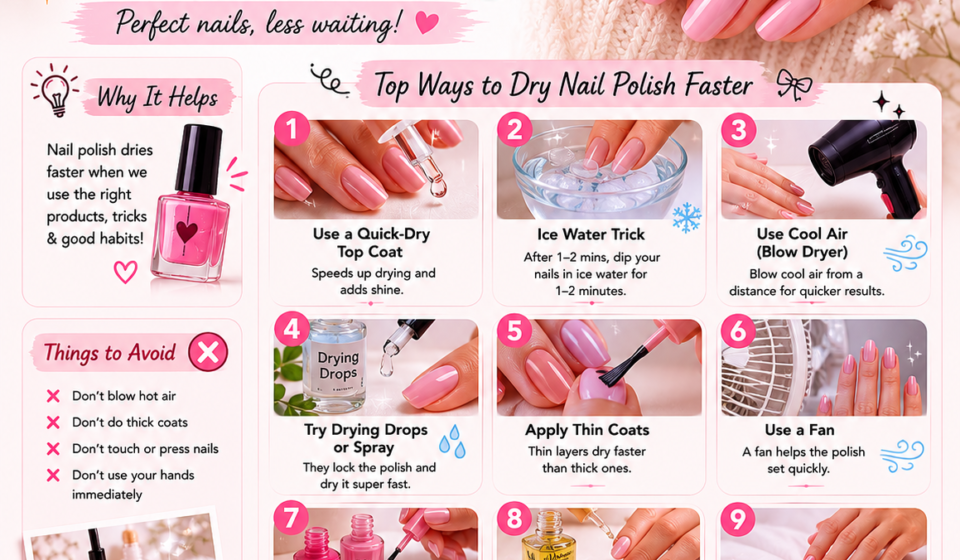
Method 1: Apply Thin, Even Coats
Effectiveness: Very High Cost: Free
This is the most impactful thing you can do for faster drying — and it happens before you even think about drying techniques. The single biggest controllable factor in nail polish drying time is coat thickness, and most people apply coats that are far thicker than necessary.
A thin coat of nail polish can dry completely in three to five minutes. A thick coat of the same formula may take 15 to 20 minutes to surface dry and far longer to cure through. Two thin coats dry faster combined than one thick coat, produce better color, are less prone to bubbling, and have better longevity.
How to apply thin coats correctly:
Wipe most of the polish off the brush on the inside of the bottle neck before applying — you want the brush loaded, not overloaded. Apply in three smooth strokes: one down the centre of the nail from base to tip, one down the left side, one down the right. The polish should flow smoothly and evenly, not clump or pool.
If you feel compelled to go back and fix or touch up an area immediately after applying, you are likely applying too much polish per stroke. Resist the urge to over-work the coat — let it settle and apply a second thin coat if needed.
Allowing each coat to dry for at least two minutes before applying the next one is also critical. Applying a second coat over a wet first coat seals in solvent that cannot evaporate, significantly lengthening total drying time.
Method 2: Cold Water Dip
Effectiveness: High Cost: Free
The cold water dip is one of the most well-known nail drying hacks — and it genuinely works, though the mechanism is slightly different from what most people assume. Cold water does not directly speed up solvent evaporation. Instead, it causes the polymers in the nail polish to contract and harden rapidly through thermal contraction, creating a hard outer surface much faster than air drying alone would.
How to do it correctly:
Fill a bowl with cold water and add a handful of ice cubes. Let it sit for one to two minutes until the water is genuinely cold. Apply your nail polish normally, then wait 60 to 90 seconds before submerging your fingernails in the cold water.
Do not dip immediately after applying — the polish needs a brief moment to begin setting before cold water contact will help rather than disrupt it. Hold your nails under the cold water for 60 seconds, then gently lift them out and allow any water droplets to slide off without touching the nails.
You will notice small water droplets beading on the nail surface — this is a sign that the outer layer has hardened enough to repel water. Pat the surrounding skin dry carefully without pressing the nails.
Important caveat: The cold water dip hardens the surface of the polish rapidly but does not fully cure the deeper layers. Your nails will feel hard to the touch after the dip but remain slightly vulnerable to pressure dents for another 10 to 15 minutes. Treat them gently during this window.
Method 3: Quick-Dry Top Coat
Effectiveness: Very High Cost: Low (one-time purchase)
A dedicated quick-dry top coat is the most reliable and consistently effective product-based solution for faster nail polish drying. These formulas are specifically engineered to dry rapidly and to accelerate the drying of the colour coats beneath them through a combination of fast-evaporating solvents and film-forming agents that create a hard, protective layer quickly.
Good quick-dry top coats can reduce total drying time from 30 or more minutes to as little as 5 to 10 minutes when used correctly. They also add significant shine and improve the longevity of the manicure — making them a worthwhile investment even beyond their drying benefits.
How to use a quick-dry top coat effectively:
Apply the quick-dry top coat only after your colour coats have had at least two to three minutes to set — applying it over very wet colour coats traps solvent beneath and reduces effectiveness. Apply one thin, even coat from base to tip and cap the free edge. Avoid going back over areas you’ve already coated.
Look for formulas that specify “60-second” or “one-minute” dry times on the packaging. Popular professional options include Seche Vite, OPI RapiDry, Sally Hansen Insta-Dri, and Essie Speed Setter.
Method 4: Quick-Dry Drops or Spray
Effectiveness: High Cost: Low (one-time purchase)
Quick-dry drops and sprays work differently from quick-dry top coats. Rather than forming a new layer over the polish, they are applied as a liquid directly onto the surface of the wet polish. Their formulation typically includes a combination of fast-evaporating solvents and oils that penetrate the surface of the polish and accelerate the evaporation of the solvents within it, while simultaneously creating a surface hardening effect.
Many quick-dry drops also leave a thin oil layer on the polish surface that prevents smudging and gives the nails a slight sheen.
How to use them:
Wait approximately 60 seconds after your final coat of polish or top coat before applying. Hold the dropper about a centimetre above the nail and allow one drop to fall onto the nail surface. The drop will spread naturally across the nail — do not rub or spread it manually. Allow it to sit for one to two minutes, then gently blot any excess from the surrounding skin.
Quick-dry drops can be used over regular top coat or as the final step without top coat if you want the fastest possible drying process. Popular options include OPI DrySpy, Essie Quick-E Drying Drops, and Orly Sec ‘N Dry.
Method 5: Cool Air from a Fan or Hairdryer
Effectiveness: High Cost: Free (if you already own these)
Moving air significantly accelerates the evaporation of solvents from nail polish — the same principle that makes wet clothes dry faster in a breeze than in still air. A small fan directed at your nails, or the cool setting on a hairdryer held at a safe distance, can meaningfully cut drying time by ensuring that solvent-laden air is continuously replaced with fresh, drier air around the nail surface.
How to use this method correctly:
If using a hairdryer, always use the cool setting (the “cold shot” button on most dryers). Hot air feels like it should work faster, but heat actually softens the polymers in nail polish rather than hardening them — it can cause the polish to bubble, smudge, or develop a wrinkled surface. Cool air is the effective setting.
Hold the hairdryer at least 30 centimetres from your nails and keep it moving gently rather than pointing at a single spot. Two to three minutes of cool airflow produces noticeably faster surface drying.
A small desktop fan set to its lowest speed and positioned to blow gently across your hands achieves the same effect more passively — simply sit near the fan while your nails dry.
Method 6: Dry Your Nails in a Cool, Low-Humidity Environment
Effectiveness: Moderate to High Cost: Free
Since nail polish solvent evaporation is slowed by humid air, choosing the right environment for your manicure makes a real difference. If you have air conditioning, drying your nails in an air-conditioned room (which actively removes humidity from the air) produces noticeably faster results than drying them in a warm, humid bathroom after a shower.
Similarly, painting your nails in winter in a dry indoor environment often produces faster drying than painting them in summer humidity — a phenomenon many people notice but don’t necessarily connect to humidity levels.
Practical tips:
Avoid painting your nails immediately after a hot shower or bath, when the bathroom air is warm and moisture-saturated. Give the room 10 to 15 minutes to clear before beginning your manicure. If you live in a humid climate, a small dehumidifier running in your nail care space makes a genuine difference to drying time.
Method 7: Apply a Thin Base Coat First
Effectiveness: Moderate Cost: Low (one-time purchase)
A thin base coat creates a slightly textured, porous surface on the natural nail that colour polish adheres to more efficiently than the smooth nail plate alone. This improved adhesion means each colour coat can be applied more thinly — because it spreads more evenly on the base coat surface — which directly reduces drying time for each subsequent layer.
Base coat also protects the natural nail from staining and significantly improves the overall longevity of the manicure, making it a worthwhile step regardless of its modest contribution to drying speed.
How to apply base coat for fastest results:
One thin, even coat of base coat is sufficient. Allow it to become touch-dry before applying the first colour coat — approximately one to two minutes. A thin, well-set base coat provides the optimal foundation for fast-drying colour layers above it.
Method 8: Baby Oil or Cuticle Oil Drop
Effectiveness: Moderate Cost: Very Low
This is one of the most accessible quick-dry methods because virtually everyone has either baby oil or cuticle oil at home. A small drop of oil applied to the surface of freshly painted nails creates a barrier that protects the polish surface from smudging while also slightly accelerating surface hardening.
The mechanism is similar to quick-dry drops — the oil penetrates the surface layer of the polish and helps displace solvent, while simultaneously protecting the outer surface from physical contact damage.
How to use it:
Wait 60 to 90 seconds after applying your final coat, then carefully place one small drop of baby oil or cuticle oil onto each nail. Allow it to spread naturally. After two to three minutes, gently dab away excess oil from the surrounding skin with a soft cloth, being careful not to press on the nail surface.
This method is particularly useful as a combination approach — use a quick-dry top coat first, then a drop of cuticle oil after 60 seconds for a double-action speed-drying effect.
Method 9: Cooking Spray
Effectiveness: Moderate Cost: Very Low
This may be the most surprising quick-dry hack on this list, but cooking spray — the kind used to grease baking tins — genuinely works on nail polish. The aerosol propellants in cooking spray create a brief evaporative cooling effect when sprayed on the nail surface, while the oil content creates the same protective smudge-resistance that cuticle oil provides.
How to use it:
Hold the cooking spray can approximately 20 to 30 centimetres above your nails and give a very brief, light spray — you want a fine mist, not a coating. Allow it to sit for two to three minutes, then rinse hands with cool water to remove the oil residue. The polish will be significantly harder after this treatment than untreated polish of the same age.
Use an unflavoured, unscented cooking spray (plain vegetable or canola oil spray). Olive oil spray works too but leaves a stronger smell.
Method 10: Use a Fast-Drying Polish Formula
Effectiveness: High Cost: Low to Moderate
Some nail polish formulas are specifically engineered to dry faster than standard formulas — not through any technique applied afterward, but through the composition of the polish itself. Fast-drying polishes contain higher ratios of fast-evaporating solvents and film-forming agents that produce a harder surface more rapidly from the moment of application.
Popular fast-drying polish lines include Sally Hansen Insta-Dri (an all-in-one formula marketed as drying in 60 seconds), OPI’s Rapid Dry formulas, and various “express” or “speed” lines from drugstore brands.
Important note: Even fast-drying formulas benefit from thin application. The speed advantage of a quick-dry formula is eliminated if applied in thick coats — the chemistry can only work as fast as solvent can physically evaporate through the coat.
Method 11: Nail Drying Lamp (UV/LED)
Effectiveness: Very High (for gel; limited for regular polish) Cost: Moderate (one-time purchase)
UV and LED lamps are designed specifically for curing gel nail polish — a different chemical process from the solvent evaporation that dries regular polish. For gel formulas, a UV or LED lamp is not optional: gel polish does not dry without UV/LED curing, and the cure is complete in 30 to 60 seconds rather than minutes.
For regular nail polish, UV/LED lamps do not produce the same dramatic acceleration because regular polish dries through solvent evaporation rather than photopolymerization — UV light does not significantly catalyse that evaporation process. However, the gentle warmth produced by some LED lamps can marginally accelerate drying of regular polish.
The takeaway: If fast-drying is consistently important to you and you regularly paint your nails at home, switching to a gel nail system (polish plus UV/LED lamp) is the only method that reliably achieves a fully cured, dent-proof result in under two minutes. Gel is a bigger initial investment but eliminates drying anxiety entirely for the duration of the wear period.
Method 12: The Thin Layer Between Coats Wait Technique
Effectiveness: High Cost: Free
This method is less a drying trick and more a discipline of application — but it is one of the most impactful habits for reducing total manicure time and producing a better-looking finish.
The technique: apply each coat as thin as possible, then wait a genuine two to three minutes before applying the next coat. Do not rush the between-coat wait by applying the next coat while the previous one is still visibly wet. A surface-dry first coat allows the second coat to be applied without lifting or dragging the layer beneath, and two thin dry-ish coats cure significantly faster than two thick wet coats stacked on top of each other.
Most people underestimate how much total drying time is created by impatient layering. Two coats applied with a proper wait between them take the same total time as one coat applied too thickly but produce a far faster final cure time because each layer has already begun drying before the next is added.
The Optimal Fast-Drying Manicure Routine
Combining several of the above methods produces dramatically faster results than any single technique alone. Here is the optimal routine for the fastest possible drying time with regular nail polish:
Step 1: Paint your nails in a cool, dry, air-conditioned room away from humidity.
Step 2: Apply one thin coat of base coat and allow two minutes to set.
Step 3: Apply your first colour coat as thin as possible and wait two to three minutes.
Step 4: Apply your second colour coat, equally thin, and wait another two minutes.
Step 5: Apply one thin coat of quick-dry top coat and cap the free edge.
Step 6: Wait 60 seconds, then apply one drop of cuticle oil or quick-dry drops to each nail.
Step 7: If needed, dip nails briefly in ice-cold water for 60 seconds after the drops have had two minutes to work.
With this approach, your nails should be genuinely surface-hard and smudge-resistant within 10 minutes of the final coat — and fully cured within 20 to 25 minutes rather than the 45 to 60 that a less optimised approach would require.
What NOT to Do When Trying to Dry Nail Polish Faster
Do Not Use Hot Air
Hot air from a hairdryer on its warm or hot setting softens the polymers in nail polish rather than hardening them. It can cause the polish surface to wrinkle, bubble, or develop an uneven texture — and it makes the polish more susceptible to smudging immediately after the heat is removed because the surface is softened rather than hardened. Always use cool air only.
Do Not Apply Polish in Thick Coats
No drying technique compensates fully for thick application. Thick coats trap solvent beneath the surface in a way that no external approach can easily override. The single most effective thing you can do for faster drying is apply thinner coats from the very beginning.
Do Not Touch, Press, or Test the Surface Too Early
The surface of nail polish becomes touch-dry before the deeper layers are cured. The surface feeling smooth and hard does not mean the full coat is cured — the layers beneath may still be soft enough to dent under pressure. Avoid pressing, picking up textured objects, or doing anything that would apply concentrated pressure to a nail surface for at least 20 minutes after the final coat, regardless of how dry it feels.
Do Not Use Hot Water
Hot water does not dry nail polish faster and can in fact damage a freshly applied manicure by causing the top layer to shrink unevenly as it cools. If you are using the water dip method, it must be genuinely cold water with ice.
Do Not Skip the Wait Between Coats
Applying coat after coat without waiting for each one to begin setting creates a wet, thick multilayer system that dries far more slowly than properly spaced thin coats. The between-coat waiting time is not wasted — it is an investment in dramatically faster total drying time.
Why Do Some Nail Polishes Take Longer to Dry Than Others?
Not all nail polishes are created equal in terms of drying speed. Several formula factors affect how quickly a polish cures:
Pigment density: Deeply pigmented, highly opaque shades — particularly blacks, deep reds, and dark blues — typically contain higher ratios of pigment to solvent, which can slow evaporation. These shades often require more coats and longer drying times.
Glitter content: Glitter polish contains particles that create gaps in the film-forming matrix, which can either speed or slow drying depending on the formula — but heavily packed glitter polishes often require more coats and take longer overall.
Age of the polish: As nail polish ages and is repeatedly opened and closed, solvents evaporate from the bottle, making the formula thicker. Thick, old polish both applies more heavily and dries more slowly than fresh polish. Adding a small amount of nail polish thinner (not remover) restores the formula to its original consistency.
Specialty formulas: Gel-effect, magnetic, thermal colour-changing, and certain other specialty formulas have different solvent ratios from standard polish and may dry more slowly.
Frequently Asked Questions
How long does nail polish actually take to dry completely? Surface dry (touch-dry) typically occurs within 5 to 10 minutes for thin coats. Complete curing — where the full depth of all coats is hardened — takes 1 to 2 hours for a standard manicure, though with quick-dry techniques and products, this can be reduced to 20 to 30 minutes.
Does cold water actually work to dry nail polish? Yes — cold water causes the polymers in nail polish to contract and harden rapidly, producing a hard surface layer faster than air drying alone. It does not fully cure the deeper layers but makes the surface significantly more smudge-resistant. Use genuinely ice-cold water and wait 60 to 90 seconds after painting before dipping.
Is it bad to use a hairdryer on nail polish? On the cool setting, no — cool air airflow accelerates drying effectively and safely. On warm or hot settings, yes — heat softens nail polish polymers and can cause wrinkling, bubbling, and surface damage. Always use the cold shot setting only.
Can I speed up nail polish drying with rubbing alcohol? Rubbing alcohol is sometimes cited as a quick-dry solution, but it actually acts as a solvent for nail polish and can dissolve or damage the surface if applied incorrectly. It is not a recommended drying technique. Quick-dry drops and cold water are far more effective and reliable.
Why does my nail polish always smudge even after waiting? Most smudging after what feels like adequate drying time is caused by pressure on the nail surface before the deeper layers have fully cured. The surface feels hard, but the layers beneath are still soft enough to deform under concentrated pressure — such as picking up keys, typing, or touching textured surfaces. Allow at least 20 minutes before any activity involving nail contact.
Does a top coat really make a difference to drying time? A standard top coat marginally improves drying time by sealing and protecting the colour coats beneath. A specifically formulated quick-dry top coat makes a very significant difference — reducing total surface drying time from 15 to 20 minutes to as little as 5 minutes. The difference between a standard top coat and a quick-dry top coat is substantial and worth the specific product investment.
Final Thoughts
Making nail polish dry faster is not about any single magic trick — it is about understanding what slows drying down and systematically addressing those factors from the moment you begin your manicure. Apply thinly, wait between coats, use a quick-dry top coat, apply drops or cuticle oil, dip in cold water if needed, and do it all in a cool, dry environment. Each step shaves minutes off the total time; combined, they transform a 45-minute drying wait into a 10-minute one.
The techniques in this guide cost very little — most of them cost nothing at all — and together they are enough to end the particular frustration of a ruined manicure right when you thought you were done.
Apply thin. Wait smart. Dry fast. And enjoy perfect nails without the wait.