

It is one of those questions that seems like it should have a simple yes or no answer — and yet the reality is a little more nuanced than most people realise. Walk down the nail care aisle at any pharmacy or beauty supply store and you will find dozens of products labelled “nail polish remover,” some described as “acetone” and others as “non-acetone” or “acetone-free.” You will also find bottles simply labelled “100% acetone” sitting right next to them.
So is nail polish remover acetone? Are they the same thing? Is one better than the other? And which should you actually be using for your specific situation?
This complete guide answers all of those questions in full — covering the chemistry of what nail polish remover actually is and how it works, the difference between acetone and non-acetone formulas, what 100% pure acetone is and when you need it, the situations where each type performs best, the effects on nail health and skin, and everything else you need to know to make an informed choice about what you put on your nails.
The Short Answer
Nail polish remover is not always acetone — and acetone is not always nail polish remover.
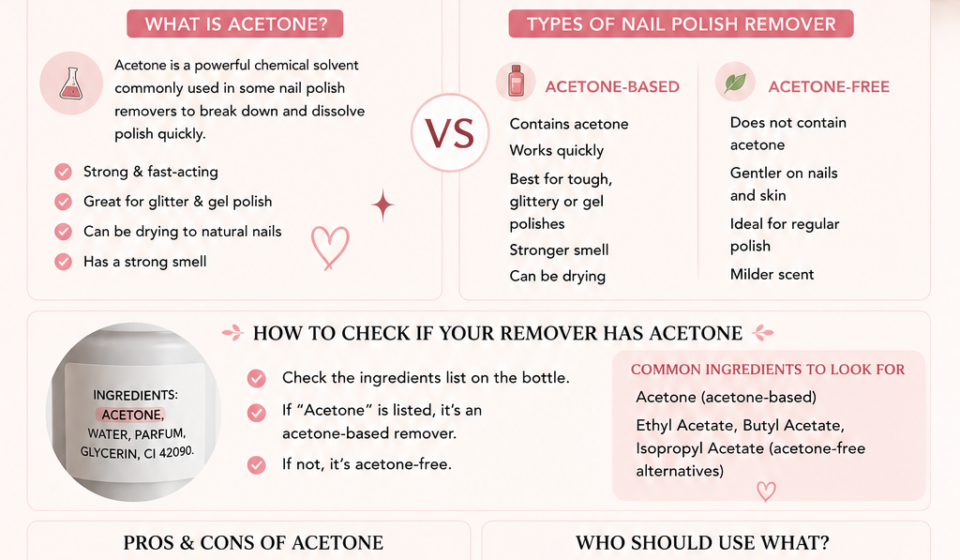
Some nail polish removers contain acetone as their primary active ingredient, mixed with water, fragrance, conditioning agents, and other additives. These are commonly labelled “acetone nail polish remover” or simply “nail polish remover” without further qualification, as acetone-based formulas have historically been the standard.
Some nail polish removers contain no acetone at all. These are labelled “non-acetone” or “acetone-free” and use alternative solvents — typically ethyl acetate, isopropyl alcohol, or propylene carbonate — to dissolve nail polish through a different chemical mechanism.
100% pure acetone is acetone with no additives or dilution. It is not the same product as an acetone nail polish remover, which is typically 50 to 70% acetone mixed with other ingredients. Pure acetone is more powerful and faster-acting than diluted acetone nail polish remover.
Understanding the differences between these three categories — acetone nail polish remover, non-acetone nail polish remover, and pure acetone — is the key to choosing the right product for your nails.
What Is Acetone?
Acetone (chemical formula: CH₃COCH₃, also known as propanone) is a naturally occurring organic compound classified as a ketone solvent. It is colourless, highly flammable, and has a strong, distinctive chemical smell. Despite its reputation as a harsh industrial chemical, acetone is actually produced naturally by the human body as a byproduct of fat metabolism and is present in small amounts in blood, urine, and exhaled breath.
As a solvent, acetone is exceptionally effective at dissolving a wide range of substances — including the polymer resins, plasticizers, and pigments that make up nail polish. This makes it one of the most efficient nail polish dissolving agents available.
In the context of nail care, acetone works by penetrating the film-forming polymer structure of dried nail polish and disrupting the molecular bonds that hold it together, essentially dissolving the solid polish back into a liquid state that can be wiped away.
Acetone is used across many industries — in manufacturing, as a paint thinner, as a cleaning agent, and as a chemical intermediate in the production of plastics and pharmaceuticals. Its role in nail care is one of its most everyday consumer applications.
What Is Nail Polish Remover Made Of?
Nail polish remover is not a single, uniform product — it is a category that encompasses multiple different formulations. Here is what each type typically contains:
Acetone-Based Nail Polish Remover
The most widely sold format of nail polish remover is acetone-based. It typically contains:
- Acetone (50 to 70%) — the primary active solvent
- Water — dilutes the acetone and reduces its harshness
- Fragrance — masks the sharp chemical smell of acetone
- Moisturising agents — typically aloe vera, vitamin E, glycerin, or similar — included to counteract acetone’s drying effect on skin and nails
- Colouring agents — some products include dye for visual appeal
The acetone in these products does the actual work of dissolving nail polish. The other ingredients are primarily there to make the product more pleasant and less harsh to use.
Non-Acetone Nail Polish Remover
Non-acetone nail polish removers use different solvents in place of acetone. The most common active ingredients include:
- Ethyl acetate — a naturally occurring ester (found in fruit and wine) that has solvent properties similar to acetone but milder. It is the most common non-acetone solvent in nail polish removers.
- Isopropyl alcohol — rubbing alcohol, which has limited but genuine solvent activity against nail polish
- Propylene carbonate — a gentle solvent often used in “natural” or “gentle” formulas
- Butyl acetate — another ester solvent similar to ethyl acetate
Non-acetone removers also typically contain water, fragrance, and conditioning agents. Because the solvents in non-acetone formulas are milder than acetone, these products generally require more product, more contact time, and more physical effort to fully remove nail polish.
100% Pure Acetone
Pure acetone is acetone with no dilution, additives, or conditioning agents. It is the most concentrated and fastest-acting form of nail polish removal available for consumer use.
Because it contains no water, fragrance, or conditioning agents, it is also the most drying and has the strongest smell. Pure acetone is typically sold in larger bottles than standard nail polish remover and is used both in professional nail salons and by home nail care enthusiasts.
How Do Acetone and Non-Acetone Removers Compare?
Understanding the differences between these two formats helps you choose the right product for your specific needs.
Speed and Effectiveness
Acetone-based removers dissolve nail polish significantly faster than non-acetone formulas. The higher solvent activity of acetone means that most regular nail polish colours are completely removed with one to two passes of an acetone-soaked cotton pad, typically in under a minute per nail.
Non-acetone removers require more product, more contact time (15 to 20 seconds of contact rather than five to ten), and more physical rubbing to achieve the same result. For light, sheer, or older polishes they work reasonably well; for dark, opaque, or glitter polishes they require significantly more effort.
Effect on Nail Health
This is where the comparison becomes more nuanced. Acetone is more drying than non-acetone alternatives — it is a powerful desiccant that removes moisture from the nail plate and the surrounding skin with repeated exposure. Regular use without adequate moisturising aftercare can lead to dry, brittle nails and dry, cracked cuticles over time.
However, the degree of nail damage caused by acetone is frequently overstated. Used in correct quantities and followed by proper moisturising, acetone-based removal does not cause permanent nail damage. The key is the aftercare — applying cuticle oil and hand cream immediately after each use replenishes the moisture that acetone removes.
Non-acetone removers are less drying, making them a better choice for people with already dry or brittle nails, those who change their nail polish very frequently, or those who are particularly sensitive to the drying effects of acetone.
Effect on Skin and Surrounding Tissue
Acetone can cause redness, dryness, and mild irritation to the skin around the nails with prolonged exposure. People with eczema, psoriasis, or very sensitive skin around the nail area may find non-acetone formulas more comfortable for regular use.
Non-acetone removers are gentler on the skin and are less likely to cause irritation, making them a better choice for people with skin sensitivities or those removing nail polish from a large area.
Effect on Nail Enhancements
This is one of the most practically important differences between the two types. Acetone dissolves acrylic nails, softens gel polish for removal, and can damage certain nail enhancement products including some press-on adhesives. This is actually the property that makes acetone essential for acrylic and gel removal — but it also means it must be used with awareness around any nail enhancements.
Non-acetone remover is safe to use on acrylic nails, gel overlays, and nail extensions for removing surface polish without affecting the underlying enhancement structure. This makes non-acetone remover the appropriate choice whenever you want to change the colour of surface polish without disturbing gel or acrylic nails beneath.
Smell
Acetone has a very strong, distinctive chemical smell that many people find overpowering. It is important to use acetone-based products in well-ventilated spaces and to avoid prolonged inhalation.
Non-acetone removers typically have a milder, more pleasant smell — sometimes fruity (particularly ethyl acetate-based formulas, which have a slightly sweet, fruit-like scent) or fragranced with added perfume.
What Is 100% Pure Acetone Used For?
If acetone-based nail polish remover already contains acetone, why would you need 100% pure acetone? The answer lies in the concentration.
Standard acetone nail polish remover is diluted to approximately 50 to 70% acetone. This concentration is perfectly adequate for removing regular nail polish but is not strong enough for several specific applications that require the full solvent power of undiluted acetone:
Removing Gel Nail Polish
Gel nail polish is chemically cured under a UV or LED lamp, creating a dense, cross-linked polymer structure that is far more resistant to solvents than regular polish. Removing it safely requires 100% pure acetone — the concentration in standard remover is too low to penetrate and dissolve the gel matrix efficiently. Standard acetone remover will eventually work with very long soak times, but pure acetone achieves safe removal within 10 to 15 minutes.
Removing Acrylic Nails
Acrylic nails are even more resistant than gel, requiring sustained contact with pure acetone for 25 to 40 minutes to soften adequately for safe removal. Standard diluted remover is not effective for acrylic removal at any practical soak time.
Removing SNS / Dip Powder Nails
Dip powder nails also respond best to pure acetone rather than diluted formulas, which produce slower and less complete results.
Professional Salon Use
Nail salons universally use pure acetone for gel and acrylic removal because it is faster, more reliable, and more cost-effective than diluted alternatives. It is the professional standard for all nail enhancement removal.
When to Use Each Type: A Practical Guide
Use Acetone Nail Polish Remover When:
- Removing regular nail polish from natural nails
- Removing glitter polish (the higher solvent activity dissolves glitter polish faster than non-acetone alternatives)
- Removing dark, pigmented, or heavily layered polish
- You want the fastest possible removal experience
- Removing nail polish from toenails (where the thicker nail plate benefits from stronger solvent action)
Use Non-Acetone Nail Polish Remover When:
- Removing surface polish from acrylic nails, gel overlays, or nail extensions (where acetone would damage the enhancement)
- You have dry, brittle, or very thin natural nails and want to minimise drying
- You change nail polish very frequently and want to reduce cumulative drying effects
- You have sensitive skin around your nails that reacts to acetone
- Removing light, sheer, or single-coat nail polish where the extra effort is minimal
- You are pregnant or prefer to minimise chemical exposure (non-acetone formulas have generally milder fume profiles)
Use 100% Pure Acetone When:
- Removing gel nail polish (essential — diluted remover is not effective enough)
- Removing acrylic nails at home
- Removing dip powder or SNS nails
- Removing stubborn nail glue from press-on nails
- You need the fastest possible removal for any nail product
- Professional or semi-professional nail care at home
Is Acetone Nail Polish Remover Safe?
This is one of the most frequently asked questions about acetone, and the reassuring answer is: yes, when used correctly, acetone nail polish remover is safe for regular use by most people.
What the Science Says
Acetone is one of the most studied solvents in toxicology. The human body naturally produces and processes acetone as part of normal metabolism. At the concentrations used in nail polish remover and with the brief, intermittent exposure of typical nail care, acetone does not cause significant toxicological harm.
Skin contact: Brief contact with diluted acetone nail polish remover causes drying and mild irritation with frequent use but does not cause chemical burns or permanent skin damage at normal usage amounts. The drying effect is real and should be addressed with moisturising aftercare.
Inhalation: Acetone vapours should not be inhaled in concentration — use in a well-ventilated space with open windows or near an air vent, and avoid prolonged, close inhalation of the fumes. Brief exposure during normal nail care in a ventilated room is not dangerous for most people.
Nail damage: Acetone itself does not permanently damage nail structure. The drying it causes is temporary and reversible with proper moisturising aftercare. The “damaged nails” attributed to acetone are almost always the result of inadequate aftercare (no moisturising), improper removal technique (peeling gel or acrylics rather than soaking), or overuse without recovery periods.
Who Should Exercise Extra Caution
People with asthma or respiratory sensitivities should use acetone in particularly well-ventilated spaces or consider non-acetone alternatives, as the fumes can trigger respiratory irritation.
Pregnant women are often advised to minimise chemical exposure as a precaution, including acetone. Many healthcare providers suggest using non-acetone alternatives during pregnancy, or ensuring maximum ventilation when acetone use is necessary.
People with very dry skin conditions (eczema, contact dermatitis) around the nails may find acetone particularly irritating and may prefer non-acetone alternatives for regular use.
Children: Nail polish remover of any type should be stored safely away from children and used by or with adult supervision on younger users.
Does Acetone Ruin Nails?
This is probably the most persistent myth in nail care, and it deserves a clear, direct answer.
Acetone does not permanently ruin nails. It does cause temporary dryness of the nail plate and surrounding skin, which can make nails feel more brittle and look more dull immediately after use. However, this dryness is entirely reversible with proper aftercare — specifically the application of cuticle oil and hand cream immediately after every use of acetone.
The nails that appear “ruined” after gel or acrylic removal are almost always damaged by the removal process itself (peeling, scraping, or forcing off gel and acrylics that were not fully softened) rather than by the acetone. The acetone, used correctly with adequate soak time, leaves the nail largely intact. The damage comes from human impatience.
Sustained, very frequent use of acetone without any moisturising aftercare over an extended period would cumulatively dry and weaken nails over time. But in the context of normal nail care — using acetone to remove nail polish once a week or gel polish every two to three weeks — with proper aftercare, acetone is a safe and effective tool.
Acetone vs. Nail Polish Remover: Addressing Common Confusions
“I bought nail polish remover and it didn’t take off my gel. What happened?”
Standard nail polish remover — whether acetone-based or non-acetone — is not formulated for gel removal. Gel polish requires pure acetone and a soak-off technique (foil wraps or bowl soak) for effective removal. The acetone concentration in standard remover is insufficient to dissolve cured gel within any practical timeframe.
“My nail polish remover says it contains acetone but it barely works on glitter polish.”
Even acetone-based nail polish remover at 50 to 70% concentration can struggle with dense glitter formulas. For glitter polish, the foil soak technique — pressing an acetone-soaked cotton pad against the nail and wrapping with foil for 10 minutes — produces significantly better results than wiping alone, because it gives the acetone sustained contact time to dissolve the glitter base.
“I’ve been told acetone-free is always better for nails. Is that true?”
Not always. Non-acetone removers are less drying per use, which is a genuine advantage for people with dry or sensitive nails. But they require more product and more physical rubbing to achieve the same result, which means more friction against the nail surface and the surrounding skin. For people with normal nail health, the difference in drying effect between acetone and non-acetone remover — when both are followed by proper moisturising — is minimal. The “always use acetone-free” advice is too absolute; the best choice depends on your specific nail type, usage frequency, and which nail products you are removing.
“Can I use nail polish remover instead of pure acetone for gel removal?”
Technically you can try, but it is not recommended. Standard nail polish remover at 50 to 70% acetone will eventually soften gel with a long enough soak time, but the process takes two to three times as long as pure acetone, dries the skin more through prolonged exposure, and often produces incomplete results. For gel removal specifically, pure acetone is the correct tool.
The Environmental and Safety Considerations
Acetone is highly flammable — its flashpoint is -20°C (-4°F), which means it can ignite at room temperature in the presence of a spark or open flame. This is the most significant safety consideration:
- Never use acetone near candles, cigarettes, gas burners, or any open flame
- Store acetone in its original container, sealed tightly, away from heat sources
- Do not pour acetone down the drain in large quantities — it can be environmentally problematic in high concentrations
- Dispose of acetone-soaked cotton according to local waste disposal guidelines
Non-acetone removers are generally less flammable than pure acetone but should still be kept away from heat and flames, as ethyl acetate is also combustible.
Natural and “Chemical-Free” Nail Polish Remover Alternatives
For those who prefer to minimise chemical exposure, several alternatives exist:
Rubbing alcohol (isopropyl alcohol): Has limited but genuine solvent activity against regular nail polish, particularly older or thinner formulas. Works best on light shades and requires more effort than dedicated removers.
Hand sanitiser: Contains alcohol and can remove light polish with significant rubbing — an emergency solution rather than a practical alternative.
Vinegar and lemon juice: Sometimes recommended online, but have very limited effectiveness. The mild acidity of these liquids provides minimal solvent activity against cured nail polish polymers and cannot be recommended as reliable removal solutions.
“Natural” or “plant-based” nail polish removers: An emerging product category using plant-derived solvents (such as soy-based or lavender-based formulas). These exist on a spectrum of effectiveness — some work reasonably well for light regular polishes, others are barely functional. Read reviews carefully and manage expectations — none currently approach the effectiveness of acetone for anything beyond very light polish.
How to Minimise the Drying Effects of Acetone
If you use acetone regularly and are concerned about its drying effects, these habits make a meaningful difference:
Use the minimum amount necessary. Dip the cotton pad rather than saturating it excessively. More acetone does not remove polish faster — adequate contact time is what matters.
Work quickly and efficiently. The faster you complete removal, the less overall acetone exposure your skin and nails experience. Pre-cut your cotton pads, have everything ready, and work through all nails efficiently.
Apply petroleum jelly to the surrounding skin before removal. A thin layer of petroleum jelly around the nails — not on the nail surface — creates a protective barrier that prevents acetone from drying the cuticle area and fingertip skin.
Apply cuticle oil immediately after removal — without delay. This is the single most important aftercare step. Cuticle oil applied immediately after acetone use begins replenishing the moisture that acetone removes before the drying effect fully sets in.
Follow with rich hand cream. A generous application of hand cream over the full hand after removal completes the moisture restoration.
Give nails a recovery period. If you change your polish very frequently, allow occasional bare nail days where you apply cuticle oil rather than immediately reapplying polish. The nail plate benefits from time without any product to fully restore its natural moisture balance.
Frequently Asked Questions
Is nail polish remover the same as acetone? Not exactly. Some nail polish removers contain acetone as their primary ingredient (mixed with water and other additives), while others contain no acetone at all. 100% pure acetone is a different, more concentrated product than standard acetone nail polish remover.
Can I use nail polish remover to remove gel nails? Standard nail polish remover — whether acetone-based or non-acetone — is not effective enough for gel nail removal. Gel polish requires 100% pure acetone and a soak-off technique for safe, complete removal.
Which is better: acetone or non-acetone nail polish remover? Neither is universally better — the right choice depends on your situation. Acetone is faster and more effective for regular and glitter polishes. Non-acetone is gentler and safer to use on nail enhancements. For gel or acrylic removal, pure acetone is essential.
Does acetone nail polish remover expire? Pure acetone does not expire in the traditional sense, but it does evaporate from the bottle over time, becoming more concentrated as a result. Acetone nail polish remover, which contains water and other additives, can change in composition over time but remains generally effective for several years when stored sealed and away from heat.
Can I use acetone to clean things other than nails? Yes — acetone is an effective general-purpose solvent for removing adhesives, paint, and certain stains from hard surfaces. However, it will dissolve or damage many plastics, synthetic fabrics, painted surfaces, and finishes. Always test in an inconspicuous area before using on any valued surface.
Is non-acetone nail polish remover safe for gel nails? Non-acetone remover is safe to use over gel nails for removing surface regular polish — it will not dissolve or damage the gel layer beneath. It is the correct choice when you want to change the surface colour of regular polish over a gel overlay or enhancement.
Final Thoughts
Nail polish remover and acetone are related but not identical — and understanding the distinction puts you in a much better position to choose the right product for every nail care situation.
For regular nail polish on natural nails, standard acetone-based remover is fast, effective, and perfectly safe with proper aftercare. For sensitive nails or nail enhancements, non-acetone remover is the gentler and more appropriate choice. For gel polish, acrylics, and dip powder, 100% pure acetone is the only product that gets the job done reliably.
The most important takeaway beyond the chemistry: whichever formula you use, always moisturise immediately and thoroughly after removal. Cuticle oil and hand cream are not optional extras in nail care — they are the essential counterpart to every solvent-based removal, and they are what keeps nails healthy through years of colour changes.
Know your product. Match it to your nail type and situation. And always care for your nails after you care about your colour.