
Whether you are renting an apartment with a strict no-holes policy, living in a home with plaster walls that crumble at the sight of a hammer, or simply trying to avoid the permanence of nail holes in freshly painted walls, hanging pictures without nails is not just possible — in many situations, it is actually the better choice.
The market for damage-free hanging solutions has expanded dramatically in recent years, driven by the boom in rental living, the growth of apartment culture, and a general shift toward more flexible, renter-friendly home décor. Today there are more options than ever for hanging pictures, frames, mirrors, canvases, and wall art without a single nail going near your wall — from heavy-duty adhesive strips that hold up to several kilograms to simple household products that work beautifully for lightweight frames.
This complete guide covers every method for hanging pictures without nails — from the most widely available and reliable products to clever household solutions — with full details on how each method works, what it can hold, which wall types it works on, and the best practices that make the difference between a picture that stays up for years and one that ends up on the floor at 3am.
Why Hang Pictures Without Nails?
Before exploring the methods, it is worth understanding the different reasons people choose nail-free hanging — because the best method depends significantly on your specific situation.
Renting: Many rental agreements explicitly prohibit putting holes in walls. Even where holes are technically permitted, tenants often prefer to avoid them to protect their security deposit. Nail-free methods allow full decorating freedom without lease-breaking consequences.
Plaster walls: Older homes with plaster walls present a unique challenge — plaster can crack, crumble, and is generally far less forgiving of nails than modern drywall. Damage-free methods often produce better results on plaster than traditional nailing.
Tile and brick: Hard surfaces like ceramic tile, brick, and concrete cannot be easily nailed without specialist equipment. Adhesive solutions are frequently the most practical approach for these surfaces.
Flexibility: Nail-free methods are typically faster to install and easier to reposition than nails. If you rearrange your décor frequently, adhesive options allow you to update your wall arrangement without a gallery of holes to fill each time.
Freshly painted walls: Even homeowners who are entirely comfortable with nails often prefer nail-free methods for freshly painted walls to preserve the finish.
Avoiding damage to valuable frames: Hanging certain frames incorrectly with nails can cause damage to the frame itself. Some adhesive methods are gentler on the hanging hardware.
What You Need to Know Before You Begin
Weight Is Everything
Every nail-free hanging method has a weight limit, and respecting those limits is the single most important factor in safe, successful picture hanging. Exceeding a method’s weight limit is what causes pictures to fall — with potential consequences ranging from a damaged frame to a cracked mirror to a serious safety hazard.
Before selecting a hanging method, weigh your picture frame (bathroom scales work well — weigh yourself holding the frame, then subtract your own weight). Check the weight rating of your chosen product carefully, and if you are anywhere near the limit, choose the next method up in terms of holding capacity.
Know Your Wall Type
Different wall types require different hanging approaches:
Drywall (plasterboard): The most common wall type in modern construction. Drywall works well with most adhesive hanging solutions, provided the surface is clean, dry, and painted (not wallpapered).
Plaster walls: Found in older homes. Plaster is harder than drywall but more brittle. Most adhesive strips work on plaster, but test in an inconspicuous area first and follow removal instructions carefully to avoid surface damage.
Painted brick or concrete: Adhesive solutions can work on these surfaces if they are smooth and clean, but porous, rough, or textured surfaces reduce adhesion significantly. Purpose-built concrete adhesive products are a better choice.
Tile: Smooth, non-porous tile provides excellent adhesion for most adhesive hanging products. Ensure the tile is completely clean and grease-free before applying.
Wallpaper: Most adhesive strips are not recommended for wallpaper, as removal can pull the paper away from the wall with it. Use putty or hook-and-loop products designed for wallpaper surfaces.
Textured or rough surfaces: Textured walls significantly reduce the contact area available for adhesive — the adhesive only bonds to the raised peaks of the texture, not the full surface. Heavy-duty solutions are needed for textured walls, and even those have reduced holding capacity compared to smooth surfaces.
Surface Preparation Matters More Than You Think
Whatever method you choose, the preparation of the wall surface before hanging is one of the most important factors in how well it holds. Clean the wall surface with a slightly damp cloth to remove dust, grease, and any residue, then allow it to dry completely before applying any adhesive product. Even a thin layer of dust between the adhesive and the wall significantly reduces the bond strength.
10 Methods for Hanging Pictures Without Nails
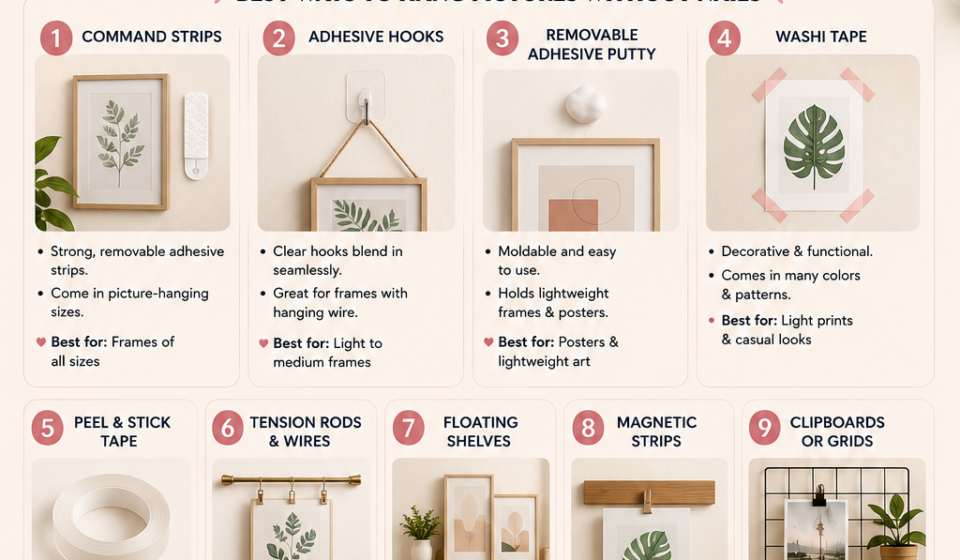
Method 1: Adhesive Hanging Strips (Command Strips)
Weight capacity: Up to 7.25 kg (16 lbs) per pair of interlocking strips Best for: Most frames on drywall, plaster, and tile Not recommended for: Wallpaper, rough or heavily textured surfaces
Adhesive hanging strips — most famously made by Command (a 3M brand) — are the most widely used and most trusted damage-free hanging solution available. They work using a system of interlocking adhesive strips that bond to both the wall and the back of the frame, distributing the weight across the adhesive surface rather than concentrating it at a single point.
The reason these products have become so popular is not just their holding power — it is the removal mechanism. Command strips are designed to be removed by stretching the adhesive tab straight down along the wall surface, which releases the bond cleanly without pulling paint or leaving residue behind. When used correctly on the right wall surfaces, they truly leave no trace.
How to use adhesive hanging strips correctly:
Step 1: Clean and completely dry the wall surface where you plan to hang. Wipe with a slightly damp cloth, then allow to dry for at least 30 minutes.
Step 2: Separate the interlocking pairs of strips and attach one side of each pair to the back of the frame, pressing firmly for 30 seconds. The number of strip pairs needed depends on the weight of the frame — follow the package guidance.
Step 3: Press the frame against the wall in the position you want it, then press firmly for 30 seconds.
Step 4: Remove the frame from the wall. The wall-side portion of the strip remains attached. Press the wall-side strips firmly for 30 seconds to ensure a strong bond directly with the wall surface.
Step 5: Allow the adhesive to bond for the manufacturer’s recommended time — typically one hour — before hanging the frame. Most failures with adhesive strips come from hanging immediately after application before the bond has fully set.
Step 6: Reattach the frame. The interlocking strips click together firmly.
Tips for best results:
- Do not use on surfaces painted with flat or matte paint — the paint itself can pull away during removal on low-sheen surfaces. Satin, semi-gloss, and gloss paints hold much better.
- Do not expose to sustained humidity (bathrooms, kitchens near steam) above the product’s rated tolerance.
- Never exceed the weight rating for the strip combination you are using.
Method 2: Adhesive Hooks
Weight capacity: Varies widely — typically 450g to 7.25 kg per hook Best for: Lightweight to medium-weight frames with a hanging wire or D-ring on the back Not recommended for: Heavy mirrors, frames without hanging hardware
Adhesive hooks attach to the wall using the same removable adhesive technology as hanging strips but in a hook format — ideal for frames with hanging wire, keyhole slots, or D-rings on the back. They are particularly useful for picture frames that are not flat enough on the back for direct strip application.
How to use adhesive hooks:
Clean the wall surface thoroughly and allow to dry. Remove the adhesive backing from the hook and press firmly against the wall for 60 seconds. Allow to set for the recommended bonding time (typically one hour) before hanging anything on the hook. Hang the frame’s wire or D-ring on the hook.
For heavier frames, use two hooks placed level with each other at the correct distance to match the frame’s hanging hardware — this distributes the weight and keeps the frame level without additional effort.
Method 3: Picture Hanging Strips Without Nails (Velcro / Hook-and-Loop Systems)
Weight capacity: Up to 4 kg per pair Best for: Canvas prints, lighter frames, fabric wall art Not recommended for: Heavy frames, glass-fronted frames
Hook-and-loop hanging systems (similar in principle to Velcro) use interlocking fabric or plastic surfaces rather than adhesive interlocking tabs. One surface attaches to the wall, the other to the back of the frame, and the two surfaces press together to hold the frame securely.
These systems are particularly gentle for removal and work well on a wider range of surfaces than some adhesive strip products. They also allow easy repositioning — simply pull the frame away from the wall and reattach it elsewhere.
Method 4: Removable Adhesive Putty (Blu-Tack / Museum Putty)
Weight capacity: Typically 100g to 500g per application Best for: Very lightweight frames, posters, cards, children’s art Not recommended for: Heavy frames, glass frames, anything requiring precision levelling
Removable adhesive putty — sold under brand names including Blu-Tack, UHU Patafix, and Loctite Fun-Tak — is the most accessible and zero-preparation hanging solution available. It is a soft, malleable adhesive that can be pressed against any clean, dry surface and holds lightweight items securely.
Putty is most suited to lightweight paper posters, thin card prints, children’s artwork, and very small lightweight frames. It is not suitable for anything with real weight — heavy frames will gradually pull away from the wall as the putty slowly deforms under sustained load.
How to use adhesive putty effectively:
Roll a small ball of putty between your fingers until it becomes soft and slightly warm. Press a small amount into each corner of the poster or frame’s back, then press firmly against the wall surface. For better hold, use more putty across the top edge where the weight pull is greatest.
For removal, peel away from the wall slowly and roll any residue off the wall surface with a clean ball of putty. Most surfaces come away clean, though putty can occasionally leave a slight oily mark on very porous surfaces — test in an inconspicuous spot first.
Method 5: Mounting Tape
Weight capacity: Up to 2 kg depending on the product and application area Best for: Smooth-backed frames, lightweight canvas boards, mirrors on smooth surfaces Not recommended for: Heavy items, rough surfaces, wallpaper
Double-sided mounting tape is a step up from putty in terms of structural holding ability. It is a foam or film-based tape with aggressive adhesive on both sides, designed for permanent or semi-permanent mounting of lightweight objects to smooth surfaces.
Mounting tape works best for items that will not need to be repositioned — unlike Command strips, most mounting tape is not designed for clean, damage-free removal and may pull paint when removed. However, for lightweight items on surfaces you are comfortable with, it is a simple, inexpensive, and very reliable solution.
How to use mounting tape:
Cut strips of mounting tape to fit along the back edges of the frame. Remove one backing, apply to the frame, then remove the remaining backing and press the frame firmly against the wall surface. Hold for 60 seconds and allow to set for 30 minutes before releasing.
Method 6: Picture Rails and Rail Hooks
Weight capacity: Very high — limited primarily by the rail installation, not the method Best for: Heavy frames, gallery walls, frequently changed artwork Not recommended for: Ceilings without a picture rail moulding
Picture rails are horizontal mouldings installed near the ceiling that allow pictures to be hung from hooks that drop over the rail and wire that hangs down to the frame. Many older homes — particularly Victorian and Edwardian properties — already have picture rails installed. In homes with picture rails, this is the most elegant, highest-capacity, and most flexible hanging solution available.
Picture rail hooks are simply placed over the rail (no tools, no adhesive) and adjusted to any position along the rail. The hanging wire or chain drops from the hook to the back of the frame. Multiple frames can be hung at different heights on the same rail, and repositioning takes seconds.
For homes without picture rails, stick-on picture rail hooks that adhere to the wall below the ceiling are available. These have lower weight limits than traditional rails but provide the same flexibility for lightweight to medium-weight frames.
Method 7: Tension Rods with Hanging Clips
Weight capacity: Medium — depends on the tension rod and clip type Best for: Gallery walls of prints, fabric art, lightweight frames, seasonal displays Not recommended for: Heavy framed pieces, single statement pieces
Tension rods — spring-loaded rods that press against opposing walls without any attachment hardware — can be used horizontally to create a picture hanging rail effect. Binder clips, S-hooks, or purpose-made hanging clips hold prints and lightweight frames along the rod.
This method is particularly popular in rental properties, children’s rooms, and spaces where displays are changed frequently. It requires no wall contact at all — the rod is held in place entirely by spring tension against the two opposing walls.
How to set it up:
Extend the tension rod to slightly beyond the width of the space you are spanning. Place it horizontally where you want your display. Use binder clips, S-hooks, or hanging clips to suspend prints, photos, or lightweight frames at different intervals along the rod. Items can be repositioned in seconds simply by sliding the clips along the rod.
Method 8: Suction Cups
Weight capacity: Varies — typically 500g to 2 kg for good-quality suction cups Best for: Glass, mirror surfaces, tiles, and other smooth non-porous surfaces Not recommended for: Textured walls, drywall, plaster, painted surfaces
Suction cups work through air pressure — the cup is pressed against a smooth, non-porous surface, creating a vacuum that generates holding force. They are the only practical wall-free hanging solution for glass surfaces (such as hanging items on a window or on a glass partition) and work very well on ceramic tile and smooth stone.
Suction cups are unreliable on porous, textured, or painted surfaces where a proper vacuum seal cannot form. Use them only on smooth, clean, non-porous surfaces.
Tips for maximum suction cup performance:
Clean both the suction cup and the surface with a damp cloth and allow both to dry completely. Lick the rim of the suction cup just before pressing it against the surface — the moisture improves the initial seal. Press firmly while twisting slightly to eliminate air pockets. Allow to set for five minutes before hanging.
Suction cups lose their hold gradually as small amounts of air leak back into the vacuum over time. Check and re-press periodically, and do not use near the weight limit of the cup’s rating.
Method 9: Washi Tape and Decorative Tape Displays
Weight capacity: Very low — for paper, card, and very lightweight prints only Best for: Paper prints, postcards, photos, children’s artwork, temporary displays Not recommended for: Framed pictures, anything with weight
For lightweight paper prints, photographs, and postcards, washi tape and decorative masking tape offer a charming, visually interesting hanging solution that doubles as part of the display. Strips of tape placed across the corners or along the top edge of a print create a gallery-style display with the tape itself visible as a design element.
Washi tape is low-tack by nature — it is designed to be repositioned and removed cleanly from most surfaces without damage. This makes it ideal for temporary displays, rotating art collections, and frequent refreshes. It is not suitable for anything with weight — it will hold a single sheet of paper reliably but nothing heavier.
Creative applications: Use washi tape to create a grid pattern on the wall and attach small prints at each intersection. Mix different washi tape patterns for a more decorative effect. Use a single long strip of washi tape as a “washing line” and clip small photos along it with mini clothespins.
Method 10: Magnetic Hanging Systems
Weight capacity: Varies — typically up to 2 kg for consumer magnetic systems Best for: Metal-backed frames, prints with magnetic backing, gallery systems Not recommended for: Very heavy frames, surfaces incompatible with adhesive base plate
Magnetic hanging systems use a magnetically adhesive plate that attaches to the wall and a corresponding magnetic element on the back of the frame or print. The magnetic force holds the frame against the wall without nails, screws, or visible hardware.
These systems are particularly elegant for lightweight framed prints and photos because the frame appears to simply float against the wall with no visible hanging mechanism. Many modern frame brands now include magnetic hanging systems as part of their product design.
The wall-side plate is attached using the same adhesive technology as Command strips and shares the same surface requirements and weight limitations.
Hanging Heavy Pictures Without Nails
Most nail-free methods have weight limits that exclude heavy frames, large mirrors, and substantial canvas art. If you have a genuinely heavy piece to hang without nails, your options narrow but do not disappear:
Heavy-duty adhesive strip systems are available specifically rated for higher weights — up to 7.25 kg with a single pair, and higher with multiple pairs used in combination. Always check that you are within the combined rating for the number of strip pairs used.
Leaning: The simplest solution for heavy pieces is not to hang them at all — lean them against the wall on the floor or on a shelf ledge. Oversized mirrors and large canvas art look deliberately styled when leaned rather than hung, and there is no weight limit concern.
Picture ledges: Floating shelves designed as picture ledges allow frames to be displayed without any wall attachment to the frame itself — only the shelf bracket attaches to the wall (with screws for heavy duty use), and the frame simply rests on the ledge. This is a particularly elegant solution for grouping multiple frames of different sizes.
Professional adhesive mounting solutions: Some professional adhesive mounting products rated for significantly higher weights are available at specialist hardware stores. These are typically permanent rather than removable and are best for items you plan to keep in the same position indefinitely.
Tips for Creating a Gallery Wall Without Nails
A gallery wall — a curated collection of multiple frames arranged together on a single wall — is one of the most popular home décor projects, and it is entirely achievable without nails.
Plan before you stick. Lay all the frames on the floor in your planned arrangement before attaching anything to the wall. Live with the arrangement for a day to make sure you love it before committing.
Use paper templates. Trace around each frame on paper, cut out the shape, and use low-tack tape to temporarily attach the paper templates to the wall in your planned arrangement. This allows you to test the layout, adjust spacing, and mark the exact positions before applying any adhesive strips.
Work from the centre out. When attaching frames to the wall, start with the centremost frame and work outward. This ensures the overall arrangement is centred on the wall as intended.
Use a spirit level. Even the smallest tilt in an individual frame is noticeable in a gallery arrangement. A small spirit level placed on top of each frame after hanging catches any lean before it becomes the feature everyone notices.
Mix hanging methods as needed. In a gallery wall with frames of different weights, you may use heavy-duty strips for the larger frames and putty or lighter strips for the smaller ones. Mixing methods within a gallery wall is entirely fine — the results are invisible once the frames are in place.
Frequently Asked Questions
Will Command strips damage my walls when removed? When used correctly on appropriate surfaces (satin, semi-gloss, or gloss painted drywall or plaster, tile) and removed by stretching the tab straight down as directed, Command strips are designed to leave no damage or residue. Damage is most common when: the tab is pulled out rather than stretched down, the paint finish is flat or matte (which the paint can pull away from the wall), the wall surface was not thoroughly cleaned before application, or the weight limit was exceeded.
Can I hang pictures without nails on a rental property? Yes — this is one of the primary use cases these products are designed for. Command strips, adhesive hooks, putty, tension rods, and picture ledges are all renter-friendly options. Always check the specific terms of your tenancy agreement if you are uncertain, as policies vary. Document the wall condition before decorating.
How much weight can adhesive strips hold? Command strips’ weight capacity ranges from approximately 450g for small strips to 7.25 kg per interlocking pair for the large heavy-duty format. Multiple pairs can be used in combination for heavier frames, but the combined weight limit is not simply additive — follow the manufacturer’s guidance on the specific combination required for each weight range.
What is the best way to hang a heavy mirror without nails? For mirrors too heavy for adhesive strips, leaning the mirror against the wall (floor-leaning or on a shelf ledge) is the safest and most elegant nail-free solution. Mirror-specific adhesive strip products rated for higher weights are also available for mirrors up to approximately 7 kg. For heavier mirrors, professional installation with appropriate wall anchors is the safest approach.
Can I use Command strips on wallpaper? Most manufacturers explicitly advise against using adhesive strips on wallpaper, as removal can pull the wallpaper from the wall surface. Putty, picture rails, or tension rod systems are better options for wallpapered walls.
How do I hang pictures on a brick wall without drilling? For brick walls, adhesive solutions specifically formulated for masonry and concrete surfaces work better than standard paper/drywall strips, though weight capacities are lower due to the porous surface. Heavy-duty suction cup hooks work if the brick is glazed or painted smoothly. Leaning artwork against a brick wall is also a very popular and stylish option that requires no attachment at all.
Final Thoughts
Hanging pictures without nails is no longer a compromise — it is often the smarter, more flexible, and more practical choice. The range of solutions available today covers virtually every combination of wall type, frame weight, surface finish, and decorating situation. From the heavy-duty reliability of Command strips for medium-weight frames to the zero-wall-contact elegance of a tension rod gallery, there is a nail-free method that works beautifully for your specific situation.
The key principles are universal across all methods: know the weight of what you are hanging, choose a method rated for that weight, prepare the surface properly, follow the manufacturer’s instructions for bonding time, and never exceed the recommended capacity.
Do that, and your pictures will stay exactly where you put them — without a single hole in the wall to show for it.