
False nails are one of the most transformative beauty shortcuts available — capable of giving you the length, shape, and polished appearance of a professional manicure in minutes. But whether your false nails were professionally applied at a salon, came from a press-on kit you applied yourself, or were fixed on with nail glue for a special occasion, there comes a point when you need them off. And how you remove them matters enormously.
Getting rid of false nails the wrong way — peeling, prying, biting, or forcing them off — is one of the most common causes of nail damage in beauty. The thin, papery, sore nails that people often blame on the false nails themselves are almost always the result of improper removal rather than the nails themselves. Done correctly, false nail removal leaves your natural nails largely intact and ready to recover quickly.
This complete guide covers everything you need to know about how to get rid of false nails safely at home — regardless of what type they are. From quick press-on removal to the longer acetone soak required for acrylics, from the foil wrap technique for gel tips to the gentle warm water approach for basic glue-on nails, you will find the right method for your specific situation here. Along with each removal method, you will find the aftercare advice that makes the difference between nails that recover quickly and nails that struggle for weeks.
Understanding Your False Nails: Why the Type Matters
The single most important thing to establish before attempting removal is what type of false nails you actually have. Different types are attached using different adhesives and methods, and they respond to completely different removal approaches. Using the wrong method wastes time at best and damages your nails at worst.
Press-On Nails
Press-on nails are pre-shaped artificial nails — typically made from ABS plastic — that come in sets and are applied using either adhesive tabs (stickers) or nail glue. They sit on top of the natural nail and, depending on how they were applied, can last anywhere from a single day (with tabs) to a week or more (with glue).
Press-ons applied with adhesive tabs are the easiest false nails to remove and require the least effort and preparation. Press-ons applied with nail glue need a bit more care.
Glue-On Nails
Similar to press-ons but sometimes referring specifically to nails sold without built-in adhesive tabs, requiring the user to apply their own nail glue. Removal approach is identical to press-ons applied with nail glue.
Acrylic Nails
Acrylic nails are the most durable and the most involved to remove. Created by combining a liquid monomer with a powder polymer that hardens to create a rigid, sculptured nail extension, acrylics form a very strong chemical bond with the natural nail surface and require sustained acetone soaking to remove safely.
Gel Nail Tips and Extensions
Gel tip extensions — artificial tips applied using gel adhesive and shaped with builder gel — are another common format. Like acrylic nails, they require acetone and patience to remove, though standard soak-off gel dissolves more quickly than acrylic in acetone.
SNS / Dip Powder Nails
Dip powder nails use a base coat, coloured acrylic powder, and a top coat — no UV lamp required. They are typically softer than hard gel or acrylic and respond to acetone soaking, though they may require a slightly different approach.
What You Need for False Nail Removal
The supplies required depend on the type of false nails you have, but assembling a complete kit before starting means you won’t have to stop mid-process.
For press-ons with adhesive tabs:
- A cuticle pusher or orangewood stick
- Warm water (optional)
- Cuticle oil and hand cream
For press-ons or glue-on nails with nail glue:
- 100% pure acetone or acetone-based nail polish remover
- Cotton balls or cotton pads
- A bowl of warm water (optional — for the soak method)
- A cuticle pusher or orangewood stick
- Nail buffer
- Cuticle oil and hand cream
For acrylic nails:
- 100% pure acetone
- Nail clippers
- A coarse nail file (100 to 150-grit)
- Cotton balls
- Aluminium foil cut into fingertip-sized rectangles, OR nail soaking clips
- A cuticle pusher or orangewood stick
- Soft nail buffer
- Petroleum jelly (for skin protection)
- Cuticle oil and rich hand cream
For gel tips and extensions:
- 100% pure acetone
- A nail file (180-grit)
- Cotton balls
- Aluminium foil or soaking clips
- A cuticle pusher
- Soft nail buffer
- Cuticle oil and hand cream
Method 1: Removing Press-On Nails with Adhesive Tabs
Press-on nails attached with adhesive tabs — the peel-and-stick stickers included in most press-on kits — are the easiest false nails to remove and the gentlest on your natural nails. The adhesive is designed to be temporary, and with the right approach, the nails lift away cleanly in minutes.
Step 1: Soak in Warm Water
Fill a bowl with comfortably warm water and soak your fingertips for five to ten minutes. Warm water softens and loosens the adhesive tab bond, making removal significantly easier and more comfortable. You can add a small amount of dish soap to the water for additional softening effect.
Step 2: Gently Work the Edges
After soaking, use a cuticle pusher or orangewood stick to very gently work the tip of the tool beneath the free edge of the press-on nail at the side where it has begun to separate from the natural nail. Do not lever or prise — use gentle, sliding pressure to ease the nail away from the adhesive tab beneath it.
Work slowly around the edges of the nail, loosening progressively from the sides toward the base. If any significant resistance is felt, soak for an additional five minutes before trying again.
Step 3: Slide the Nail Off
Once the edges are sufficiently loosened, the press-on nail should slide forward off the natural nail with minimal effort. If it does not come free easily, return to soaking rather than increasing force.
Step 4: Remove Adhesive Tab Residue
Any adhesive tab sticker remaining on the natural nail surface can be rolled away using the clean pad of your finger in circular motions, or dissolved with a small amount of nail polish remover on a cotton pad. The sticker residue should lift easily.
Step 5: Buff and Moisturise
Use a soft nail buffer to gently smooth the natural nail surface, then apply cuticle oil and hand cream generously.
Method 2: Removing Press-On or Glue-On Nails Applied with Nail Glue
Nail glue (cyanoacrylate adhesive) creates a stronger bond than adhesive tabs and requires acetone to dissolve safely. Do not attempt to force or peel nails applied with nail glue — the bond is strong enough to pull surface layers of the natural nail away with it.
Option A: The Acetone Soak Bowl Method
Step 1: If the press-on nails are long, clip them shorter before beginning. Less material means less surface for the acetone to work through.
Step 2: Pour enough acetone or acetone-based nail polish remover into a glass or ceramic bowl to submerge your fingernails. Do not use plastic bowls as acetone degrades many plastics.
Step 3: Apply petroleum jelly or thick hand cream to the skin around each nail and on the fingers themselves — everywhere except the nail surface — to protect from prolonged acetone exposure.
Step 4: Submerge your fingertips in the acetone and soak for 15 to 20 minutes. Check one nail at the 10-minute mark. The nail glue softens as acetone dissolves it, and you should begin to feel the press-on nail becoming loose.
Step 5: When the glue has softened sufficiently, the press-on nail will lift or slide away from the natural nail with minimal pressure from a cuticle pusher. Do not force nails that still feel firmly attached — re-soak for five more minutes.
Step 6: Buff any remaining glue residue from the natural nail surface gently with a soft buffer. Wash hands thoroughly and apply cuticle oil and hand cream immediately.
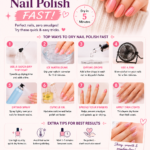
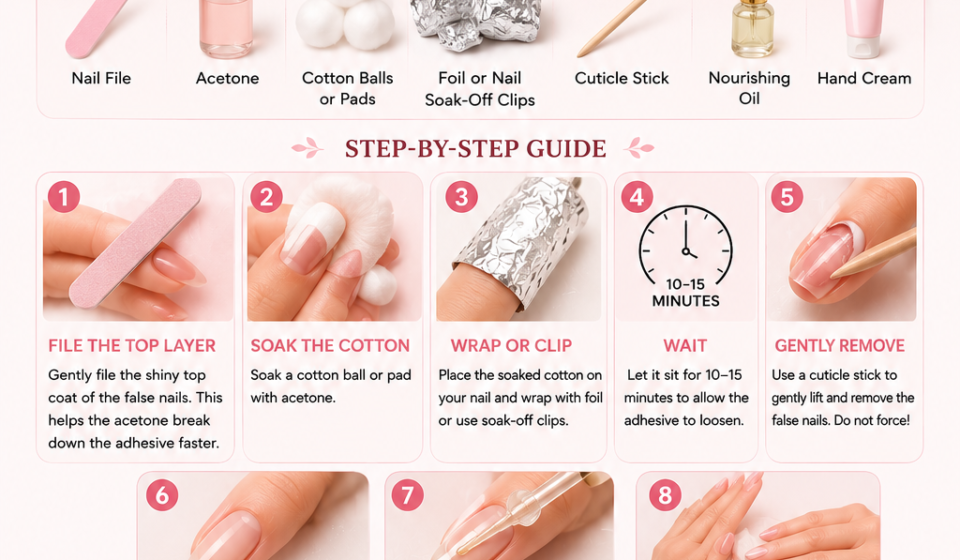
Option B: The Foil Wrap Method
For a more targeted approach that exposes less skin to acetone:
Step 1: Soak a small piece of cotton ball in 100% pure acetone until saturated.
Step 2: Place the cotton directly over the nail and wrap tightly with a small piece of aluminium foil to hold it in place and trap heat.
Step 3: Wait 10 to 15 minutes. The concentrated acetone contact dissolves the glue from the nail surface.
Step 4: Unwrap and gently slide the press-on nail away using a cuticle pusher. If it resists, rewrap with fresh acetone-soaked cotton and wait another five minutes.
Step 5: Buff, wash, and moisturise.
Method 3: Removing Acrylic Nails
Acrylic nails are the most substantial type of false nail and require the most time and care to remove correctly. The rigid acrylic material is created through a chemical polymerisation process and bonds very strongly to the natural nail surface. Acetone gradually swells and softens the acrylic so it can be gently pushed away — a process that takes patience but leaves natural nails in far better condition than any forcing or peeling approach.
Step 1: Clip the Length Down
Using nail clippers, clip the acrylic nails as short as possible without cutting into the natural nail beneath. The less acrylic material you leave, the less your soak time will be.
Step 2: File the Surface
Using a coarse file (100 to 150-grit), file the top surface of each acrylic nail to remove the shine and thin the bulk of the acrylic layer. File until the surface is completely matte and the nails feel noticeably thinner. Do not file through to the natural nail — stop when you start to feel resistance change or can see the natural nail colour.
This step is critical — filing breaks the sealed surface and allows acetone to penetrate the acrylic immediately rather than sitting on the surface.
Step 3: Protect the Surrounding Skin
Apply petroleum jelly or thick cuticle oil to all the skin surrounding each nail — the cuticle area, the nail folds on either side, and the fingertip — but not onto the acrylic surface itself. This protects skin from prolonged acetone exposure.
Step 4: Apply Acetone and Wrap
Saturate a cotton ball piece with 100% pure acetone. Place it directly over the nail surface, covering the entire acrylic area. Wrap a rectangle of aluminium foil tightly around the fingertip to hold the cotton in place, seal in heat, and slow acetone evaporation.
Repeat for all ten fingers. Nail soaking clips can be used instead of foil as a reusable alternative.
Step 5: Wait 25 to 40 Minutes
This is the non-negotiable part of acrylic removal. Set a timer for 25 minutes as a minimum for standard acrylic. Thicker builds or older nails may need the full 40 minutes. Do not remove the wraps early to check progress — doing so breaks the heat seal and adds time overall.
Step 6: Test and Remove
Unwrap one finger and use a cuticle pusher to gently press against the acrylic from the cuticle end. If it has softened properly, it will feel rubbery or gummy and slide away from the nail with very light pressure. If it resists, rewrap with fresh acetone-soaked cotton and wait another ten minutes.
Work one nail at a time, sliding the softened acrylic off gently. Never scrape or force.
Step 7: Buff, Wash, and Moisturise
Use a soft buffer to smooth any remaining residue. Wash hands thoroughly with soap and water to remove all acetone. Apply cuticle oil generously to each nail and massage in for 30 seconds per nail. Follow with rich hand cream over the full hand.
Method 4: Removing Gel Nail Tips and Extensions
Gel tip extensions use a soak-off gel or builder gel to create and bond the nail tip. Standard soak-off gel dissolves in acetone faster than acrylic — typically within 10 to 20 minutes — but hard gel extensions may not dissolve at all and require filing instead.
Step 1: Establish the Gel Type
If your gel tips were applied at a salon, ask your technician whether they used soak-off gel or hard gel. Soak-off gel dissolves in acetone. Hard gel does not and must be filed away — attempting to soak hard gel tips produces little result and wastes significant time.
Step 2: File the Surface
Using a 180-grit file, lightly buff the entire surface of each gel nail until the shine is completely gone. This breaks the sealed polymerized surface and allows acetone to penetrate immediately.
Step 3: Apply Acetone and Wrap
Follow the same foil wrap process as described for acrylic removal: saturate cotton with 100% pure acetone, place over the nail, wrap tightly with foil. Protect surrounding skin with petroleum jelly first.
Step 4: Wait 15 to 20 Minutes
Standard soak-off gel requires less time than acrylic. Check one nail at 15 minutes — the gel should feel soft and begin to lift at the edges. If it is still firm, wait another five minutes.
Step 5: Remove Gently
Use a cuticle pusher to gently slide the softened gel away from the natural nail. Work from the cuticle toward the tip. If any sections resist, do not force — re-wrap with fresh acetone and wait longer.
Step 6: Buff, Wash, and Moisturise
Buff the natural nail surface gently, wash hands thoroughly, and apply cuticle oil and hand cream immediately.
Method 5: Removing SNS / Dip Powder Nails
Dip powder nails sit in terms of removal difficulty between press-ons with glue and full acrylics. They are softer than hard acrylic but still require acetone soaking for safe removal.
Step 1: File the Surface
Use a 180-grit file to buff off the shiny top coat layer and break the surface seal. Dip powder is typically softer than acrylic and files away relatively quickly.
Step 2: Soak with Acetone
Use either the foil wrap method (10 to 15 minutes) or the bowl soak method (10 to 20 minutes) with 100% pure acetone. Dip powder softens and begins to dissolve more readily than acrylic once the surface is broken.
Step 3: Remove with Cuticle Pusher
The softened dip powder will slide away from the nail surface with gentle pressure. Any remaining residue can be loosened with additional brief acetone contact and wiped away.
Step 4: Buff, Wash, and Moisturise
Follow the standard finishing routine — gentle buffing, thorough washing, immediate and generous moisturising.
The Most Common False Nail Removal Mistakes
Peeling or Pulling False Nails Off
This is the most damaging removal mistake — and the most tempting. When a press-on or glue-on nail begins to lift at the edges, the instinct to simply pull it the rest of the way off is almost irresistible. Resist it entirely. False nails bond to the surface layer of the natural nail, and pulling them free tears that surface away. The result is nails that are visibly thin, sensitive to touch, and prone to peeling for weeks. No matter how close to coming off the nail looks, complete the proper removal process.
Using Regular Nail Polish Remover Instead of Pure Acetone
Regular nail polish remover — even acetone-based formulas — contains acetone at too low a concentration to dissolve nail glue or acrylic efficiently. You may succeed eventually with very long soaking times, but the process will be significantly slower, more drying to skin and nails, and often incomplete. For any false nail attached with professional nail glue or acrylic, 100% pure acetone is the right product.
Not Filing the Surface Before Soaking
The shiny sealed surface of acrylics, gel tips, and dip powder nails prevents acetone from penetrating effectively. Skipping the filing step adds fifteen to twenty minutes to the soaking process at minimum and often produces incomplete results. Two minutes of filing before soaking is one of the highest-return preparation steps in the entire removal process.
Removing Too Early and Scraping
If the false nail resists gentle cuticle pusher pressure after soaking, it is not ready. The correct response is always to re-wrap with fresh acetone and wait longer — never to press harder, use a metal tool aggressively, or scrape. Scraping removes natural nail material along with the adhesive or acrylic and is a primary cause of nail thinning after false nail wear.
Skipping Aftercare
Acetone exposure — particularly during the extended soaks required for acrylic removal — is significantly drying to both nails and skin. Skipping cuticle oil and hand cream after removal leaves nails dehydrated and brittle at exactly the moment when they are most in need of nourishment. The aftercare routine is not optional — it is the completion of a process that protects your nail health.
How to Care for Natural Nails After False Nail Removal
Natural nails after false nail wear typically need a period of recovery — how long depends on how long the false nails were worn, how they were removed, and the underlying health of the natural nail.
Immediately After Removal
Apply cuticle oil to every nail and massage it in thoroughly for at least 30 seconds per nail. Cuticle oil penetrates the nail plate and replaces the moisture that acetone removes, helping to restore flexibility and prevent brittleness. Follow with rich hand cream applied generously over the full hand.
The First Week
Continue applying cuticle oil morning and evening every day. Use a strengthening or hardening base coat on bare nails — this adds a protective layer while the nail plate recovers its natural thickness and resilience. Avoid prolonged water exposure and wear gloves for cleaning and washing dishes, as water exposure weakens already-compromised nails.
Keeping Nails Short During Recovery
Keep natural nails trimmed short during the recovery period. Short nails experience significantly less mechanical stress than long ones and are much less likely to break or peel during the weeks when the nail plate is rebuilding strength. Short, well-maintained natural nails also grow back more evenly than long nails that have been weakened by a break.
Nutrition for Nail Recovery
What you eat directly affects how quickly and strongly your nails recover. Protein provides the amino acids needed for keratin production. Biotin (vitamin B7) supports nail thickness and strength. Iron and zinc both play roles in nail plate health. Increasing your intake of eggs, lean meat, nuts, seeds, and leafy greens in the weeks following false nail removal supports faster recovery.
When to Consider a Break from False Nails
If your natural nails are significantly thinned, flexible, or peeling after removal, give them a longer break before reapplying. Two to four weeks of bare nail recovery with consistent moisturising and strengthening treatment is typically enough to restore reasonable nail health. After extended continuous false nail wear, a longer break — four to eight weeks — gives the nail plate time for full recovery.
Frequently Asked Questions
How long does it take to remove false nails at home? It depends entirely on the type. Press-ons with adhesive tabs: 15 to 20 minutes including soaking. Press-ons with nail glue: 20 to 30 minutes. Acrylic nails: 60 to 90 minutes including preparation, soaking, and aftercare. Gel tip extensions: 40 to 60 minutes. Allow enough time to complete the process properly — rushing produces damage.
Can I remove false nails without acetone? For press-ons with adhesive tabs, yes — warm water alone is often sufficient. For nails applied with nail glue or professional adhesive, warm soapy water soaking can loosen the bond over a longer period (20 to 30 minutes) but is far less effective than acetone. For acrylics and gel tips, there is no practical acetone-free home removal method that doesn’t involve filing the false nail material away entirely.
Will removing false nails damage my natural nails? Correct removal technique does not cause significant damage beyond temporary dryness from acetone exposure. The nail damage that people associate with false nails is almost always caused by improper removal — particularly peeling, forcing, or scraping. With the methods described in this guide, natural nails emerge largely intact and recover fully with proper aftercare.
What is the fastest way to get rid of false nails? For press-ons with tabs: the warm water soak method. For glue-on or press-ons with nail glue: the acetone bowl soak method with warm acetone accelerates dissolution. For acrylics, thorough filing before soaking and warm acetone reduce the time to the lower end of the 25 to 40 minute range. There is no shortcut for the chemical process — but warm acetone and thorough preparation are the two factors that make the biggest difference to speed.
Why won’t my false nails come off even after soaking? If nails are not softening after adequate soaking time, the most common causes are: insufficient acetone (the cotton must be genuinely saturated), a loose foil wrap allowing acetone to evaporate, room-temperature or cold acetone that is less chemically active, or — for gel tips — the possibility that hard gel rather than soak-off gel was used. Try warming the acetone, re-saturating the cotton, wrapping more tightly, and extending the soak time.
Can I reuse press-on nails after removing them? Press-on nails removed carefully — particularly those with adhesive tabs — can often be reused once or twice if undamaged. Nails that were attached with nail glue are generally single-use as the glue residue is difficult to clean from the underside of the nail. Store reusable press-ons in their original packaging or a small container to prevent damage to the shape.
Final Thoughts
Getting rid of false nails safely comes down to one essential principle: let the chemistry do the work, never force. Whether you are easing a press-on nail free from a softened adhesive tab or patiently waiting for acetone to dissolve the acrylic that’s been on your nails for three weeks, the right approach is always the gentle one — and the gentle approach is always the faster one in the long run, because it avoids the damage that forces you to stop and restart.
Know your nail type. Choose the right method. Use the right product. Give it the time it needs. And always — always — moisturise when you are done.
Your natural nails will come through the process healthy, intact, and ready to recover quickly when you treat the removal with the same care you gave to the application.