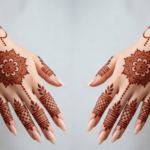
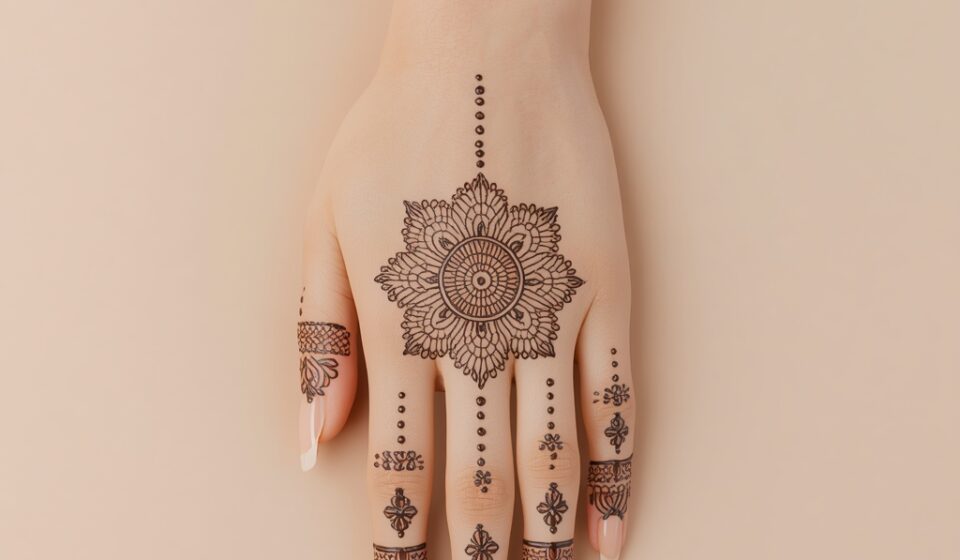

Mehndi, or henna, is far more than a temporary body modification; it is an ancient art form that has woven itself into the cultural, spiritual, and aesthetic fabric of human history across the globe. From the grand, opulent weddings of South Asia to the modern, minimalist fashion statements of the West, the application of henna paste to the skin remains a deeply cherished tradition. The image provided showcases a breathtaking example of modern, minimalist henna artistry—a design that beautifully bridges the gap between traditional intricacy and contemporary elegance.
At the heart of this stunning artwork is a perfectly symmetrical mandala, a geometric marvel that sits proudly on the back of the hand. This is not the heavily dense, full-coverage mehndi of eras past, where every millimeter of skin is concealed beneath thick layers of paste. Instead, it is a masterclass in the utilization of negative space, precision, and proportion. The pristine white acrylic nails provide a striking, high-contrast backdrop to the rich, dark brown, almost black, stain of the henna. Every dot, every scallop, and every teardrop shape is placed with calculated intention, creating a harmonious visual symphony that captivates the eye.
In this comprehensive guide, we will embark on a deep dive into the world of mehndi art, utilizing this specific mandala design as our anchor. We will explore the meticulous breakdown of its components, the botanical science that allows henna to stain the skin, the profound historical journey of the art form, and the step-by-step methodology required to recreate this exact masterpiece. Whether you are an aspiring henna artist, a bride-to-be seeking inspiration, or simply an admirer of intricate beauty, this exploration will provide you with an exhaustive understanding of the magic of mehndi.
Part 1: Visual Decoding of the Featured Mandala Masterpiece
To truly appreciate the design captured in the image, we must dissect its individual elements. This particular style is often categorized as “Indo-Western” or “Modern Arabic,” characterized by its focal points and the deliberate use of empty, bare skin to amplify the impact of the drawn lines.
The Central Mandala: The Heart of the Design
The word “mandala” is derived from the ancient Sanskrit language, meaning “circle.” In various spiritual traditions, particularly Hinduism and Buddhism, the mandala represents the universe, unity, and wholeness. In the context of this mehndi design, the mandala serves as the undeniable focal point.
- The Core: It begins with a tight, solidly filled circle, anchoring the center of the hand.
- The Floral Bloom: Radiating outward from the core are highly symmetrical, uniform petals, mimicking the bloom of a lotus or sunflower. These petals are defined by bold, thick outlines, which give the design a distinct three-dimensional pop.
- The Concentric Embellishments: Surrounding the petals are multiple concentric rings. The artist has utilized a combination of thin, delicate lines and bolder strokes to create depth.
- The Outer Frills: The outermost edge of the mandala features a scalloped border, topped with precise dots. At the four cardinal points (top, bottom, left, and right), the artist has added small, elegant leafy motifs that stretch slightly outward, breaking the perfect circle and guiding the eye along the contours of the hand.
The Finger Art: Symmetry and Sophistication
Often in traditional designs, the fingers are completely capped in solid henna paste. Here, the artist has chosen a much more refined, jewelry-like approach.
- Ring Illusions: Each finger, including the thumb, is adorned with what appears to be temporary, intricate rings. These are created using multiple parallel bands of varying thicknesses.
- Repetition of Form: To tie the fingers to the central mandala, the artist has incorporated miniature half-mandalas or floral crowns resting atop the band structures on each finger.
- The Fingertips: The design stops well before the nail bed, allowing the flawless nude-and-white manicure to stand out. This deliberate pause in the design ensures the hand does not look overcrowded.
The Wrist Cuff: Grounding the Artwork
Just above the wristbone, the design concludes with a beautifully structured cuff or bracelet.
- Parallel Precision: Similar to the fingers, the wrist is banded with thick and thin lines, encompassing a grid or woven pattern within.
- The Finishing Droplets: A central, teardrop-shaped floral motif hangs downward from the wristband, perfectly aligning with the central axis of the hand and the bottom tip of the main mandala. This creates a flawless line of symmetry that is incredibly pleasing to the human eye.
Part 2: The Botanical and Chemical Science of Henna
Before we can master the application, we must understand the medium. What is henna, and how does it magically transform from a green leafy powder into a rich mahogany stain on human skin?
The Lawsonia Inermis Plant
Henna comes from a flowering plant botanically known as Lawsonia inermis. This shrub thrives in hot, arid climates, specifically in regions across North Africa, the Middle East, and South Asia. The plant itself produces small, highly fragrant white or pink flowers, which are sometimes used in the production of perfumes. However, it is the leaves of the henna plant that hold the true treasure.
The Chemistry of the Stain: Lawsone
The magical staining agent within the henna leaves is a naphthoquinone derivative known as lawsone (2-hydroxy-1,4-naphthoquinone). In its natural state within the living leaf, lawsone is linked to sugar molecules and cannot stain the skin.
- Release: To release the dye, the leaves must be dried, crushed into a fine powder, and mixed with a slightly acidic liquid (like lemon juice or strong tea). The acid breaks the bonds holding the lawsone.
- Oxidation: Once the paste is applied to the skin, the lawsone molecules migrate from the paste into the outermost layer of the skin, the epidermis.
- Binding to Keratin: Lawsone has a natural, incredibly strong affinity for keratin, the protein that makes up our skin, hair, and nails. When the lawsone molecule meets keratin, it binds to it tightly.
- Color Maturation: When the paste is first removed, the stain is usually a bright, neon orange. Over the next 24 to 48 hours, as the skin is exposed to the air, an oxidation process occurs, darkening the lawsone to a rich reddish-brown, maroon, or cherry-black hue.
Essential Oils: The Terp Factor
Professional henna artists do not just use water and powder. They use “terps” (terpenes), which are found in specific essential oils. Oils like cajeput, eucalyptus, tea tree, and lavender act as natural solvents. When added to the henna paste, these essential oils help to extract more lawsone from the plant matter and drive the dye deeper into the skin layers, resulting in the incredibly dark stains seen in the reference image.
Part 3: The Deep-Rooted History and Cultural Tapestry of Mehndi
The stunning visual of a fully decorated hand is the culmination of thousands of years of human history. The practice of applying henna is deeply entrenched in the cultural DNA of numerous civilizations.
Ancient Origins
The exact birthplace of henna art is fiercely debated among historians, but evidence points to ancient Egypt as one of its earliest users. Mummies of pharaohs, most notably Ramses II, have been discovered with henna-stained fingers and toes. In these ancient times, henna was not just cosmetic; it was believed to possess magical and medicinal properties. The desert heat was grueling, and ancient peoples discovered that dipping their hands and feet in a paste made of crushed henna leaves provided a profound, long-lasting cooling effect to the body.
The Journey to South Asia
While it was used across the Middle East for centuries, henna truly found its spiritual and artistic home when it was introduced to the Indian subcontinent, largely believed to be during the Mughal Empire in the 12th century. The Mughals brought with them Persian aesthetics, which deeply influenced the intricate, swirling patterns that evolved into modern Indian bridal mehndi.
Symbolism in Celebrations
Today, the mandala design pictured above is not just for casual wear; it is deeply tied to joyous occasions.
- Weddings: In Hindu and Islamic traditions, the Mehndi Ki Raat (Night of Henna) is a major pre-wedding festivity. It is said that the darker the bride’s henna stain, the deeper the love of her future husband and the stronger her relationship with her mother-in-law. The intricate designs also serve a practical purpose: they force the bride to sit still, rest, and be pampered before the exhausting wedding day.
- Festivals: Mehndi is an integral part of major festivals such as Eid al-Fitr, Eid al-Adha, Diwali, Karva Chauth, and Teej. During Eid, women of all ages gather to adorn their hands with elegant designs, much like the one in our featured image, as a symbol of joy, renewal, and celebration.
Part 4: Formulating the Perfect Henna Paste
To achieve the razor-sharp lines and flawless dots of the featured mandala design, one cannot rely on mass-produced, chemical-laden store-bought cones. The secret to professional artistry lies in mixing the paste from scratch. Achieving the correct consistency is an art form in itself.
The Ingredients for Perfection
To create a high-quality, professional-grade henna paste, you require specific, pure ingredients:
- Body Art Quality (BAQ) Henna Powder: This is crucial. BAQ powder is triple-sifted, meaning it is entirely free of twigs, sand, or large leaf particles. This ultra-fine powder ensures the paste flows smoothly out of the smallest cone opening without clogging.
- Liquid: Lemon juice is the traditional favorite for its acidic properties, though many artists prefer strong brewed black tea, coffee, or even plain distilled water for a milder scent.
- Sugar: A vital ingredient. White sugar, fructose, or molasses is added to the paste to make it “stringy” and flexible. More importantly, sugar acts as a humectant. It draws moisture from the air, preventing the henna paste from drying out and cracking off the skin too quickly. The longer the paste stays moist on the skin, the deeper the stain.
- Essential Oils: As discussed, 100% pure therapeutic grade essential oils like lavender or cajeput are necessary to coax out the maximum amount of dye.
The Mixing Process
- Sifting: Even BAQ powder is often sifted through a fine nylon stocking to guarantee absolute purity.
- The Mix: The powder is combined with the liquid and sugar until it reaches a consistency resembling thick mashed potatoes.
- Dye Release: The bowl is covered with plastic wrap, pressed directly onto the surface of the paste to prevent a crust from forming. It is left in a warm place for 12 to 24 hours. The artist knows the dye has released when the surface of the paste turns a dark, oxidized brown, while the paste underneath remains a vibrant olive green.
- Final Adjustments: After dye release, essential oils are added. The paste is then thinned carefully with more liquid until it reaches the consistency of stringy toothpaste or warm honey. When a spoon is lifted from the bowl, the paste should fall in a smooth, continuous ribbon without breaking.
- Cone Preparation: The paste is meticulously loaded into hand-rolled cones made from cellophane. The tip is rolled incredibly tight, allowing for the micro-fine extrusion needed for the detailed concentric rings in our reference image.
Part 5: Step-by-Step Masterclass: Recreating the Mandala Masterpiece
Replicating the exquisite design shown in the image requires patience, a steady hand, and a systematic approach. The beauty of a mandala lies in its symmetry, meaning the artist must constantly maintain a sense of geographical awareness on the canvas of the hand.
Step 1: Preparation and Posture
Ensure the skin is entirely clean, free of any lotions, oils, or sweat, as these create a barrier that prevents the lawsone from binding to the keratin. The hand should be resting flat on a supportive surface. A comfortable artist makes for clean lines.
Step 2: Establishing the Epicenter
Every great mandala starts from a single point. Locate the exact center of the back of the hand.
- Squeeze a perfect, slightly enlarged dot of henna in the very center.
- Draw a tightly woven, thin spiral or a perfect circle directly around this dot. This is the seed from which the entire design will grow.
Step 3: Building the Concentric Foundation
The key to this design is contrasting line weights.
- Draw a second, slightly thicker circle around the first.
- Using incredibly light pressure on the cone, add a layer of tiny, uniform frills or scallops (often called “humps” by artists) resting on the thick circle. These must be identical in size to maintain symmetry.
- Draw another thin circle enclosing the frills to seal them in.
Step 4: The Floral Bloom
Now, we create the prominent petals that define the inner ring of the mandala.
- Lightly map out where the petals will go using tiny guide dots (e.g., at 12, 3, 6, and 9 o’clock, then filling in the spaces between).
- Draw the petals with a steady, sweeping motion.
- Once the outlines are perfect, return to each petal and add a thicker border to the inside or outside edge to create that bold, three-dimensional contrast seen in the image. Add a single, sharp line down the center of each petal.
Step 5: Expanding the Perimeter
- Enclose the petals with two more concentric circles—one thin, one slightly thicker.
- Create the outer border of larger scallops. To achieve the specific look in the image, these scallops should be bold.
- The Dot Work: Carefully place a single, uniform dot at the valley between each of the outer scallops. Perfect pressure control is essential here; every dot must be the exact same volume.
- Add the final leafy flourishes at the top, bottom, and sides to break the rigid circular shape and let the design breathe.
Step 6: Detailing the Fingers
Move to the fingers, starting with the middle finger to establish the central axis.
- Leave a generous gap of bare skin between the main mandala and the start of the finger designs. This negative space is what makes the design look modern and elegant rather than cluttered.
- Draw horizontal bands across the lower and middle phalanges of the fingers. Use a mix of thick foundation lines and thin detailing lines.
- Add the miniature half-florals pointing downwards towards the knuckles, mirroring the style of the central mandala.
- Finish with teardrop motifs and dots. Ensure the design stops symmetrically across all fingers, leaving the manicured tips bare.
Step 7: The Wrist Cuff
Finish by anchoring the design at the wrist.
- Draw two parallel, horizontal lines across the wrist.
- Fill the space between them with a delicate crisscross or grid pattern. Add tiny dots at the intersection of the grid lines for an added touch of luxury.
- Cap the top and bottom of the band with matching scallops.
- Carefully execute the final hanging teardrop/floral motif in the dead center, ensuring it aligns perfectly with the bottom point of the hand’s central mandala.
Part 6: The Vital Role of Negative Space in Modern Artistry
When analyzing the provided image, one of the most striking features is not just the henna itself, but the skin that is left bare. This is the concept of “negative space.”
In traditional Indian bridal mehndi, the goal was often horror vacui (the fear of empty space). Artists would cover the hands and arms entirely, weaving hidden names, figures, and dense paisley patterns until the skin was merely a background texture.
However, the modern era of mehndi, heavily influenced by global minimalism and geometric design trends, has reversed this philosophy. In the featured mandala design, the pristine, untouched skin around the central circle acts as a visual resting place. It provides a stark, bright contrast to the deep, intricate line work of the henna. This intentional use of negative space elevates the design from a traditional body covering to a piece of wearable, high-end jewelry. It draws the viewer’s absolute focus directly to the perfection of the mandala, making the artwork feel lighter, more breathable, and incredibly chic.
Part 7: Health and Safety Warning: The Peril of “Black Henna”
As we admire the stunning, almost black stain in the provided image, it is imperative to discuss a critical issue within the henna industry: the dangerous rise of so-called “Black Henna.”
The Myth of Natural Black Henna
Let us be unequivocally clear: there is no such thing as a plant that produces natural black henna. The Lawsonia inermis plant only produces a reddish-brown dye. When you see a henna artist mixing a powder with water and immediately achieving a jet-black, instantly drying stain, you are witnessing the use of dangerous chemicals.
PPD: A Hidden Danger
To achieve a rapid, black stain, unscrupulous vendors mix natural henna (or entirely synthetic bases) with Para-phenylenediamine (PPD). PPD is a highly toxic chemical commonly used in commercial dark hair dyes. While it is strictly regulated in hair dye (and meant to be washed off the scalp quickly), “black henna” cones contain dangerously high, illegal concentrations of PPD and are left on the skin to dry.
The Consequences
Applying PPD to the skin can cause severe, sometimes life-altering allergic reactions. Symptoms include blistering, chemical burns, intense weeping sores, and permanent scarring in the exact shape of the design. Furthermore, a severe reaction to PPD can sensitize an individual for life, meaning they can never safely dye their hair, use certain sunscreens, or wear black clothing dyes without triggering an extreme allergic shock.
The dark stain seen in our reference image is likely a mature, well-cared-for stain using pure, natural henna and essential oils (which can reach a very deep cherry-black or maroon after 48 hours of oxidation), or perhaps it was taken shortly after the paste was removed using Jagua (a natural fruit extract from the Amazon that stains blue-black). Always ask your artist about their ingredients. If the paste smells like chemicals, bleach, or ammonia, or if the artist claims it will stain black in 20 minutes, refuse the application.
Part 8: The Ultimate Aftercare Regimen
You have mixed the perfect paste and applied a flawless mandala design. However, the artist’s job is only half done. The darkness and longevity of a henna stain depend entirely on the aftercare provided by the wearer over the subsequent 48 hours. Henna is a partnership between the artist and the canvas.
1. The Incubation Period
Once the paste is applied, it will begin to dry. However, remember that lawsone is only released and absorbed when the paste is moist. The goal is to keep the paste on the skin, slightly warm, and slightly humid for as long as possible. Professional artists recommend leaving the paste on for a minimum of 6 to 8 hours, though many brides sleep with it on overnight (up to 12 hours).
2. The Sealant
To prevent the dried paste from cracking and flaking off too quickly, a traditional sealant is used. Once the henna is dry to the touch, gently dab a mixture of sticky lemon juice and sugar over the design using a cotton ball. The sugar binds the paste to the skin, while the acid in the lemon juice keeps the paste moist and active.
3. Heat Therapy
Lawsone loves heat. Applying gentle warmth helps open the pores of the skin, allowing the dye to penetrate deeper. While the paste is on, you can hold your hands over the gentle steam of boiling water (with caution) or warm them near a space heater. In cooler climates, wrapping the hands in medical tape (Mefix) or wrapping them in toilet paper and wearing warm socks over the hands to bed traps body heat and guarantees a stellar stain.
4. The Removal (No Water!)
When it is finally time to remove the paste, do not wash it off with water. Water interrupts the oxidation process and will drastically lighten your final result. Instead, gently scrape the dried paste off using a butter knife, a credit card, or simply by rubbing your hands together. If the paste is stubborn, use a natural oil like coconut or olive oil to gently massage it away.
5. The Vicks Vaporub Hack
Once the paste is scraped off, your stain will be a bright, alarming pumpkin orange. Do not panic; this is normal! To accelerate the darkening process, many South Asian women swear by applying a generous layer of Vicks VapoRub or Tiger Balm over the fresh orange stain. The menthol and eucalyptus oils in these balms create localized heat on the skin and act as a terpene, driving the oxidation process into overdrive.
6. The Oxidation Window
For the first 24 hours after removal, keep the area completely away from water. When you must shower or wash your hands, coat the design in a heavy barrier like shea butter, coconut oil, or petroleum jelly to waterproof it. Over the next two days, you will watch the color magically transform from bright orange to red, to crimson, and finally to the deep, luxurious mahogany shown in the reference image.
Part 9: The Global Evolution and Future of Mehndi
The image we are analyzing represents a distinct moment in the evolution of body art. Mehndi has successfully transitioned from a localized ethnic tradition to a globally recognized art form.
The Influence of Social Media
Platforms like Instagram, Pinterest, and TikTok have revolutionized the henna industry. Artists from India, the UK, the Middle East, and the USA can share techniques in real-time. This digital cross-pollination is exactly what birthed the “Modern Minimalist Mandala” style. It combines the geometric precision of Moroccan henna, the bold line work of Khaleeji (Gulf) styles, and the central focal points of Indian design, catered to a modern audience that prefers clean aesthetics over chaotic coverage.
Beyond the Hands
While the hands and feet remain the traditional canvases, modern henna has expanded. Pregnant women frequently celebrate their impending motherhood with beautiful “belly henna” mandalas, symbolizing the circle of life. Henna crowns have become a deeply empowering practice for women experiencing hair loss due to chemotherapy, replacing clinical baldness with intricate, beautiful floral crowns.
The Professionalization of the Art
Historically, mehndi was a folk art, passed down informally from mothers to daughters and performed by female relatives at home. Today, it is a highly lucrative, professionalized industry. Master artists command premium rates for bridal bookings, teach international masterclasses, and sell their own proprietary blends of organic henna powder and essential oils. The immaculate precision seen in the provided image is a testament to the dedication, countless hours of practice, and professional tools utilized by today’s elite artists.
Conclusion: A Masterpiece of Patience and Beauty
The image of the beautifully manicured hand adorned with an intricate, dark-stained mandala is a perfect visual summary of what makes mehndi so captivating. It is an art form that demands incredible precision from the artist and immense patience from the wearer. It is a unique medium; unlike a painting that lasts forever on a canvas, henna is beautiful precisely because it is temporary. It blooms to a rich, dark color, stays for a week or two, and slowly fades away as the skin naturally exfoliates, making way for a fresh canvas and new designs.
From the complex chemical reactions of the lawsone molecule binding to our skin cells, to the ancient traditions of queens and pharaohs, right down to the modern aesthetic choices of negative space and crisp line work, every single dot and stroke holds meaning. Recreating the elegance of the mandala mehndi design is an exercise in symmetry, mindfulness, and respect for a botanical tradition that has decorated the human body for millennia. It stands as a testament to the fact that some of the most profound beauty is found not in permanent alterations, but in fleeting, carefully crafted moments of art.