
There is something deeply satisfying about long, healthy nails — the way they make your hands look more elegant, the way they hold nail color more beautifully, the way they feel substantial and strong rather than fragile and stubby. But for many people, getting nails to grow to a desirable length feels like an exercise in frustration: they chip before they get there, they peel halfway through the journey, or they simply seem to grow at a pace that makes watching paint dry feel exciting by comparison.
The truth is that nail growth rate is influenced by a surprisingly wide range of factors — some biological and fixed, others entirely within your control. While you cannot change your genetics or your age (both of which influence how quickly nails grow), there is a great deal you can do to optimize the conditions under which your nails grow and to protect the length you’re gaining from being lost to breakage, peeling, and damage.
This comprehensive guide covers everything science and nail care expertise have to say about how to make your nails grow faster — from the nutritional foundations that drive keratin production to the daily habits that protect length, from the supplements worth considering to the treatments and products that genuinely make a difference. By the end, you’ll have a complete, actionable plan for getting the longer nails you want, as quickly as your biology will allow.
Understanding Nail Growth: The Basics
Before exploring how to accelerate nail growth, it helps to understand the biological process behind it. Nails grow from the nail matrix — a small, crescent-shaped area of specialized cells hidden beneath the skin at the base of the nail, behind the cuticle. These cells divide and multiply continuously, pushing older, hardened cells forward along the nail bed to create the visible nail plate.
On average, fingernails grow approximately 3 to 4 millimeters per month — roughly 0.1 millimeters per day. Toenails grow significantly more slowly, at about 1.5 millimeters per month. These averages, however, mask considerable individual variation — and that variation is where the opportunity lies.
Factors that influence nail growth rate include:
- Age: Nails grow fastest in young adults (teens through mid-thirties) and slow gradually with age. Children actually have the fastest nail growth of all.
- Dominant hand: Nails on your dominant hand consistently grow slightly faster than those on your non-dominant hand, likely due to increased blood flow from greater use.
- Season and temperature: Nails grow faster in warm weather than in cold, due to improved circulation in warmer temperatures.
- Health status: Illness, nutritional deficiencies, and certain medications can slow nail growth significantly.
- Hormonal factors: Pregnancy dramatically accelerates nail growth due to hormonal changes and increased circulation.
- Individual genetics: Some people simply grow nails faster than others — a baseline difference that no amount of optimization can entirely overcome.
Understanding these factors helps set realistic expectations: the goal of nail growth optimization is to reach your personal maximum growth rate, not to exceed what your biology makes possible.
The Science of Nail Composition
Nails are made of keratin — the same fibrous structural protein that forms hair and the outer layer of skin. Keratin is assembled from amino acids, primarily cysteine, which contains sulfur bonds that give keratin its characteristic strength and structure.
For the nail matrix to produce strong, fast-growing keratin efficiently, it needs a reliable supply of the amino acids, vitamins, and minerals that keratin synthesis requires. This is why nutrition is so foundational to nail growth — it is not a supporting factor, it is the primary biological driver of how quickly and strongly your nails grow.
15 Proven Ways to Make Your Nails Grow Faster
1. Eat Enough Protein
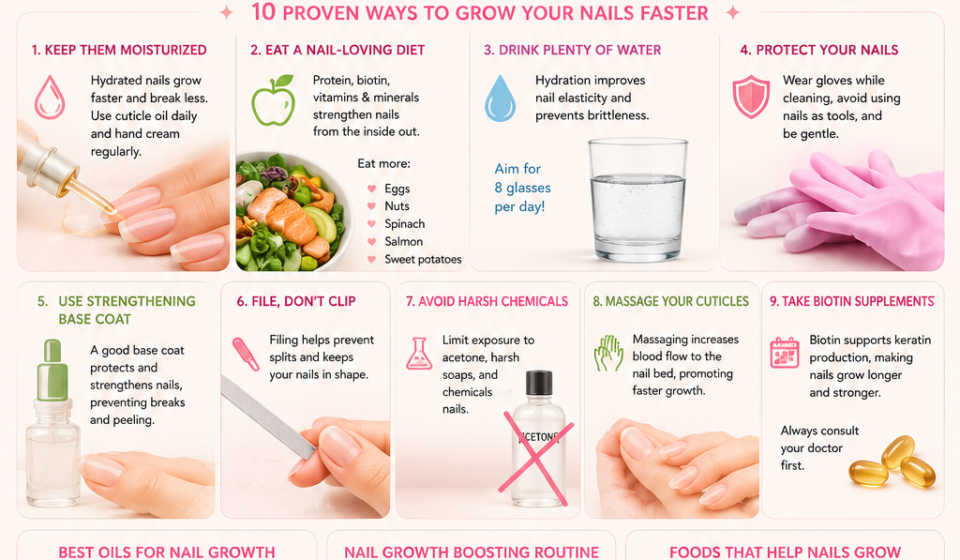
Protein is the raw material of keratin. Without sufficient dietary protein, the nail matrix cannot produce keratin efficiently, and growth slows noticeably. This is one of the most reliable and well-documented relationships in nail health — people on very low protein diets consistently show slowed nail growth, and restoring adequate protein intake accelerates it.
The recommended dietary intake for protein is approximately 0.8 grams per kilogram of body weight for a sedentary adult, but those who are more active, older, or recovering from illness may need more. Excellent protein sources for nail health include eggs (which also contain biotin), lean meats, fish, legumes, nuts, and dairy products.
Practical tip: If you’re not hitting your protein targets through food alone, a simple protein shake or Greek yogurt as a daily snack is one of the most cost-effective nail growth investments you can make.
2. Prioritize Biotin
Biotin — vitamin B7 — is the nutrient most frequently associated with nail growth and strength, and for good reason. Biotin plays a direct role in the metabolism of amino acids used in keratin synthesis. Multiple clinical studies have found that biotin supplementation measurably increases nail thickness and reduces brittleness in people with soft, thin nails.
The key caveat is that biotin supplementation shows the most dramatic results in people who are deficient or insufficient in biotin — which, while relatively uncommon with a varied diet, is more prevalent than many people realize, particularly among those with certain digestive conditions, those taking antibiotics long-term, or those who eat raw egg whites regularly (which contain a protein that blocks biotin absorption).
Recommended intake: The adequate intake for biotin in adults is 30 micrograms per day. Most biotin nail supplements contain significantly more — typically 2,500 to 5,000 micrograms. While biotin is water-soluble and excess is excreted rather than stored, very high doses can interfere with certain laboratory blood tests. Inform your doctor if you are taking biotin supplements before any blood work.
Food sources of biotin: Eggs (particularly the yolk), liver, salmon, avocado, nuts, seeds, and sweet potato.
3. Ensure Adequate Iron Intake
Iron deficiency is one of the most common nutritional deficiencies worldwide and one of the most impactful on nail health and growth rate. Iron is essential for the production of hemoglobin, which carries oxygen in the blood. Without sufficient oxygen delivery to the nail matrix, the rate of cell division — and therefore nail growth — slows. Iron deficiency also frequently causes brittle nails, spoon-shaped nails (koilonychia), and vertical ridges.
Women of reproductive age are particularly at risk for iron deficiency due to monthly blood loss and should pay close attention to their iron intake.
Food sources of iron: Red meat, liver, shellfish (particularly clams and oysters), legumes, tofu, pumpkin seeds, and dark leafy greens. Consuming iron-rich foods alongside vitamin C significantly improves absorption.
Important note: Iron supplementation should only be undertaken after a confirmed deficiency through blood testing, as excess iron is harmful. Speak to your doctor if you suspect deficiency.
4. Stay Well Hydrated
Water is so fundamental to cellular function that its role in nail growth is often overlooked in favor of more specific nutrients — but hydration is actually one of the most direct and controllable factors in nail health and growth rate.
Dehydrated nails become brittle, dry, and prone to peeling and breaking — which means that even if your nail matrix is producing new growth efficiently, you’re constantly losing that length to damage at the tip rather than gaining it. Adequate hydration keeps the nail plate flexible, reduces brittleness, and allows nails to grow longer before they encounter the kind of stress that causes breakage.
Aim for eight to ten glasses of water per day as a baseline, increasing with exercise, heat, or caffeine consumption. The difference in nail quality between well-hydrated and dehydrated nails is frequently visible within two to three weeks of consistent improvement in water intake.
5. Apply Cuticle Oil Daily
Cuticle oil is the single most impactful topical product for nail health and growth optimization. While it does not directly stimulate the nail matrix to produce more keratin, it does something equally important: it maintains the health and integrity of the nail plate and surrounding tissue, reducing breakage and allowing the length produced by the matrix to be retained rather than lost.
The cuticle itself plays a critical protective role — it seals the space between the nail plate and the surrounding skin, preventing moisture loss, bacteria, and debris from reaching the nail matrix. Dry, cracked cuticles compromise this seal and can lead to inflammation around the nail matrix that slows growth.
Oils rich in vitamin E, jojoba, sweet almond, and argan oil are the most nourishing for cuticle and nail health. Apply a drop to each nail bed morning and evening and massage gently in circular motions to stimulate circulation while conditioning the tissue.
6. Massage Your Nail Beds
Nail bed massage — gently rubbing the skin around and beneath the nail — stimulates blood circulation to the nail matrix. Since the nail matrix’s growth rate is directly linked to the blood supply it receives (which delivers oxygen, amino acids, vitamins, and minerals to the cells responsible for growth), anything that improves local circulation has a direct positive effect on growth rate.
This is not simply theoretical — massage stimulates the production of new cells by increasing nutrient delivery to the growth site. Spending 30 to 60 seconds massaging each nail bed while applying cuticle oil is a simple, cost-free practice that pays meaningful dividends in growth rate over consistent application.
7. Take a Zinc Supplement If Deficient
Zinc is a mineral that plays several roles relevant to nail growth: it supports protein synthesis (and therefore keratin production), contributes to cell division in the nail matrix, and helps regulate the immune responses that can cause inflammation around the nail bed if triggered.
White spots on the nails — a phenomenon often mistakenly attributed to calcium deficiency — are actually more frequently associated with zinc insufficiency or minor trauma to the nail matrix. More significantly, zinc deficiency is associated with slowed nail growth, increased brittleness, and changes in nail texture.
Food sources of zinc: Oysters (the richest dietary source), red meat, poultry, beans, nuts, and whole grains. Zinc supplements are widely available and generally safe at standard doses, but as with iron, supplementation is most effective when addressing a genuine deficiency.
8. Add Collagen to Your Routine
Collagen is the most abundant protein in the human body and plays a structural role in the nail bed — the tissue that supports the growing nail plate from underneath. While the nail itself is keratin rather than collagen, the nail bed’s health directly influences how smoothly and evenly the nail grows, and collagen is central to nail bed tissue integrity.
Hydrolyzed collagen supplements — collagen that has been broken down into smaller peptides for improved absorption — have been studied specifically in the context of nail health. A 2017 study published in the Journal of Cosmetic Dermatology found that participants taking daily collagen supplements experienced a 12% increase in nail growth rate and a 42% decrease in broken nails after 24 weeks of use, with 64% of participants showing overall improvement in nail condition.
Collagen supplements are available as powders, capsules, and liquids. Marine collagen (from fish) is generally considered to have the highest bioavailability. Adding a daily collagen supplement to coffee, smoothies, or water is one of the most evidence-backed steps you can take for nail growth.
9. Stop Biting and Picking Your Nails
This may seem obvious, but it deserves explicit inclusion in any nail growth guide because nail biting and picking are among the most common and most damaging habits affecting nail length. Nail biting removes length directly and can damage the nail matrix through repeated trauma at the base, sometimes causing permanent changes in nail growth direction or texture.
Nail picking — removing gel or regular polish by peeling rather than soaking — strips away the top layers of the natural nail plate with the polish, thinning the nail over time and making it more prone to breakage.
Breaking these habits requires identifying the trigger (stress, boredom, anxiety) and replacing the behavior. Applying a bitter-tasting nail deterrent, keeping nails polished (making them less accessible), and addressing the underlying anxiety or boredom directly are the most effective strategies.
10. File Correctly and Regularly
The way you file your nails significantly affects how quickly they appear to grow and how much length they retain. Incorrect filing is one of the most common causes of nail breakage that erases growth before it can accumulate.
File in one direction only. Sawing back and forth across the nail tip creates micro-tears in the keratin structure, weakening the nail edge and making it far more likely to split, peel, or break. Always use smooth, one-directional strokes from the outside edge toward the center.
Use the correct grit. A 180-grit file is appropriate for natural nails. Coarser grits (100 to 150) are for acrylics and will roughen and damage natural nails. Finer glass or crystal files produce the smoothest edge.
File regularly. A small amount of filing every few days — maintaining the shape and smoothing any rough edges before they can catch and tear — keeps nails structurally sound and prevents the snags that cause unexpected breakage.
Keep a consistent shape. Maintaining a consistent shape rather than allowing nails to grow in irregular, uneven formations prevents the structural weaknesses that lead to breakage on one side or corner.
11. Protect Nails from Water and Chemicals
Prolonged water exposure causes the nail plate to expand as it absorbs moisture, then contract as it dries. This repeated expansion and contraction weakens the keratin bonds within the nail plate over time, leading to peeling, splitting, and brittleness — all of which destroy length as fast as the matrix produces it.
Household cleaning chemicals are even more damaging — bleach, detergents, and other harsh agents strip the nail plate of moisture and oils, leaving it dry, fragile, and structurally compromised.
Practical protective measures:
- Wear rubber gloves for dishwashing, cleaning, and any prolonged water exposure
- Apply cuticle oil before swimming to create a light protective barrier
- Dry hands thoroughly after washing, paying attention to the skin around the nails
- Avoid soaking nails in hot water for extended periods
12. Use a Strengthening Base Coat
A quality strengthening base coat serves two nail growth purposes simultaneously: it protects the nail plate from the drying effects of polish, and it adds a reinforcing layer that makes the nail more resistant to breakage during the growth phase.
Look for base coats containing keratin, calcium, hydrolyzed wheat protein, or nylon for the most effective strengthening effect. Apply as the first layer under every manicure, and consider wearing a strengthening base coat alone — without color — during polish-free recovery periods to keep the nail protected while allowing it to breathe.
13. Give Your Nails Regular Breaks from Gel and Acrylics
Gel and acrylic nails are beautiful, long-lasting, and popular — but repeated applications without rest periods can thin and weaken the natural nail plate over time, due to the filing required for application and the acetone exposure during removal.
Thin, compromised nails break more easily, which means that even if the nail matrix is producing growth efficiently, it is being lost to breakage faster than it can accumulate.
A one to two week break from all enhancements every two to three months allows the nail plate to recover its natural thickness and strength. During this time, focus on hydration, cuticle oil, and a strengthening base coat to maximize the recovery period.
14. Manage Stress
Chronic stress has a measurably negative effect on nail growth, primarily through its impact on blood circulation and immune function. When the body is in a sustained stress response, blood is preferentially directed toward major organs and muscle groups — the small capillaries supplying the nail matrix receive less circulation, and growth slows.
Stress also depletes nutrients — particularly zinc, magnesium, and B vitamins — that are essential for keratin production, further compounding the effect on nail growth.
Stress management practices that improve nail growth are the same ones that improve overall health: regular exercise (which dramatically improves circulation), adequate sleep, mindfulness or meditation practices, and social connection. Consistent exercise in particular has a direct positive effect on nail growth through its circulation-boosting effects.
15. Consider a Comprehensive Nail Growth Supplement
Beyond individual nutrients, a number of comprehensive nail, hair, and skin supplements are specifically formulated with the full spectrum of vitamins, minerals, and amino acids that support keratin production and nail growth. These typically combine biotin, collagen peptides, zinc, iron, vitamins C and E, silica, and various B vitamins into a single daily supplement.
While individual results vary significantly, many people find that a comprehensive nail supplement produces more noticeable results than any single nutrient alone — because nail growth depends on many factors simultaneously, and addressing multiple potential deficiencies at once is often more effective than targeting just one.
Key ingredients to look for in a nail growth supplement:
- Biotin (2,500 to 5,000 mcg)
- Hydrolyzed collagen (2.5 to 5 grams)
- Zinc (8 to 11 mg)
- Vitamin C (which supports collagen synthesis)
- Silicon or silica (which supports keratin structure)
- B vitamins complex (B6, B12, folic acid)
How Long Does It Take to See Results?
This is the question everyone asks, and the honest answer requires some nuance. Nail growth optimization is not a quick fix — the nail matrix responds to improved conditions over weeks and months, not days.
Weeks 1 to 2: Nail bed hydration and cuticle condition improve noticeably with consistent oil and moisture application. Breakage may begin to reduce.
Weeks 3 to 4: With improved nutrition and hydration, growth rate begins to increase. At the average growth rate of 3 to 4 mm per month, you should be able to measure a difference by the end of the first month.
Months 2 to 3: With consistent practice across nutrition, hydration, protection, and supplements, growth rate should be meaningfully higher than your starting point. Most people who follow a comprehensive nail growth protocol see their most significant results in this window.
Months 4 to 6: The full effects of collagen supplementation and sustained nutritional optimization become most apparent in this longer window. Nail thickness, strength, and growth rate should all show clear improvement over the starting baseline.
The most important factor is consistency — sporadic attention to nail growth produces sporadic results. Daily habits, sustained over months, produce the most significant transformation.
What to Do If Your Nails Simply Won’t Grow
If your nails are growing very slowly despite consistent attention to all of the above, it may be worth investigating potential underlying causes with a healthcare provider. Several medical conditions can significantly impair nail growth:
Thyroid disorders — both hypothyroidism and hyperthyroidism can cause nail abnormalities and slowed growth. A simple blood test can rule this out.
Nutritional deficiencies — a blood panel testing for iron, zinc, vitamin D, vitamin B12, and folate can identify deficiencies that are impacting growth.
Psoriasis — a skin condition that can affect the nails (nail psoriasis), causing pitting, thickening, and disrupted growth patterns.
Fungal nail infections — onychomycosis can significantly slow nail growth and requires antifungal treatment.
Circulation issues — conditions affecting peripheral blood flow can reduce nutrient delivery to the nail matrix.
If nails have changed in texture, color, shape, or growth pattern suddenly and without obvious cause, a dermatologist consultation is the most productive next step.
Frequently Asked Questions
How fast do nails grow in a month? The average fingernail grows approximately 3 to 4 millimeters per month under normal conditions. With optimized nutrition, hydration, and nail care, this can increase to 4 to 5 millimeters per month for some individuals.
Does cutting your nails make them grow faster? No — cutting nails does not stimulate the nail matrix to produce more growth. Nails grow from the matrix at the base, not from the tip, so removing length at the tip has no effect on the growth rate. The perception that regular trimming promotes growth may come from the fact that regularly trimmed nails break less often, so more length is retained over time.
Does Vaseline help nails grow? Vaseline (petroleum jelly) does not stimulate nail growth directly, but it is an excellent occlusive moisturizer that prevents moisture loss from the nail plate and surrounding skin. Applied to the cuticle and nail bed at night, it helps maintain hydration levels that support nail health and reduce brittleness — which indirectly supports length retention.
What vitamins make nails grow faster? Biotin (B7) is the most evidence-backed vitamin specifically for nail growth and strength. Vitamin C supports collagen synthesis in the nail bed. Vitamin D and the B vitamins (particularly B12 and folate) support overall cellular health and keratin production. A deficiency in any of these can slow nail growth noticeably.
Does drinking more water help nails grow faster? Yes — adequate hydration directly affects nail plate health and flexibility. Dehydrated nails are brittle and prone to breakage, which destroys length gains as fast as the matrix produces them. Improved hydration reduces breakage and allows accumulated growth to be retained.
How can I grow my nails in a week? Realistic expectations matter here: nails grow approximately 1 millimeter per week on average, and no intervention will dramatically exceed this in such a short timeframe. What you can achieve in one week is improved nail health, reduced breakage, and optimized conditions for growth — the results in terms of visible length take longer to accumulate.
Final Thoughts
Growing longer, stronger nails faster is genuinely achievable — but it requires a holistic approach rather than a single magic solution. The nail matrix needs adequate raw materials (protein, biotin, zinc, iron, collagen) to produce keratin efficiently. The nail plate needs protection from water, chemicals, and physical damage to retain the length being produced. And the surrounding tissue needs consistent hydration and care to maintain the environment in which healthy growth can occur.
None of these steps is complicated, expensive, or particularly time-consuming. Together, consistently applied over weeks and months, they create the conditions in which your nails can reach their full genetic growth potential — which, for most people, is significantly more than they’re currently achieving.
Start today: add cuticle oil to your morning routine, increase your protein and water intake, put on rubber gloves before the dishes, and take stock of the nail-related habits that may be costing you length without your realizing it. In three months, your nails will tell the story of what consistent, informed nail care can achieve.