
Press on nails have had a complete reinvention. Once associated with cheap, plastic-looking sets that lasted a day before popping off, modern press on nails are sophisticated, beautifully designed, and — when applied correctly — genuinely impressive. They have become a go-to for nail art lovers, busy people who cannot commit to salon appointments, and anyone who wants the look of a professional manicure on their own schedule and budget.
But when the time comes to take them off, many people find themselves in unfamiliar territory. Do you just pull them off? Do you need acetone? Will they damage your natural nails? How long does it take? And why does every method online seem to give slightly different advice?
The answers depend largely on one critical factor: how your press on nails were attached. A set applied with the adhesive tabs that come in the kit requires an entirely different removal approach than a set bonded on with nail glue. Getting the method right for your specific situation makes the difference between nails that come off cleanly in ten minutes and a removal process that takes longer and risks damage.
This comprehensive guide covers every method for taking press on nails off safely at home — from the simplest warm water soak to the foil wrap acetone technique — with full step-by-step instructions, tips for avoiding the most common mistakes, and a complete aftercare routine for keeping your natural nails healthy after removal.
Before You Begin: Identify How Your Press On Nails Were Applied
The most important step in press on nail removal is identifying what was used to apply them, because this determines which removal method is appropriate.
Applied with Adhesive Tabs
Adhesive tabs — the small, double-sided sticker pads included in most press on nail kits — are designed for temporary wear, typically one to five days. The adhesive is gentler and more temporary than nail glue, and the nails come off far more easily as a result.
If your nails were applied with tabs, you have the easiest removal situation. Warm water soaking, cuticle oil, or even a gentle edge lift will remove them with minimal effort and no specialist products required.
How to tell: If you applied adhesive tabs, you likely remember doing so. If you are unsure, try gently pressing a cuticle pusher under the edge of one nail. If it begins to lift without significant resistance after 30 to 60 seconds of gentle pressure, adhesive tabs were almost certainly used.
Applied with Nail Glue
Nail glue — the cyanoacrylate-based adhesive that comes in the small tubes sold alongside press on sets, or purchased separately — creates a significantly stronger bond than adhesive tabs and is designed to last one to three weeks. Press on nails applied with nail glue require acetone for safe removal.
How to tell: If you applied nail glue, the press on nail will feel very firmly fixed and will not lift at the edges under gentle pressure. Attempting to pull or lever the nail off will feel like pulling at the actual nail rather than at a surface layer.
If you are genuinely unsure which adhesive was used, treat the nails as if they were applied with nail glue and use the acetone method — it is safe and effective for both.
What You Need for Press On Nail Removal
For Tab-Applied Press On Nails:
- A bowl of warm water
- A few drops of dish soap or cuticle oil (optional)
- A cuticle pusher or orangewood stick
- Cuticle oil
- Hand cream
For Glue-Applied Press On Nails:
- 100% pure acetone or acetone-based nail polish remover
- Cotton balls or cotton pads
- A glass or ceramic bowl (for the bowl soak method)
- Aluminium foil cut into fingertip rectangles, OR nail soaking clips (for the foil method)
- A cuticle pusher or orangewood stick
- A soft nail buffer
- Petroleum jelly (to protect surrounding skin)
- Cuticle oil
- Rich hand cream
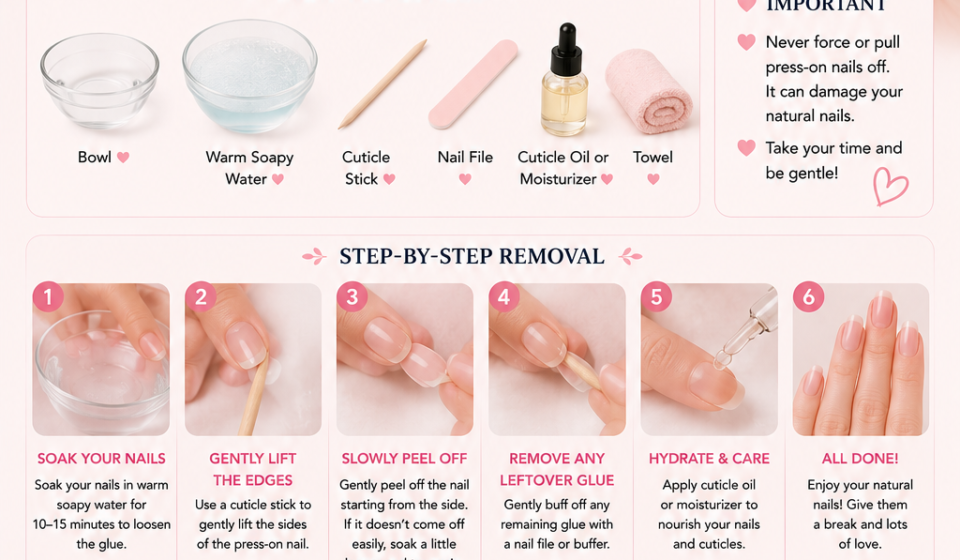
Method 1: Warm Water Soak (Best for Adhesive Tab Press Ons)
Time required: 15 to 20 minutes Damage risk: Very low Best for: Press on nails applied with adhesive tabs
The warm water soak is the gentlest and most accessible press on nail removal method. It works by softening and loosening the adhesive tab bond through prolonged warm water exposure, allowing the press on nail to slide away from the natural nail with minimal effort and no chemicals.
Step 1: Prepare the Soak
Fill a bowl large enough to comfortably fit both hands with comfortably warm water — not hot, which can be uncomfortable over the soaking period, but genuinely warm enough that you can feel it softening the adhesive. Add a few drops of dish soap or a squeeze of cuticle oil to the water for additional softening effect. Some people add a small amount of mild shampoo, which also works well.
Step 2: Soak for 10 to 15 Minutes
Submerge your fingertips fully in the warm water and hold them there for a minimum of 10 minutes. As the warm water penetrates beneath the press on nail, it softens the adhesive tab and gradually reduces the bond between the tab and the natural nail.
Resist the temptation to try lifting the nails during this period — let the soak do its work. If after 10 minutes the nails still feel firmly attached, continue soaking for another five minutes.
Step 3: Gently Work the Edges
After soaking, use a cuticle pusher or orangewood stick to very gently ease the tip of the tool under the free edge of the press on nail at the side nearest the lateral nail fold. Apply gentle, sliding pressure rather than levering — the goal is to ease the nail away from the adhesive surface gradually, not to prise it off with force.
Work the tool slowly around the edges of the nail, loosening progressively from the sides inward toward the base. If you feel significant resistance at any point, stop, return the hand to the warm water for another two to three minutes, and try again.
Step 4: Slide the Press On Nail Off
Once the edges are sufficiently loosened, the press on nail will slide forward off the natural nail with a smooth, gentle motion. If any pulling sensation is felt, do not continue — the tab is still adhered in that area and the nail is not ready to come off cleanly.
Step 5: Remove Adhesive Tab Residue
Any adhesive tab sticker remaining on the natural nail surface can be easily removed. Roll it away using the pad of a clean finger in small circular motions — the sticker tends to roll off the nail surface very cleanly this way. Alternatively, apply a small amount of acetone or nail polish remover on a cotton pad and wipe gently.
Step 6: Buff and Moisturise
Use a soft nail buffer to gently smooth the natural nail surface. Apply cuticle oil to each nail and massage in for 30 seconds. Follow with hand cream.
Method 2: Cuticle Oil Soak Method (Gentle and Effective for Tab Press Ons)
Time required: 15 to 25 minutes Damage risk: Very low Best for: Adhesive tab press ons, nails that need the gentlest possible approach
The cuticle oil method uses oil to penetrate beneath the press on nail at the edges and gradually dissolve the adhesive tab bond. It is slightly slower than the warm water method but is exceptionally gentle and has the added benefit of nourishing the nail and cuticle during the removal process.
How to Use This Method
Apply a generous amount of cuticle oil — or any pure oil such as olive oil, jojoba oil, or coconut oil — around the edges of each press on nail, working the oil into the gap between the press on nail and the skin on all sides.
Allow the oil to penetrate for five to ten minutes, then use a cuticle pusher to gently ease the nail away from the edges inward. Reapply oil as needed if resistance is encountered. Once loosened, the nail should slide off smoothly.
This method is particularly good for people with sensitive skin around the nails, those who want to avoid any water exposure, and anyone doing a slow, careful removal while watching television or relaxing.
Method 3: Dental Floss Technique (Quick Method for Already-Lifting Press Ons)
Time required: 5 to 10 minutes Damage risk: Low to moderate (must be done carefully) Best for: Adhesive tab press ons that are already slightly lifting at the edges; requires a helper
The dental floss technique is a quick, no-product-needed method for removing press on nails that have already begun to lift naturally at the edges. It should only be used when the press on nail is already separating from the natural nail — attempting it on a fully adhered nail risks damage.
This method requires two people — one to hold the hand steady, one to work the floss.
How to Use This Method
Have your helper take a length of unwaxed dental floss (approximately 30 to 40 centimetres) and fold it double for extra strength. Identify the edge of the press on nail where it has begun to lift — this is the entry point.
Very gently, the helper slides the folded floss beneath the lifting edge of the press on nail. Using a gentle sawing motion while applying slight upward pressure, they work the floss slowly from one side of the nail to the other, easing it beneath the press on nail in a smooth arc.
The press on nail should separate and pop free cleanly. If significant resistance is encountered at any point, stop immediately — the adhesive is still holding firmly in that area, and forcing the floss through risks tearing the natural nail surface. Switch to the warm water method for areas that resist.
Important: This technique must be genuinely gentle. Dental floss at the wrong angle or with too much pressure can cause cuts to the surrounding skin or damage to the natural nail surface.
Method 4: Acetone Soak Method (For Glue-Applied Press On Nails)
Time required: 20 to 30 minutes Damage risk: Low when done correctly Best for: Press on nails applied with nail glue
Nail glue (cyanoacrylate adhesive) creates a bond that warm water and oil cannot dissolve. Acetone is the only practical solvent for nail glue removal at home, and when used correctly, it dissolves the adhesive cleanly without damaging the natural nail beneath.
Option A: Bowl Soak
Step 1: Pour enough 100% pure acetone into a glass or ceramic bowl to submerge your fingernails — approximately half an inch. Pure acetone works faster than diluted acetone-based remover, but either will work with enough time.
Step 2: Apply petroleum jelly or thick hand cream generously to all the skin on your fingers and hand — everywhere except the nail surface. This protects the skin from prolonged acetone exposure.
Step 3: Submerge your fingertips in the acetone. Soak for 15 to 20 minutes. Check one nail at the 10-minute mark by gently pressing a cuticle pusher against the edge of the press on nail. If the glue has begun to dissolve, the nail will feel loose or will have begun lifting slightly.
Step 4: When the glue has softened sufficiently, the press on nail will lift away from the natural nail with very gentle cuticle pusher pressure. Do not force nails that still feel firmly adhered — return to the soak for another five minutes.
Step 5: Wipe away any dissolved glue residue with a fresh acetone-soaked cotton pad. Buff gently, wash hands thoroughly, and moisturise immediately and generously.
Option B: Foil Wrap Method (More Targeted)
The foil wrap method concentrates the acetone directly on each nail while limiting skin exposure.
Step 1: Apply petroleum jelly around each nail to protect the surrounding skin.
Step 2: Cut or tear cotton balls into pieces roughly the size of each nail. Saturate each piece thoroughly with 100% pure acetone.
Step 3: Place one saturated cotton piece directly over each nail, covering the full surface. Wrap a small rectangle of aluminium foil tightly around the fingertip to hold the cotton in place and trap heat, which accelerates the process.
Step 4: Wait 15 minutes. The concentrated acetone contact will dissolve the nail glue from the nail surface.
Step 5: Unwrap one finger and test by pressing the cuticle pusher gently against the press on nail edge. If it slides freely, proceed with removing it. If it still feels attached, rewrap with fresh acetone-soaked cotton and wait another five minutes.
Step 6: Remove each press on nail by sliding it forward off the natural nail with the cuticle pusher. Wipe away any remaining glue residue with acetone-soaked cotton.
Step 7: Buff gently, wash thoroughly, and apply cuticle oil and hand cream immediately.
Method 5: Warm Soapy Water Extended Soak (No Acetone Alternative for Glue Press Ons)
Time required: 30 to 45 minutes Damage risk: Low Best for: Those who prefer to avoid acetone; works best when glue bond is already weakening
For those who prefer to avoid acetone, an extended warm soapy water soak can sometimes loosen nail glue sufficiently for gentle press on nail removal — though it is significantly less efficient than acetone and works best when the glue bond has already begun to weaken naturally (after one to two weeks of wear).
Fill a bowl with warm water and a generous squeeze of dish soap. Soak fingertips for 20 to 30 minutes, checking the edges of each press on nail every ten minutes. The warm soapy water gradually softens the glue, particularly at the edges, and may allow the press on nail to be eased away with patient cuticle pusher work.
This method requires more time and more patience than the acetone approach but avoids chemical exposure entirely. For press ons where the glue is already losing its grip at the edges, it is often surprisingly effective.
What Happens If You Just Pull Press On Nails Off?
This question deserves a direct and honest answer, because many people do it — and because the consequences vary significantly depending on how the nails were attached.
If applied with adhesive tabs: Pulling press on nails off without soaking first is less risky than with glue, but still not ideal. The adhesive tab can sometimes remain on the natural nail and must be rolled away separately. On some nail surfaces, the tab can pull at the surface of the natural nail if removed without softening first. The warm water soak makes removal both safer and more comfortable.
If applied with nail glue: Pulling press on nails off without acetone is genuinely damaging and should never be done. Nail glue bonds to the surface layers of the natural nail plate, and tearing a press on nail free physically strips those layers away. The result is nails that are visibly thin, tender to the touch, and have a rough, peeling surface that can take weeks or months to fully recover. The thinning that many people attribute to wearing press on nails is almost exclusively caused by improper removal — specifically by pulling or peeling them off.
No matter how firmly attached or how inconvenient the proper removal process seems in the moment, the two to four minutes of additional time the correct method takes is always worthwhile.
How to Make Press On Nail Removal Faster
Start the Removal at the Right Time
The best time to remove press on nails applied with adhesive tabs is when they naturally begin to lift slightly at the edges — typically after three to five days. At this point, the adhesive has already begun to weaken and removal takes less soaking time and effort. Removing them before the adhesive shows any natural weakening takes longer.
Warm the Acetone
For glue-applied press ons, warm acetone is noticeably more effective than room temperature acetone. Place your acetone bowl inside a larger bowl of warm water for five minutes before soaking to bring the temperature up. Warm acetone dissolves nail glue faster, reducing the required soak time.
Use Pure Acetone Rather Than Diluted Remover
Standard nail polish remover — even acetone-based formulas — contains acetone at a lower concentration than pure acetone. For nail glue removal, pure acetone works meaningfully faster. Pure acetone is widely available at pharmacies and beauty supply stores.
File Down Long Extensions Before Soaking
If your press on nails are extended and long, clip or file them shorter before soaking. Less material above the natural nail means less for the acetone to work through and a faster, easier removal experience.
How to Care for Your Natural Nails After Removing Press On Nails
Natural nails after press on nail wear typically need some attention — the degree depending on how long the press ons were worn, how they were attached, and how the removal went.
Immediately After Removal
Apply cuticle oil generously to every nail bed and massage in for at least 30 seconds per nail. This replenishes the moisture that may have been stripped by acetone and restores flexibility to the nail plate. Follow immediately with a rich hand cream over the full hand.
The Following Days
Apply cuticle oil twice daily — morning and evening — for at least one week following removal. If the nails feel slightly thin or soft, apply a clear strengthening base coat to bare nails to add a protective layer while the natural nail recovers.
Keep nails trimmed short during the recovery period. Short nails experience less mechanical stress and are far less likely to break or peel while the nail plate is rebuilding its natural strength.
Giving Nails a Rest Between Sets
One of the best things you can do for long-term nail health when wearing press on nails regularly is to allow a few days of bare nail time between sets. This allows the nail plate to breathe, recover full moisture balance, and remain in good overall condition rather than gradually depleting through continuous adhesive application.
Even two to three days between sets makes a meaningful difference to how the nail surface looks and feels over time.
Reapplying Press On Nails
If you want to reapply a new set of press ons immediately after removal, allow your nails a minimum of 30 minutes after moisturising before applying. The cuticle oil and hand cream you apply during aftercare need to be fully absorbed before any new adhesive can bond properly — applying over oily nails significantly reduces press on nail longevity.
If you used acetone during removal, buff the nail surface very lightly with a fine buffer to remove any smooth, slightly glassy surface left by the acetone — a lightly buffed surface allows adhesive tabs and nail glue to bond more effectively.
Can You Reuse Press On Nails After Removal?
This is one of the most frequently asked questions about press on nails, and the answer is a qualified yes — with some important conditions.
Press ons removed with the warm water method from adhesive tabs can often be reused one or two times if they have come off without damage. Remove any adhesive tab residue from the underside of the nail by gently peeling it away or dissolving with a small amount of acetone on a cotton swab. Store nails in their original packaging or a small labelled container to maintain their shape and prevent them from getting mixed up.
Press ons that were applied with nail glue are much more difficult to reuse successfully. Nail glue tends to remain on the underside of the press on nail after removal, creating an uneven surface that new adhesive does not bond to cleanly. Some people successfully remove old glue residue from the underside of the press on nail using acetone and a soft brush, but this requires patience and the results are not always perfect.
Press ons that were removed by peeling or pulling are typically unusable for reapplication, as the peeling process usually deforms or cracks the press on nail itself.
Frequently Asked Questions
How long does it take to take press on nails off? For press ons applied with adhesive tabs, the full process takes approximately 15 to 20 minutes including soaking and aftercare. For press ons applied with nail glue, allow 25 to 35 minutes for the acetone method. Rushing either process increases the risk of damage.
Do press on nails ruin your natural nails? Press on nails do not inherently damage natural nails when applied and removed correctly. Damage occurs almost exclusively during improper removal — particularly peeling or pulling nails off without softening the adhesive first. Correct application, correct removal, and good aftercare keep natural nails healthy through multiple press on nail cycles.
Can I remove press on nails with just water? Yes — for press ons applied with adhesive tabs, warm water soaking is the primary and recommended removal method. For press ons applied with nail glue, water alone is not sufficient to dissolve the cyanoacrylate adhesive, though extended warm soapy water soaking can gradually weaken the bond enough to allow careful removal with sufficient patience.
How do I remove press on nails without acetone? For tab-applied press ons: warm water or cuticle oil are effective acetone-free methods. For glue-applied press ons without acetone: an extended 30 to 45-minute warm soapy water soak is the most practical option, though it is slower and less complete than acetone. Rubbing alcohol (isopropyl alcohol) can also dissolve nail glue partially — apply with a cotton pad, hold against the nail for a few minutes, and work at the edges with a cuticle pusher.
Is it normal for press on nails to hurt when removing? No — removal should not be painful. If you feel pain during removal, it almost always means the adhesive is still bonded to the natural nail and you are beginning to pull at the nail itself rather than simply releasing the adhesive. Stop immediately, return to the soak, and allow more time before trying again.
How soon can I reapply press on nails after removing them? Allow at least 30 minutes to one hour after removal and aftercare before applying a new set. The cuticle oil and hand cream applied during aftercare need time to absorb fully before new adhesive can bond effectively. If you used acetone, a very light buff of the nail surface before reapplication improves adhesion significantly.
Can I shower with press on nails and will it make them easier to remove? Yes — press on nails applied with adhesive tabs typically loosen during showering or bathing, which is one reason they tend to need replacing every few days. Extended hot shower exposure can loosen glue-applied nails too, and a long soak in a warm bath is sometimes enough to allow careful removal of glue-applied press ons without additional acetone, particularly if the glue bond has already begun to weaken.
Final Thoughts
Taking press on nails off is genuinely simple when you match the method to the adhesive — warm water for tabs, acetone for glue, patience for both. The removal process that feels like it might take ages actually takes less time than most people expect, and the nails that emerge from a properly executed removal are in far better condition than those that have been peeled, pulled, or forced free.
The two principles that matter most: never force a nail that is not ready to come off, and always moisturise immediately after removal. Follow these, give yourself the small amount of time the process requires, and your natural nails will stay healthy, strong, and ready for the next set — whenever you are.
Press on nails are one of the most accessible and genuinely enjoyable forms of nail art available today. Knowing how to remove them properly means you can wear them as often as you want, change them as frequently as you like, and do all of it without any cost to the natural nails underneath.