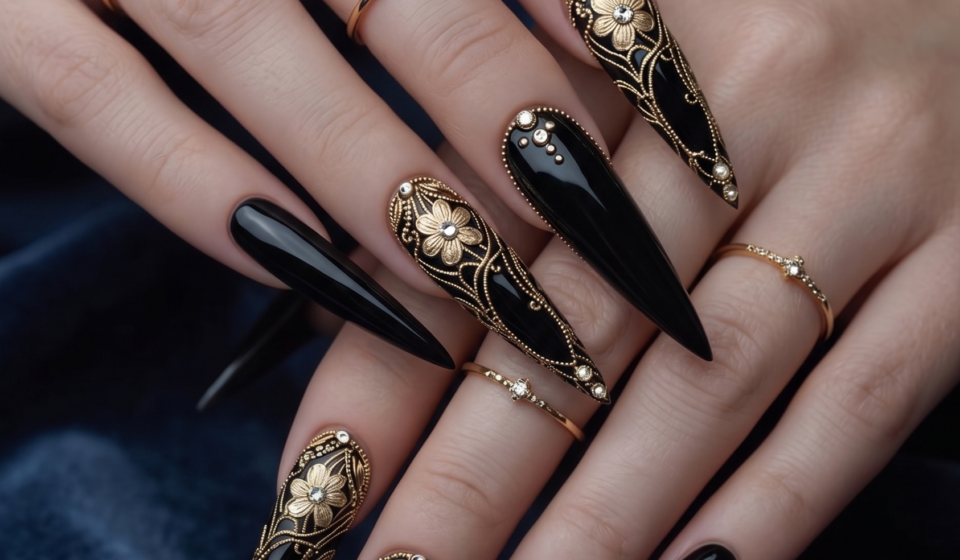

There is a category of beauty that exists beyond simple attractiveness — a realm where aesthetics become genuinely awe-inspiring, where the craftsmanship is so precise and the visual language so rich that looking at it creates something close to reverence. Royal Black and Gold Lace nails inhabit this category. They are nail art that does not merely decorate — they make a statement about who you are, what you value, and the kind of beauty you want to carry with you.
The Royal Black and Gold Lace nail aesthetic draws from one of the most powerful visual vocabularies in human history: the combination of absolute black with pure gold, filtered through the delicate, intricate geometry of lace. Black and gold have adorned royalty, religious spaces, ceremonial garments, and the highest expressions of decorative art across virtually every culture and era. Lace — with its mathematical complexity, its combination of strength and delicacy, its ability to create elaborate visual patterns from the simplest thread — is one of the most sophisticated textile arts ever developed. When these elements come together on the canvas of a nail, the result is something that genuinely earns the word “elegant.”
This comprehensive guide covers everything about the Royal Black and Gold Lace nail aesthetic — its visual identity and emotional resonance, the techniques required to execute it, the products and tools that produce the best results, step-by-step creation guidance for both salon and home application, the many beautiful variations within the style, which nail shapes showcase it best, styling advice, care instructions, and answers to the most important questions about achieving and wearing this extraordinary look.
The Visual Identity of Royal Black & Gold Lace Nails
Before exploring technique and execution, it is worth fully understanding what makes Royal Black and Gold Lace nails the specific aesthetic they are — because understanding the design philosophy produces better results than simply following steps.
The Black Foundation
The jet-black base is not merely a background color in this design — it is a foundational element that does specific visual work. Black is the color of depth, of formality, of absolute contrast. On nails, a deeply saturated, perfectly applied jet black creates a surface that appears to have genuine depth — almost like looking into something rather than at something.
In the Royal Black and Gold Lace aesthetic, this depth is what makes the gold lace pattern read with such visual power. The gold sits against the black not merely as color against color, but as light against darkness, as intricacy against simplicity, as gilded detail against velvet void.
The finish of the black base matters enormously. A high-gloss black creates a lacquered, patent leather quality that makes gold appear almost luminous against it — like candlelight reflected in a dark mirror. A matte black creates a more velvet, absorbed quality that makes gold appear warmer and more organic — like embroidery on dark fabric. Both are beautiful; both create genuinely different emotional experiences.
The Gold Lace Pattern
The gold lace pattern is where the design earns its complexity and its beauty. True lace patterns are characterized by several specific visual qualities that distinguish them from simple decorative lines or generic filigree:
Mathematical regularity: Real lace has a structural logic — patterns repeat, elements mirror each other, the geometry is internally consistent. Great gold lace nail art replicates this regularity rather than producing random decorative lines.
Negative space integration: Lace is defined as much by its empty spaces as its threads — the voids between the pattern elements are as important to the design as the pattern itself. In nail art, the black base showing through the gold pattern IS the equivalent of those voids.
Layered complexity: The most beautiful lace has depth — different scales of pattern working together, smaller detail within larger structures, a sense that the closer you look, the more you see.
Delicacy alongside structural integrity: Lace is simultaneously fragile-looking and structurally coherent. Gold lace nail art should share this quality — lines should be fine enough to suggest delicacy, but the overall pattern should hold together as a unified composition.
Achieving all of this in nail art requires either exceptional freehand skill with a very fine nail art brush or gold liner, or the use of high-quality lace nail decals that replicate the pattern structure accurately.
The Gold Color Quality
Not all gold nail art reads the same way. The specific quality of gold matters enormously in the Royal Black and Gold Lace aesthetic:
Deep, warm gold (sometimes called antique gold or old gold) has a richness and seriousness that reads as genuinely regal. It references historical gilding, royal artifacts, and the warm glow of candlelight. This is the most sophisticated gold tone for this aesthetic.
Bright, pure gold (more yellow-toned) has a more vivid, celebratory quality. Against jet black, it creates maximum contrast and visual impact — spectacular for occasion and evening wear.
Rose gold introduces warmth and a slightly romantic, feminine quality to the design. Rose gold lace on black is beautiful but slightly different in emotional register from classic gold — softer, more intimate.
Chrome or mirror gold creates a reflective, metallic quality that reads as futuristic and luxurious simultaneously. Chrome gold lace on black is one of the most photographically spectacular variations of the design.
Why Royal Black & Gold Lace Nails Are Having Their Moment in 2026
The rise of Royal Black and Gold Lace nails to genuine trend status in 2026 reflects several converging cultural currents.
The regal aesthetic is having a broader cultural revival. Across fashion, interiors, and beauty, 2026 has seen a renewed appreciation for the opulent, the ceremonial, and the historically referential. Royal imagery — crowns, ermine, gold embroidery, dark velvet — has appeared on fashion runways, in major editorial shoots, and in the design language of luxury brands. Nails are absorbing this cultural moment as they always do.
Gothic glam has matured into mainstream elegance. What was once perceived as a niche aesthetic associated with subculture has evolved into something much more broadly appreciated — the dark, dramatic, beautifully crafted end of the beauty spectrum is no longer alternative but aspirational. Royal Black and Gold Lace sits at the highest expression of this matured gothic glam aesthetic.
The nail art community has developed the technical capacity. The widespread availability of high-quality gold nail art liners, professional-grade lace decals, and the accumulated skill of millions of nail art practitioners means that a design that would previously have required exceptional specialist skill can now be achieved to a high standard by a much larger population of nail artists.
Occasion dressing has returned in full force. After years of casual-first fashion, formal and semi-formal occasion dressing is experiencing a significant revival. With it has come demand for nails that match the level of intention and artistry that occasion dressing represents — and Royal Black and Gold Lace nails are perfectly positioned to meet that demand.
The Techniques Behind Royal Black & Gold Lace Nail Art
There are several distinct techniques for creating gold lace patterns on a black nail base, ranging from highly accessible to professionally demanding.
Technique 1: Gold Lace Nail Decals (Most Accessible)
High-quality gold lace nail decals — thin, precisely printed adhesive transfers that replicate lace patterns with remarkable fidelity — are the most accessible route to authentic-looking gold lace nail art. They are available from specialist nail art suppliers, online beauty retailers, and increasingly from mainstream beauty stores.
How to apply lace nail decals:
Prepare the nail with a base coat and two coats of jet-black gel or regular polish, fully dried or cured. Apply a thin coat of gel top coat or slightly tacky regular top coat and allow it to become sticky rather than fully dry.
Carefully peel the decal from its backing and position it over the nail surface. Press gently from the center outward to eliminate air bubbles. Trim any excess with small scissors. Seal with a full top coat, pressing the edges of the decal firmly to prevent lifting.
Choosing the right decals: Look for decals with genuine lace pattern structure rather than generic filigree — the difference in the authenticity of the final result is significant. Gold foil decals produce the most metallic, authentic-looking result. Printed gold decals can look slightly flatter but are easier to work with.
Technique 2: Gold Nail Art Liner (Intermediate Skill)
Gold nail art liner — a very fine-tipped pen or brush loaded with gold nail paint — allows freehand creation of lace-inspired patterns directly on the nail surface. This technique produces the most authentic and customizable results but requires a steady hand and some practice.
Creating lace-inspired patterns freehand:
The key to convincing freehand lace is starting with a structural element and building detail within it. Begin with thin curved or diagonal lines creating the basic framework of the pattern. Within each section created by the framework lines, add smaller detail — dots, tiny loops, fine crosshatching, small flower or diamond motifs. The pattern should feel internally consistent and mirror itself across the nail with relative regularity.
Common lace-inspired motifs for freehand nail art include:
- Fine diamond or rhombus grids with small dots at intersection points
- Overlapping arched borders filled with tiny dot or line details
- Central medallion motifs surrounded by radiating fine-line patterns
- Scalloped border patterns along the tip of the nail
Practice the pattern on paper before attempting it on nails, and work with the finest possible liner brush or liner pen for the most delicate lines.
Technique 3: Stamping Plates with Gold Stamping Polish (Intermediate)
Nail stamping is a technique where a design is etched into a metal plate, filled with stamping polish, scraped flat, then transferred to a clear jelly stamper and pressed onto the nail. Many stamping plate manufacturers produce plates with authentic lace patterns specifically designed for nail art.
How to use stamping for gold lace:
Apply your jet-black base and allow to cure or dry fully. Apply gold stamping polish (which must be highly pigmented and fast-drying) to the desired pattern on your stamping plate. Scrape the excess polish cleanly from the plate surface with a scraper card. Press the clear jelly stamper firmly onto the plate to pick up the pattern, then press firmly and evenly onto the nail. Lift cleanly, seal with top coat.
Stamping produces crisp, consistent patterns that are difficult to achieve freehand and works particularly well for repeating all-over lace patterns.
Technique 4: Gold Chrome Powder on Gel (Advanced, Most Spectacular)
For the most luxurious version of the Royal Black and Gold Lace aesthetic, gold chrome powder can be applied to specific areas of the nail through a stencil to create a chrome lace pattern on a black gel base.
Apply jet-black gel base and cure. Apply lace-pattern nail stencils (adhesive stencils with lace cutouts). Apply non-wipe gel top coat over the exposed areas through the stencil, cure for 60 seconds. Remove the stencil carefully. Apply gold chrome powder to the tacky gel areas using a silicone applicator, buffing gently until the chrome pattern is brilliant. Seal with gel top coat and cure.
The resulting chrome gold lace pattern on black gel is one of the most spectacular nail art effects achievable — the mirror-like brilliance of the chrome gold against the depth of the black base creates an almost surreal luxuriousness.
Step-by-Step: Creating Royal Black & Gold Lace Nails at Home
What You Need
- Jet-black gel polish or regular nail polish (deeply pigmented)
- Gold lace nail decals OR gold nail art liner OR gold stamping polish and stamping plate
- Matte or gloss top coat (your choice determines the finish character)
- Base coat
- Small scissors
- Fine tweezers (for decal application)
- Cuticle oil and hand cream
- UV/LED lamp (if using gel products)
- A nail art brush set (for liner work)
Step 1: Shape and Prepare
File nails into your chosen shape and buff the surface lightly. Push cuticles back gently and clean the nail surface with a lint-free wipe dampened with acetone to remove any oils. Apply base coat and cure or dry completely.
Step 2: Build the Black Base
Apply two coats of jet-black polish or gel, curing between each coat. The black must be completely opaque — any patchiness or unevenness will be visible through the gold lace pattern. Take time to apply perfectly and build full opacity before proceeding.
Step 3: Apply the Gold Lace Pattern
Choose your technique based on your skill level and available materials:
Decals: Apply as described above — position over the tacky top coat surface, smooth from center outward, trim edges, seal firmly.
Freehand liner: Build the lace pattern systematically — structural lines first, detail within each section second, finishing dots and small elements last. Work on one nail completely before moving to the next.
Stamping: Fill the plate, scrape clean, transfer to stamper, press onto nail, seal.
Step 4: Accent Nail Treatment
Designate one or two nails on each hand for an accent treatment that elevates the overall design. Options include:
- Full chrome gold on the accent nail with a black lace border
- Matte black on the accent nail with the lace pattern in 3D using gold foil elements
- A combination of lace pattern and small rhinestone accents at key points in the design
- Reverse design — gold base with black lace pattern on the accent nail
Step 5: Add Dimension (Optional)
At this stage, 3D elements can be added to amplify the royal, opulent quality of the design. Small gold metal charms — crowns, fleur-de-lis, stars, or geometric shapes — applied with gel adhesive at key points in the lace pattern create genuine dimensional richness. Tiny gold caviar beads pressed into the center of pattern motifs add textural interest.
Step 6: Seal and Finish
Apply your chosen top coat — high gloss for maximum drama and patent leather quality, matte for velvet depth and sophistication. Seal the edges of any decals or applied elements carefully. Apply cuticle oil around each nail. Admire the result.
Stunning Variations on the Royal Black & Gold Lace Theme
The Victorian Mourning Variation
Matte black base with antique gold lace in a more ornate, baroque pattern — heavier, more complex, more densely worked than standard lace motifs. Small cameo-style elements or miniature crown charms at the center of each nail. This variation references Victorian mourning jewelry and dress in the most beautiful possible way.
The Geisha Glam Variation
Jet-black glossy base with gold lace patterns inspired by Japanese kintsugi and textile art rather than European lace — geometric, angular, more graphic in structure. Gold foil elements alongside the liner work create the impression of gilded broken porcelain pieced back together.
The Dark Bridal Variation
For the bride who does not want traditional white — matte black with fine, delicate gold lace only at the tip and cuticle edges of each nail, leaving the center of each nail in pure black. Subtle, deeply sophisticated, and uniquely memorable.
The Emerald and Gold Variation
Deep emerald green base (rather than black) with gold lace patterns — the warmth of the green against the gold creates an even more explicitly regal and jewel-like quality. This variation references medieval heraldry and Renaissance decorative arts most directly.
The Royal Navy Variation
Deep navy blue base with gold lace — more maritime, less gothic than the black version but equally luxurious. The navy adds a slightly cooler, more reserved quality to the design while the gold maintains the regal register.
The Mixed Metals Variation
Gold lace on some nails, silver lace on others, with the black base consistent throughout. The mixing of metals creates an unexpected, editorial quality — the design acknowledges the convention of single-metal jewelry styling and deliberately subverts it.
The Maximalist All-Over Variation
Every element of the nail surface covered in lace pattern — no negative black space visible, the entire nail a dense gold composition over a black base that is essentially invisible. The most opulent and maximally baroque interpretation of the aesthetic, suitable for the most formal and theatrical occasions.
Best Nail Shapes for Royal Black & Gold Lace
The shape chosen for Royal Black and Gold Lace nails fundamentally changes the character of the design.
Coffin (Highly Recommended): The coffin shape’s flat tip provides the most spacious flat canvas for lace patterns, allowing the full complexity of the design to be visible and appreciated. The tapered sides add drama that complements the design’s regal quality. Long coffin nails in Royal Black and Gold Lace are among the most spectacular nail art looks achievable.
Stiletto: The extreme length and sharp point of stiletto nails amplify the gothic element of the aesthetic to its maximum. Gold lace on a black stiletto nail has an almost medieval quality — simultaneously dangerous and beautiful.
Almond: A slightly softer interpretation. The tapered, rounded tip gives the design a more feminine, romantic quality while still providing enough length and canvas for the lace pattern to be expressed fully.
Square: The architectural precision of a square nail pairs interestingly with the organic complexity of lace patterns, creating a designed tension between rigid geometry and flowing organic pattern that can be very striking.
Long Oval: For those who want elegance without drama, long oval nails in Royal Black and Gold Lace produce a refined, mature interpretation of the aesthetic — more Edwardian evening glove than medieval court.
Styling the Royal Black & Gold Lace Look
The Royal Black and Gold Lace nail aesthetic demands styling choices that honor its formality and intentionality.
Jewelry: Gold jewelry is essential. Architectural rings with genuine presence — not delicate stacking rings but statement pieces — complement the regal quality of the nails. A single bold gold cuff or a significant pendant read correctly with this design. Avoid silver, which clashes with the warmth of the gold lace.
Wardrobe: Black and gold clothing is the natural pairing — a black evening dress, dark velvet, dramatic silk, formal tailoring. The nails also work powerfully against pure white for a dramatic, editorial contrast. Deep jewel tones — emerald, sapphire, burgundy — partner beautifully for a less expected but equally sophisticated combination.
Occasions: Royal Black and Gold Lace nails are designed for occasions with formality and intention. Evening events, galas, formal dinners, opening nights, sophisticated Halloween celebrations, winter holiday celebrations, and formal ceremonies are all ideal settings. In professional environments, a more restrained version — shorter length, simpler lace pattern — can be appropriate in creative industries.
Makeup: The nails are bold enough that the rest of the face should be deliberate rather than competing. A classic red lip, a dramatic smoky eye in bronze and black, or bold gold-toned eye makeup all complement the aesthetic. Avoid fussy, competing detail — let the nails be the hands’ adornment and the makeup serve as frame rather than focal point.
Care and Maintenance
Protect gold lace decals at the edges: The edges of applied decals are the most vulnerable point. A thorough top coat application over every edge and regular refreshing of the top coat prevents lifting and maintains the crispness of the pattern.
Avoid abrasive contact: Gold liner patterns can be abraded by rough surfaces. Reaching into bags, working with abrasive materials, or any activity that creates friction across the nail surface gradually wears the gold line work. Be mindful of this in the days immediately after application when the top coat is newest and least thick.
Maintain the black base freshness: Jet black can chip and look worn at the free edge more visibly than many other colors. Keep the free edge sealed with top coat and file any chips promptly.
Book infills promptly: The formal quality of this design makes grown-out cuticle areas particularly visible. Book infill appointments at the standard two to three week interval rather than extending beyond it.
Handle 3D elements with care: If the design includes gold charms or 3D elements, treat the enhanced nails with care — avoid direct impact on the raised elements and wear gloves for any activity that might dislodge them.
Frequently Asked Questions
How long do Royal Black and Gold Lace nails last? On a gel base with proper sealing, this design lasts two to three weeks. Decal-based designs may show edge lifting before the gel base wears, which can be addressed by refreshing the top coat. Freehand liner patterns sealed under multiple top coat layers are very durable.
Is this design achievable at home? Yes — particularly with high-quality lace nail decals and a well-applied black gel base. The decal version requires no artistic skill and produces results that are genuinely stunning. Freehand liner work is achievable with practice and the right tools. Chrome stencil lace is the most technically demanding option but produces the most spectacular results.
What occasions are Royal Black and Gold Lace nails appropriate for? Formal evening events, galas, weddings (particularly as a guest or in a gothic or dark romantic theme), concerts, theatre, gallery openings, holiday celebrations, and any occasion where you want your hands to make a considered statement. They are not conventional office nails but are entirely appropriate in creative professional environments.
Can I wear this design on short nails? Yes — shorter nails in Royal Black and Gold Lace have a more restrained, jewelry-like quality that is very elegant. The lace pattern on shorter nails should be simpler and more open than on longer nails, where complexity can be fully expressed.
How do I remove this design without damaging the decals for potential reuse? Decals cannot typically be reused after removal. For gel-based designs, standard gel removal with acetone soaking applies. For regular polish designs, careful acetone on a cotton pad over the nail will dissolve the polish and decal together.
What makes this different from regular black and gold nail art? The lace specificity is the distinction — the particular visual language of true lace patterns (mathematical regularity, negative space integration, layered complexity, internal structural logic) is what separates Royal Black and Gold Lace nail art from simply painting gold decorative elements on a black base. The quality of the pattern fidelity to actual lace structure determines whether the result reads as genuinely elegant or merely decorative.
Final Thoughts
Royal Black and Gold Lace nails are one of those rare nail aesthetics that exist beyond trend — they draw from visual traditions that have been considered beautiful for centuries, and they will be considered beautiful centuries from now. The combination of absolute black, pure gold, and the intricate, mathematically perfect language of lace is not something that goes out of fashion. It only cycles in and out of the specific cultural moment that celebrates it most loudly.
In 2026, that moment is now. The cultural appetite for dark glamour, regal aesthetics, and genuinely crafted beauty has created the perfect environment for this design to be appreciated at the level it deserves.
But the truth is, you do not need cultural permission to wear something this beautiful. You only need the intention to wear it fully — to choose it deliberately, to style it with the attention it deserves, and to carry it with the quiet confidence of someone who knows exactly what they are wearing and why.
Royal Black and Gold Lace nails are not for every day. They are for the days when you want your hands to be extraordinary. Choose them for those days, and they will never disappoint you.