
Walk into any nail salon and the first question your technician will ask — before color, before finish, before anything else — is: what shape do you want? For many people, this question draws a blank. Square? Round? The one that looks like a coffin? Choosing a nail shape can feel overwhelming, especially when trends change season to season and there seem to be more options every year.
But here’s the thing: nail shape is one of the most transformative decisions you can make for your manicure. The right shape can make fingers look longer, hands look more elegant, nails look stronger, and your entire style look more intentional. The wrong shape can do the opposite — making wide fingers appear wider, short nails look stubbier, or a polished look feel off somehow without anyone being able to pinpoint why.
This complete nail shapes guide breaks down every major nail shape, who each one suits best, how to achieve it, and how to match your shape to your finger type, nail length, lifestyle, and personal aesthetic. By the end, you’ll know exactly which nail shape is right for you.
Why Nail Shape Matters More Than You Think
Most people put the majority of their nail-related thought into color. Shape, however, is the architectural foundation of your manicure. It determines how the eye travels across your hand, how much length appears to be there, how strong the nail looks, and how your chosen color reads once applied.
A dark burgundy on a square nail looks entirely different from the same color on an almond nail. A sheer nude on a stiletto creates a completely different statement than on a round nail. Shape sets the entire visual tone.
Beyond aesthetics, nail shape also has real practical implications. A shape that works beautifully for someone with a desk job may be completely impractical for someone who works with their hands. Understanding the balance between form and function is key to choosing a shape you’ll actually love wearing day to day.
The 9 Main Nail Shapes: A Complete Breakdown
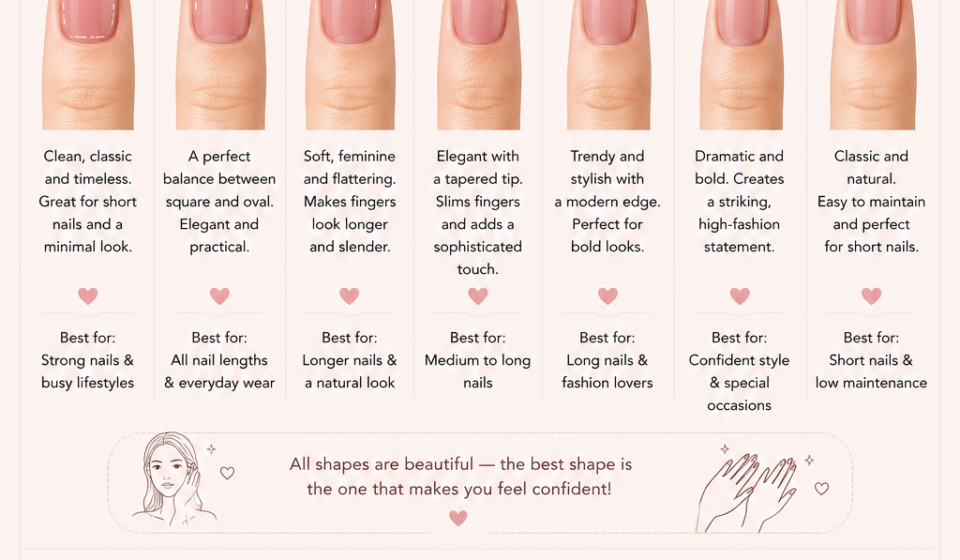
1. Square Nails
What it looks like: Straight sides with a completely flat, horizontal tip. No rounding at the corners. Clean, structured, and geometric.
Best for: Wide nail beds, long fingers, people who prefer a bold, modern aesthetic, and those who type or work on keyboards frequently.
Not ideal for: Short or wide fingers, as the horizontal tip emphasizes width rather than length. Can also be prone to corner breakage if nails are grown very long.
How to achieve it: Grow nails to your desired length, file the sides straight down (parallel to each other), then file the tip perfectly flat and horizontal. Finish by lightly smoothing the very corners so they don’t snag.
Style personality: Minimalist, bold, architectural. Square nails have a clean-cut confidence to them. They look particularly striking with block colors, French tips, and geometric nail art.
Maintenance level: Low to moderate. Square nails are easy to maintain at shorter lengths but can be prone to chipping at the sharp corners if grown long.
2. Round Nails
What it looks like: Straight sides that curve gently into a semicircular tip, following the natural curve of the fingertip. Soft and natural in appearance.
Best for: Short fingers, wide nail beds, beginners, low-maintenance wearers, and anyone who works with their hands. Also ideal for men’s manicures.
Not ideal for: Those looking to create the illusion of length, as round nails tend to make fingers look their natural width.
How to achieve it: File the sides straight, then file the tip by following the natural curve of your fingertip. Rotate the file as you move from one side to the other to achieve a smooth, even arc.
Style personality: Natural, understated, classic. Round nails are the most low-key shape and suit every occasion from casual to professional without drawing attention to themselves.
Maintenance level: Very low. Round nails are the most durable everyday shape because there are no sharp corners or points to catch or break.
3. Oval Nails
What it looks like: Similar to round but elongated — the sides taper slightly inward before curving into a rounded tip. Think of an egg shape applied to the nail.
Best for: Wide fingers, short fingers, anyone wanting to create the illusion of length and slimness. Oval nails are widely considered the most universally flattering shape.
Not ideal for: People with very narrow nail beds, as the tapering can make the nail look even narrower.
How to achieve it: File the sides of the nail at a slight inward angle (rather than straight down), then curve into the tip. The key is gradual tapering — the tip should be narrower than the base of the nail.
Style personality: Feminine, elegant, timeless. Oval nails have been a staple of classic beauty for decades. They photograph beautifully and suit everything from boardroom polish to romantic occasion dressing.
Maintenance level: Low to moderate. Without sharp corners or extreme points, oval nails are relatively resilient and easy to maintain.
4. Squoval Nails
What it looks like: A hybrid between square and oval — straight sides like a square nail, but with softly rounded corners instead of sharp ones. The tip is mostly flat but the edges curve gently.
Best for: Almost everyone. Squoval is often called the most universally flattering shape because it combines the modern structure of square with the softness and finger-lengthening effect of oval. It is particularly good for medium-length nails.
Not ideal for: Those wanting a very dramatic or fashion-forward look — squoval is beautiful but not a statement shape.
How to achieve it: File the nail into a square shape first, then gently round the corners using small, diagonal strokes until they are smooth rather than sharp. The result should look square when viewed straight on but have no harsh corners.
Style personality: Polished, versatile, professional. Squoval is the shape that looks effortlessly put-together on almost any hand. It’s the go-to for French manicures and classic nudes.
Maintenance level: Low. The rounded corners make squoval one of the most durable everyday shapes, less prone to corner chipping than pure square.
5. Almond Nails
What it looks like: Tapered sides that come to a softly rounded point — shaped, as the name suggests, like an almond. Slimmer than oval, with more pronounced tapering, but without the sharpness of a stiletto.
Best for: Wide fingers, short fingers (when worn at medium length), those who want a glamorous and elongating shape without committing to the extreme length required by stiletto. Almond nails are one of the most popular salon shapes globally.
Not ideal for: Very short nails (the shape requires some length to work properly) or those who need highly durable nails for manual work.
How to achieve it: File both sides of the nail inward at a diagonal, tapering progressively toward the center. The tip should come to a rounded point rather than a sharp one. Symmetry is key — uneven tapering on either side is immediately visible.
Style personality: Glamorous, feminine, editorial. Almond nails are the shape of choice for fashion campaigns, red carpets, and anyone who wants their hands to look effortlessly elegant. They showcase nail art and bold colors beautifully.
Maintenance level: Moderate. Almond nails require a bit more length to achieve the shape and are less resistant to breakage than rounder shapes. Gel or acrylic overlays significantly improve durability.
6. Stiletto Nails
What it looks like: Dramatically tapered sides that come to a sharp, pointed tip. Long, aggressive, and unmistakably bold. The most extreme of all nail shapes.
Best for: Those who want a high-fashion, statement look. Best suited to long fingers and narrow nail beds. Almost always done in acrylic or gel rather than natural nails, as the shape is extremely fragile in natural nail.
Not ideal for: Practical everyday life — typing, texting, and most manual tasks become challenging. Also not suited to short fingers, as the extreme length can appear disproportionate.
How to achieve it: File both sides sharply inward at a steep diagonal, aiming for a centered, needle-like point. This shape almost always requires a skilled nail technician and is rarely achievable on natural nails without reinforcement.
Style personality: Fierce, dramatic, avant-garde. Stiletto nails make an unambiguous statement. They are the nail shape of choice for editorial shoots, stage performers, and those who treat their nails as a deliberate fashion accessory.
Maintenance level: High. Stiletto nails are the most fragile shape and prone to breaking. They require regular salon visits and almost always need acrylic or gel support.
7. Coffin / Ballerina Nails
What it looks like: Tapered sides like a stiletto, but with a flat, square tip instead of a point. The resulting shape resembles a coffin (or, more optimistically, a ballerina’s pointe shoe). Long, dramatic, and fashion-forward.
Best for: Long fingers, those who want high-fashion drama with slightly more practicality than stiletto. Coffin nails are currently one of the most requested salon shapes globally, popularized heavily by celebrity nail culture.
Not ideal for: Short fingers (the length can look disproportionate), short natural nails (extensions are usually required), or anyone needing high durability for manual work.
How to achieve it: File both sides at an inward diagonal as you would for stiletto, then file the tip flat and horizontal. The flat tip is what distinguishes coffin from stiletto and makes it slightly more practical. Usually achieved with acrylic or gel extensions.
Style personality: Trendy, glamorous, contemporary. Coffin nails look striking with ombre, chrome powder, negative space designs, and bold solid colors. They are a statement shape that reads as fashion-conscious and deliberate.
Maintenance level: High. Like stiletto, coffin nails require length and reinforcement. The flat tip can chip if not properly sealed, so regular top coat application is important.
8. Flare / Duck Nails
What it looks like: The nail widens dramatically toward the tip, flaring outward like a duck’s bill or a fan. The base is narrow and the tip is significantly wider.
Best for: Those who specifically want this retro, bold aesthetic. It is a niche look associated with certain subcultures and nail art communities.
Not ideal for: Everyday wear, practical tasks, or those looking for a universally flattering shape. Flare nails are a deliberate artistic choice rather than a flattering one.
Style personality: Bold, retro, countercultural. Flare nails have roots in 1990s nail culture and have experienced periodic revivals as a statement aesthetic.
Maintenance level: High, and almost always requires acrylics.
9. Lipstick Nails
What it looks like: One side of the nail is filed at a sharp diagonal angle, creating a tip that resembles a freshly cut lipstick bullet. Asymmetrical and deliberately quirky.
Best for: Nail art enthusiasts, creative individuals, those who want a genuinely unique and conversation-starting shape.
Not ideal for: Traditional or conservative aesthetics, or those wanting a flattering shape — lipstick nails are art over utility.
Style personality: Playful, creative, maximalist. A genuine statement shape for those who see their nails as a canvas.
How to Choose the Right Nail Shape for Your Fingers
Understanding your finger type is the most reliable starting point for choosing a flattering nail shape. Here’s a quick reference guide:
Short Fingers
Shapes that elongate are your best friends. Oval, almond, and stiletto all draw the eye upward and create the illusion of length. Avoid square and squoval at very short lengths, as horizontal tips emphasize width. Round is fine for a natural look but won’t add apparent length.
Long Fingers
You have the most flexibility of any finger type. Square, coffin, and stiletto all look particularly striking on long fingers. Oval and almond are equally flattering. The only shape to be cautious with is very dramatic flare or duck nail, which can look disproportionate even on longer fingers.
Wide Nail Beds
Oval and almond are the most flattering choices, as tapering the sides visually narrows the nail. Stiletto and coffin also work well. Avoid pure square at short lengths, which maximizes the horizontal appearance of wide nail beds.
Narrow Nail Beds
Square and round work beautifully, as they don’t taper the already-slim nail further. Squoval is also a great option. Extreme almond and stiletto can make very narrow nail beds appear almost painfully thin at the tip.
Short Bitten Nails
Round is the most flattering for very short nails that are still growing out, as it follows the natural curve of the fingertip and looks intentional rather than unfinished. A squoval is also achievable once there’s a small amount of free edge.
Nail Shapes by Lifestyle
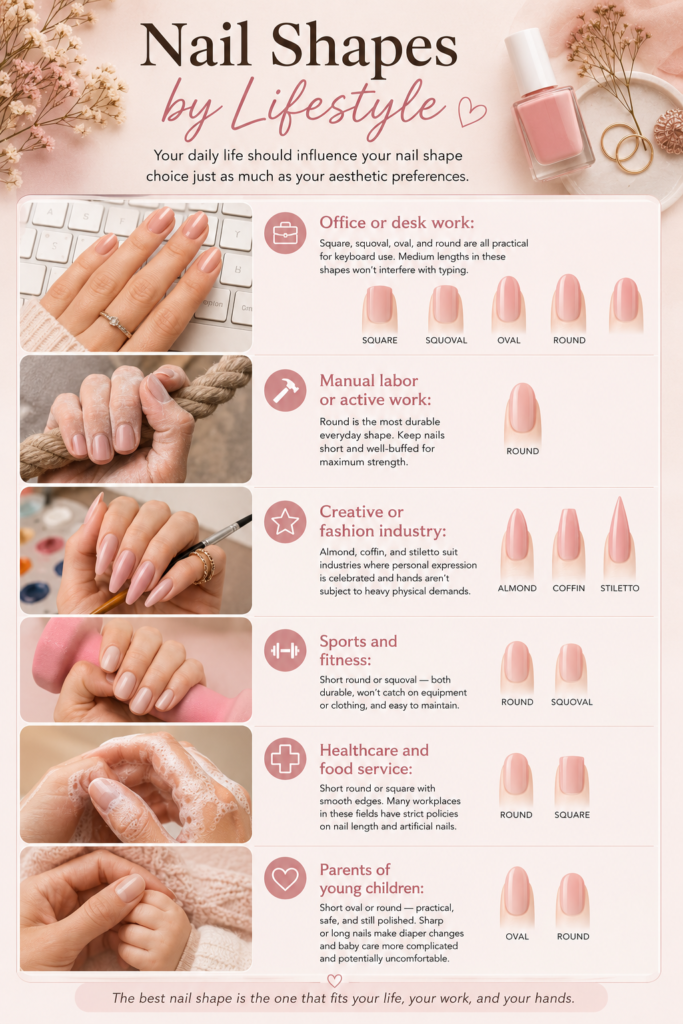
Your daily life should influence your nail shape choice just as much as your aesthetic preferences.
Office or desk work: Square, squoval, oval, and round are all practical for keyboard use. Medium lengths in these shapes won’t interfere with typing.
Manual labor or active work: Round is the most durable everyday shape. Keep nails short and well-buffed for maximum strength.
Creative or fashion industry: Almond, coffin, and stiletto suit industries where personal expression is celebrated and hands aren’t subject to heavy physical demands.
Sports and fitness: Short round or squoval — both durable, won’t catch on equipment or clothing, and easy to maintain.
Healthcare and food service: Short round or square with smooth edges. Many workplaces in these fields have strict policies on nail length and artificial nails.
Parents of young children: Short oval or round — practical, safe, and still polished. Sharp or long nails make diaper changes and baby care more complicated and potentially uncomfortable.
Nail Shapes and Nail Art: What Works Best
Not all shapes showcase nail art equally well. Here’s a quick guide to pairing shape with design:
French tips: Squoval and oval give the most classic result. Square creates a bolder, more modern French tip. Almond creates an elongated, fashion-forward French.
Geometric designs: Square and coffin provide the flat canvas that makes geometric patterns look sharpest.
Florals and detailed art: Oval and almond provide the most elegant backdrop for detailed freehand nail art.
Ombre and chrome: Coffin is the classic choice for ombre and mirror powder looks — the flat tip showcases the gradient beautifully.
Negative space designs: Squoval and square are the most striking shapes for negative space nail art.
Solid bold colors: Stiletto and almond make even a single block color look dramatic and intentional.
How to Maintain Your Chosen Nail Shape
Regardless of which shape you choose, a few maintenance habits keep it looking its best between salon visits or at-home filing sessions.
File regularly. As nails grow, the shape changes. A light file every few days — or once a week — keeps your chosen shape consistent and prevents the nail from growing out of form.
Always file in one direction. Sawing back and forth creates micro-tears in the nail edge, which leads to peeling and weakens the nail over time. Always use smooth, one-directional strokes.
Use the right grit. A 180-grit file is suitable for shaping natural nails. Finer grits (240+) are better for buffing and finishing. Coarser grits (100–150) are for acrylics and should not be used on natural nails.
Seal the edges. Apply a thin layer of base coat or top coat along the very tip of each nail after filing. This seals the edge and significantly reduces chipping and peeling.
Moisturize. Hydrated nails are flexible nails. Flexible nails hold their shape better and are far less likely to snap at key structural points — particularly important for pointed shapes like almond and stiletto.
Frequently Asked Questions
Which nail shape is most professional? Squoval, oval, and short square are widely considered the most professional nail shapes. They are polished without being distracting and are appropriate across virtually all workplace settings.
Which nail shape is best for short nails? Oval and round are the most flattering shapes for short nails. They follow the natural curve of the finger and create the illusion of length without requiring significant free edge.
Which nail shape makes fingers look longer and slimmer? Oval, almond, and stiletto are the most elongating shapes, as their tapering sides draw the eye upward rather than across.
Which nail shape is the strongest and most durable? Round nails are the most resistant to breakage because they have no corners or points where stress concentrates. Squoval is a close second.
Can I change my nail shape at home? Yes — most shapes except coffin and stiletto can be achieved at home with a good nail file and some practice. Start conservatively, removing less than you think you need and assessing as you go.
How often should I reshape my nails? A light reshaping every one to two weeks keeps your shape looking intentional as nails grow. A full reshape is typically needed every three to four weeks.
Final Thoughts
There is no single best nail shape — only the best nail shape for you. Your finger type, your lifestyle, your personal aesthetic, and even your profession all play a role in determining which shape will make your hands look and feel their best.
If you’re new to experimenting with nail shape, oval or squoval is the perfect starting point: both are universally flattering, low-maintenance, and effortlessly elegant. From there, you can explore almond for more glamour, square for more structure, or coffin and stiletto when you’re ready to make a genuine statement.
The most important thing is to choose deliberately rather than defaulting. Your nail shape is one of the easiest ways to elevate your entire aesthetic — and now you have everything you need to choose it with confidence.