

Acrylic nails have become one of the most popular nail enhancement options in the beauty world — and for good reason. They’re durable, customizable, and can give you salon-perfect nails that look flawless for weeks. But one of the most common questions people ask before getting them is: how long do acrylic nails last?
The short answer is 2 to 3 weeks before a fill is needed, and 6 to 8 weeks before a full set replacement is required. But the real answer is much more nuanced — and knowing the details can save you time, money, and your natural nails.
In this complete guide, we’ll cover everything you need to know about the lifespan of acrylic nails, what affects how long they last, how to make them last longer, and when it’s time to get them redone.
What Are Acrylic Nails?
Before diving into longevity, it helps to understand what acrylic nails actually are. Acrylics are a type of nail extension made by combining a liquid monomer with a powder polymer to create a hard, protective coating over your natural nails. The mixture hardens when exposed to air, creating a strong shell that can be shaped, filed, and painted.
Unlike gel nails, acrylics don’t require a UV/LED lamp to cure. They’re considered one of the most durable nail enhancement options available, which is why so many people prefer them for long-lasting wear.
How Long Do Acrylic Nails Last on Average?
Here’s a breakdown of the typical acrylic nail timeline:
2 to 3 Weeks: Time for a Fill
As your natural nails grow, a visible gap appears between the acrylic and your cuticle. This gap is called the “regrowth zone” and is completely normal. After 2 to 3 weeks, most people need to visit the salon for a fill (also called a infill or backfill).
During a fill appointment, your nail technician:
- Files down the existing acrylic
- Fills in the gap near the cuticle with fresh acrylic
- Shapes and repaints the nails
A fill appointment is shorter and less expensive than a full set and typically takes 45 to 60 minutes.
6 to 8 Weeks: Full Set Replacement
After two or three fills, the acrylic layer can become too thick, discolored, or prone to lifting. At this point — usually around 6 to 8 weeks — it’s recommended to remove the full set and start fresh with a brand-new application.
Continuing past this point without replacing the full set can lead to bacterial growth under the nail, breakage, or damage to the natural nail beneath.
Factors That Affect How Long Acrylic Nails Last
Not everyone gets the same lifespan out of their acrylics. Several variables play a major role in how quickly your nails lift, chip, or break.
1. Your Natural Nail Growth Rate
Nail growth varies significantly from person to person. On average, nails grow about 3 to 4 millimeters per month — but hormones, age, diet, and health conditions can speed up or slow down growth. Faster nail growth means you’ll notice the gap sooner and need fills more frequently.
2. The Quality of Application
A skilled nail technician using high-quality products will give you a set that lasts much longer than a rushed or poorly applied one. Proper prep — including cuticle pushing, nail dehydration, and primer application — is critical to ensuring the acrylic bonds properly to the natural nail.
If the prep work is skipped or done poorly, lifting can begin in just a few days.
3. Your Daily Lifestyle and Activities
How you use your hands every day has a massive impact on acrylic longevity. People who:
- Type on keyboards frequently
- Do heavy physical or manual work
- Swim regularly
- Wash dishes without gloves
…will likely notice their acrylics lifting or breaking sooner than those with less hand-intensive lifestyles.
4. Exposure to Water and Chemicals
Water is one of the biggest enemies of acrylic nails. Prolonged exposure to water — especially hot water — causes the acrylic to expand and contract, which weakens the bond and accelerates lifting. Household cleaning chemicals, acetone-based products, and hand sanitizers can also break down acrylic much faster.
5. Nail Length and Shape
Longer acrylic nails are naturally more prone to breakage than shorter ones. Styles like coffin and stiletto nails, while gorgeous, have more surface area and stress points, making them more vulnerable than a short square or oval shape.
6. Aftercare Habits
How you care for your acrylics between salon visits is perhaps the biggest factor of all. Proper moisturizing, avoiding picking or biting, wearing gloves during chores, and applying cuticle oil daily can dramatically extend how long your nails look and feel great.
Signs It’s Time to Get a Fill or Replacement
Knowing when to book your next appointment is important for both the look and health of your nails. Watch out for these signs:
- Visible gap near the cuticle (more than 2–3mm)
- Lifting at the edges or near the cuticle
- Breakage or cracks in the acrylic
- Yellowing or discoloration
- Greenish tint (potential sign of bacterial or fungal infection underneath)
- Thick, uneven texture after multiple fills
If you notice any green or dark discoloration under the nail, remove the acrylics immediately and consult a dermatologist. This can indicate a bacterial infection that needs prompt treatment.
How to Make Acrylic Nails Last Longer
The good news is that with the right habits, you can significantly extend the life of your acrylics and keep them looking salon-fresh for longer.
Apply Cuticle Oil Daily
Cuticle oil keeps the skin around your nails hydrated and flexible, which prevents cracking near the nail bed and reduces lifting. Apply it every morning and evening for best results.
Wear Gloves While Cleaning
Household chemicals and hot water are harsh on acrylics. Wearing rubber gloves while washing dishes, cleaning counters, or doing laundry will protect your nails from the chemical exposure that weakens acrylic bonds.
Avoid Using Your Nails as Tools
One of the most common causes of acrylic breakage is using your nails to open cans, peel stickers, or pry things open. Always use a proper tool instead.
Keep Nails Dry After Washing
After washing your hands, take an extra few seconds to thoroughly dry your nails — including underneath the tips. Trapped moisture under acrylics can encourage lifting and even bacterial growth.
Use a Non-Acetone Nail Polish Remover
If you change your nail polish between salon visits, always use a non-acetone formula. Acetone dissolves acrylic and will cause your nails to weaken, lift, and thin out prematurely.
Don’t Skip Your Fill Appointment
It might be tempting to stretch your fill appointment by an extra week to save money, but this is one of the biggest mistakes acrylic nail wearers make. The longer you wait, the more likely lifting and breakage become — and repairs can end up costing more than a regular fill.
Keep Nails at a Manageable Length
If you’re prone to breakage, consider keeping your acrylics at a shorter, more practical length. Shorter nails are more resilient and require less frequent repairs.
How to Safely Remove Acrylic Nails
When it’s time to remove your acrylics, never peel or force them off. Doing so strips layers of your natural nail and can cause serious damage, pain, and thinning that takes months to recover from.
The safest removal methods include:
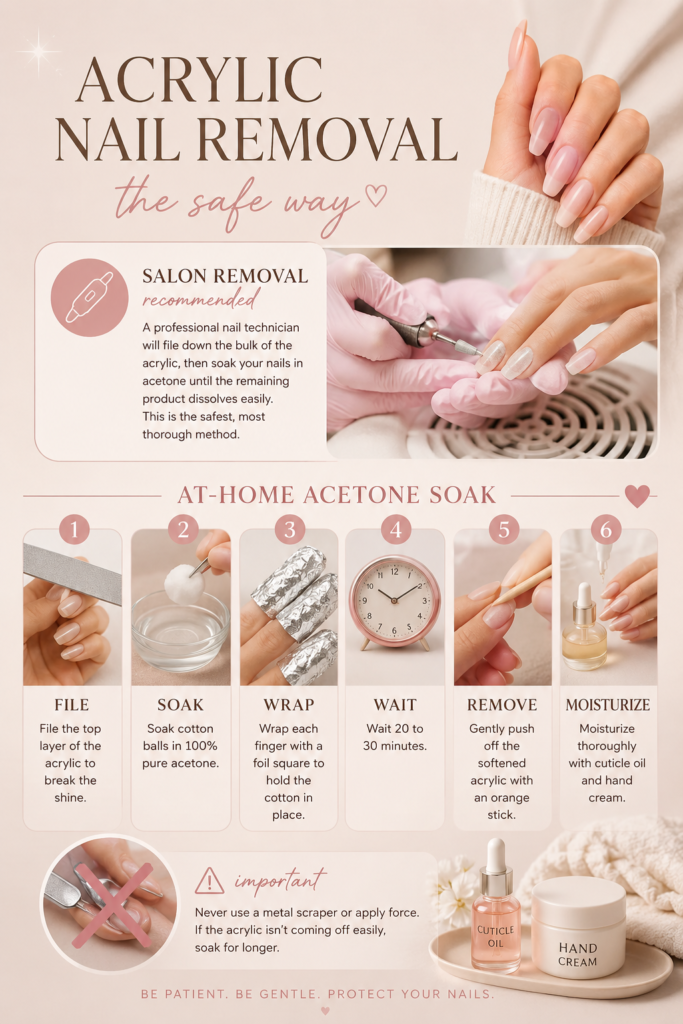
Salon Removal (Recommended)
A professional nail technician will file down the bulk of the acrylic, then soak your nails in acetone until the remaining product dissolves easily. This is the safest, most thorough method.
At-Home Acetone Soak
If salon removal isn’t an option:
- File the top layer of the acrylic to break the shine
- Soak cotton balls in 100% pure acetone
- Wrap each finger with a foil square to hold the cotton in place
- Wait 20 to 30 minutes
- Gently push off the softened acrylic with an orange stick
- Moisturize thoroughly with cuticle oil and hand cream
Never use a metal scraper or apply force. If the acrylic isn’t coming off easily, soak for longer.
Acrylic Nails vs. Other Nail Extensions: Longevity Comparison
Wondering how acrylics compare to other nail enhancement types in terms of lifespan?
| Nail Type | Fill Needed | Full Replacement |
|---|---|---|
| Acrylic Nails | Every 2–3 weeks | Every 6–8 weeks |
| Gel Nails | Every 2–3 weeks | Every 4–6 weeks |
| Dip Powder Nails | Every 3–4 weeks | Every 6–8 weeks |
| Press-On Nails | N/A | Every 1–2 weeks |
| Gel Polish (no extension) | N/A | Every 2–3 weeks |
Acrylics and dip powder tend to offer the most durability for nail extensions, while gel polish alone has the shortest lifespan.
Do Acrylic Nails Damage Natural Nails?
This is a concern many people have — and the answer depends entirely on how they’re applied and removed. When applied correctly by a trained technician and removed properly, acrylics should not cause significant damage to natural nails.
However, problems arise when:
- The nails are over-filed during prep
- Poor-quality products are used
- Acrylics are peeled off instead of soaked
- Fills are left too long, causing lifting and moisture trapping
After removing acrylics, it’s normal for your natural nails to feel thin and sensitive for a few weeks. Strengthen them with a nail hardener and keep them moisturized to speed up recovery.
How Often Should You Get Acrylic Nails Done?
For most people, the ideal schedule looks like this:
- Every 2–3 weeks: Fill appointment to address regrowth
- Every 6–8 weeks: Full set removal and reapplication
- Between appointments: Daily cuticle oil, gloves during chores, non-acetone polish remover
If budget is a concern, stretching fills to every 3 weeks is generally fine for most people — but try not to go beyond that without risking lifting and breakage.
Final Thoughts: Getting the Most Out of Your Acrylic Nails
Acrylic nails are a fantastic investment for anyone who wants beautiful, durable nails that can last for weeks at a time. On average, you can expect to need a fill every 2 to 3 weeks and a full set replacement every 6 to 8 weeks — but with the right aftercare habits, quality products, and a skilled technician, your acrylics can look stunning for every day of that cycle.
The key takeaways:
- Fill every 2–3 weeks to maintain the look and prevent lifting
- Replace the full set every 6–8 weeks to keep nails healthy
- Use cuticle oil daily, avoid acetone products, and wear gloves during chores
- Never peel off acrylics — always soak them off properly
- Choose an experienced technician and quality products for the longest-lasting results
With proper care and a consistent maintenance schedule, acrylic nails can be a long-lasting, low-drama beauty staple that keeps your hands looking polished and put-together day after day.